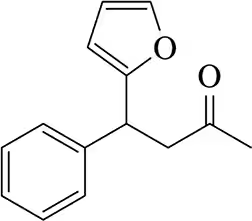
Suggest a reagent and a reactant that could be used to form the following molecules by conjugate addition of a cuprate. There can be multiple possibilities. (c)
Verified step by step guidance
1
Identify the target molecule: The structure provided is an ester with a phenyl group and a furan ring attached to the carbon chain. This suggests that the molecule could be formed by conjugate addition.
Understand conjugate addition: Conjugate addition involves the addition of a nucleophile to the β-position of an α,β-unsaturated carbonyl compound. In this case, a cuprate reagent can be used as the nucleophile.
Select the cuprate reagent: A common choice for cuprate reagents is a Gilman reagent, which is typically a lithium diorganocuprate, such as (R)₂CuLi. The 'R' group should match the group being added to the molecule, which in this case is a phenyl group.
Choose the α,β-unsaturated carbonyl compound: The target molecule has an ester functional group, suggesting that the starting material could be an α,β-unsaturated ester. A suitable reactant could be ethyl acrylate, which has the necessary unsaturation for conjugate addition.
Outline the reaction: Combine the chosen cuprate reagent, such as phenyl cuprate ((C₆H₅)₂CuLi), with the α,β-unsaturated ester (ethyl acrylate) under appropriate conditions to achieve the conjugate addition, forming the desired product.
Verified video answer for a similar problem:
This video solution was recommended by our tutors as helpful for the problem above
Play a video:
0 Comments
Key Concepts
Here are the essential concepts you must grasp in order to answer the question correctly.
Conjugate Addition
Conjugate addition refers to the nucleophilic addition of a reagent to an α,β-unsaturated carbonyl compound. In this reaction, the nucleophile attacks the β-carbon, leading to the formation of a new carbon-carbon bond. This process is crucial in organic synthesis as it allows for the construction of complex molecules with specific stereochemistry.
Cuprates, or organocuprates, are organometallic compounds containing copper, typically in the form of lithium diorganocopper reagents. They are strong nucleophiles used in organic synthesis, particularly for conjugate additions to α,β-unsaturated carbonyl compounds. Their ability to selectively add to the β-position makes them valuable for forming carbon-carbon bonds.
Reagents and Reactants in Organic Synthesis
In organic chemistry, reagents are substances that cause a chemical reaction, while reactants are the starting materials that undergo the reaction. Identifying the appropriate reagents and reactants is essential for achieving desired transformations. In the context of conjugate addition, selecting the right cuprate and unsaturated carbonyl compound is key to successfully forming the target molecule.

 Verified step by step guidance
 09:23
09:23