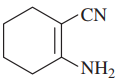
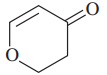
Use resonance structures to identify the areas of high and low electron density in the following compounds: g. h.
Verified step by step guidance
1
Identify the functional groups in each compound. In the first compound, there is a cyano group (CN) and an amino group (NH2). In the second compound, there is a carbonyl group (C=O) and an ether linkage (O).
For the first compound, consider the resonance structures of the cyano group. The cyano group can be represented as having a triple bond between carbon and nitrogen, with a lone pair on nitrogen. This creates a region of high electron density on the nitrogen atom.
In the first compound, the amino group (NH2) can donate electron density through resonance, increasing electron density on the adjacent carbon atom. This makes the carbon atom next to the NH2 group a region of higher electron density.
For the second compound, analyze the resonance structures of the carbonyl group. The oxygen in the carbonyl group can pull electron density towards itself due to its electronegativity, creating a partial negative charge on the oxygen and a partial positive charge on the carbon, indicating a region of low electron density on the carbon.
In the second compound, the ether oxygen can also participate in resonance by donating electron density to the adjacent carbon, creating a region of higher electron density around the oxygen atom.
Verified video answer for a similar problem:
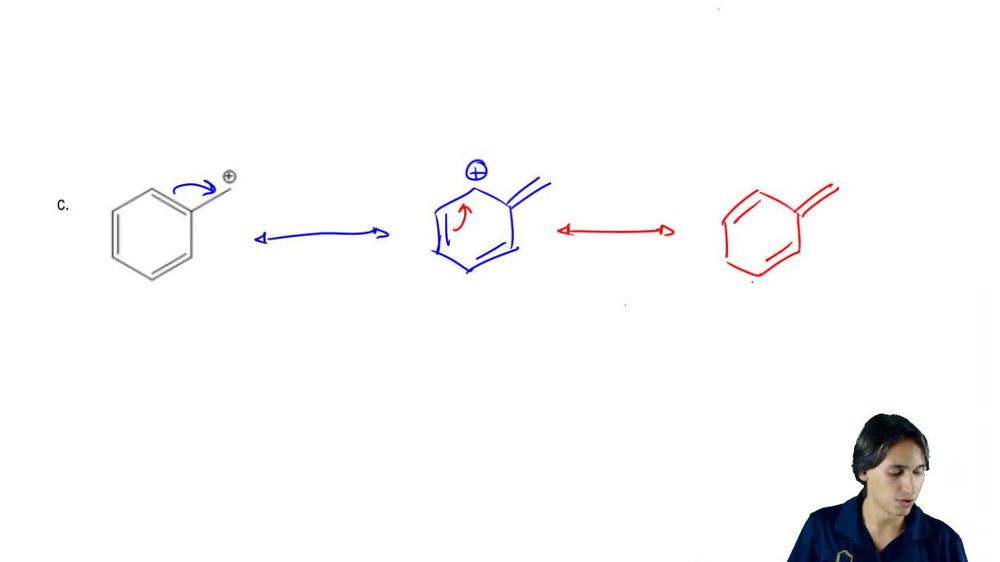
This video solution was recommended by our tutors as helpful for the problem above
Video duration:
7m
Play a video:
0 Comments
Key Concepts
Here are the essential concepts you must grasp in order to answer the question correctly.
Resonance Structures
Resonance structures are different Lewis structures for a molecule that depict the same arrangement of atoms but differ in the placement of electrons. They help illustrate the delocalization of electrons within a molecule, which can affect electron density and stability. In organic chemistry, resonance is crucial for understanding the distribution of electron density across a molecule.
Electron density refers to the probability of finding electrons in a particular region of a molecule. Areas of high electron density are typically associated with negative charges or lone pairs, while areas of low electron density are associated with positive charges or electron-deficient regions. Understanding electron density is essential for predicting reactivity and interactions in chemical compounds.
Functional groups are specific groups of atoms within molecules that are responsible for the characteristic chemical reactions of those molecules. In the given structure, the cyano group (CN) and the amino group (NH2) are functional groups that influence electron distribution and resonance. These groups can affect the electron density by either donating or withdrawing electrons, impacting the molecule's reactivity.