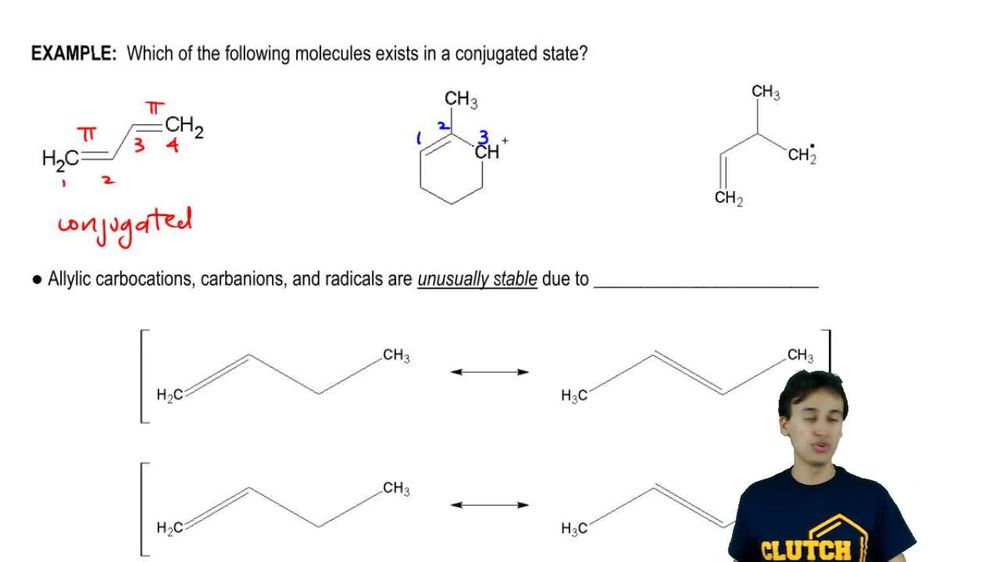
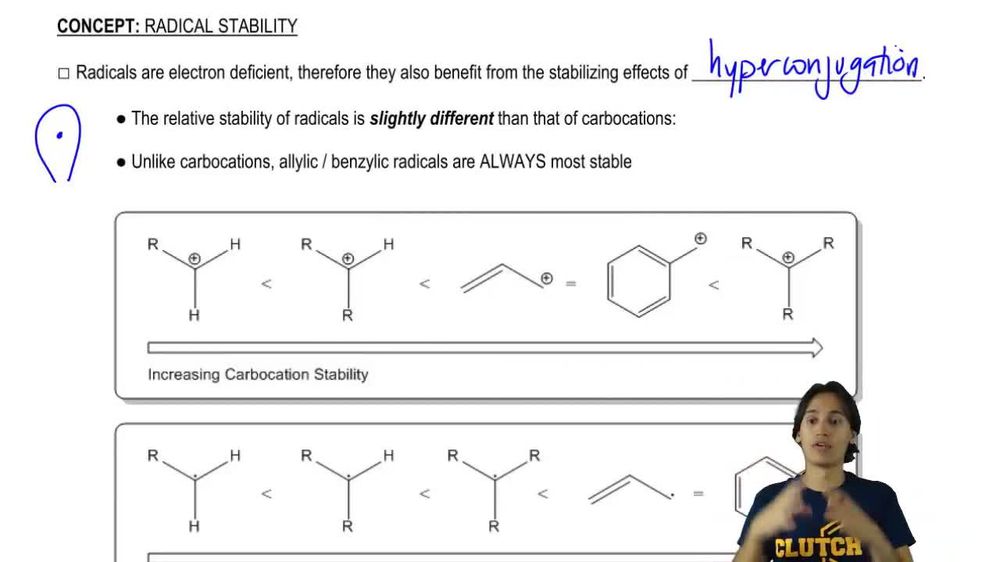
The pKa of ascorbic acid (vitamin C, page 55) is 4.17, showing that it is slightly more acidic than acetic acid (CH3COOH, pKa 4.74). c. Compare the most stable conjugate base of ascorbic acid with the conjugate base of acetic acid, and suggest why these two compounds have similar acidities, even though ascorbic acid lacks the carboxylic acid (COOH) group.
Verified step by step guidance
1
Identify the functional groups in ascorbic acid and acetic acid. Ascorbic acid contains multiple hydroxyl groups and a lactone ring, while acetic acid contains a carboxylic acid group.
Determine the conjugate base of each acid. For ascorbic acid, deprotonation occurs at one of the hydroxyl groups, leading to a resonance-stabilized anion. For acetic acid, deprotonation occurs at the carboxylic acid group, forming an acetate ion.
Analyze the resonance stabilization of the conjugate bases. Ascorbic acid's conjugate base is stabilized by resonance within the lactone ring and adjacent hydroxyl groups, while acetic acid's conjugate base is stabilized by resonance between the oxygen atoms in the carboxylate group.
Consider the electronegativity and inductive effects. The electronegative oxygen atoms in ascorbic acid contribute to its acidity, similar to the electronegative oxygen in acetic acid's carboxyl group.
Conclude why the acidities are similar. Despite lacking a carboxylic acid group, ascorbic acid's structure allows for effective resonance stabilization and electronegative influence, making its acidity comparable to acetic acid.
Verified video answer for a similar problem:
This video solution was recommended by our tutors as helpful for the problem above
Video duration:
6m
Play a video:
1 Comment
Key Concepts
Here are the essential concepts you must grasp in order to answer the question correctly.
Acidity and pKa
Acidity is a measure of a substance's ability to donate protons (H+ ions) in solution. The pKa value quantifies this acidity, with lower pKa values indicating stronger acids. Ascorbic acid has a pKa of 4.17, making it a stronger acid than acetic acid, which has a pKa of 4.74. Understanding these values helps compare the relative strengths of different acids.
When an acid donates a proton, it forms its conjugate base. The stability of the conjugate base significantly influences the acidity of the original acid. In the case of ascorbic acid, its conjugate base is stabilized by resonance and intramolecular hydrogen bonding, which can explain its comparable acidity to acetic acid, despite the absence of a carboxylic acid group.
Resonance stabilization occurs when a molecule can be represented by multiple valid Lewis structures, allowing for the delocalization of electrons. This delocalization can enhance the stability of a conjugate base. In ascorbic acid, the presence of hydroxyl groups and the structure of the molecule allow for effective resonance stabilization, contributing to its acidity despite lacking a traditional carboxylic acid group.

 6:02 minutes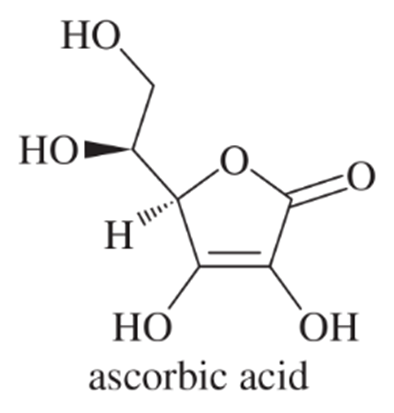
 Verified step by step guidance
 07:45
07:45