If HCl is a weaker acid than HBr, why is ClCH2COOH a stronger acid than BrCH2COOH?
Verified step by step guidance
1
Step 1: Understand the problem. The question is asking why ClCH2COOH (chloroacetic acid) is a stronger acid than BrCH2COOH (bromoacetic acid), despite HCl being a weaker acid than HBr. This involves analyzing the inductive effect of the halogen substituents (Cl and Br) on the carboxylic acid group.
Step 2: Recall the concept of electronegativity. Chlorine (Cl) is more electronegative than bromine (Br). Electronegativity is the ability of an atom to attract electrons towards itself. This property plays a key role in the inductive effect.
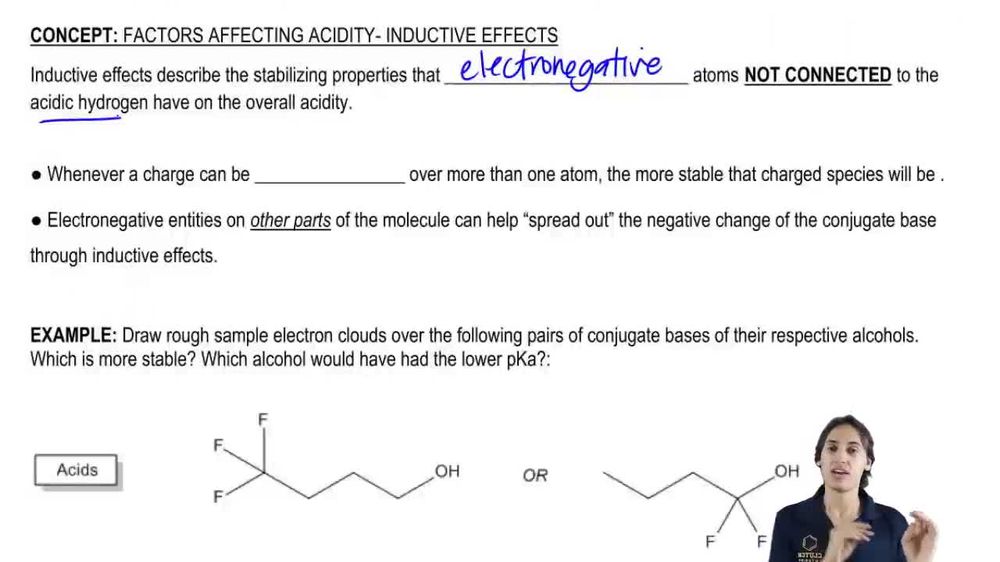
Step 3: Explain the inductive effect. The electronegative halogen substituent (Cl or Br) pulls electron density away from the carboxylic acid group through the sigma bonds. This stabilizes the negative charge on the conjugate base (CH2COO⁻) after the acid donates a proton (H⁺). A more stable conjugate base corresponds to a stronger acid.
Step 4: Compare the inductive effects of Cl and Br. Since Cl is more electronegative than Br, it exerts a stronger inductive effect. This means ClCH2COOH has a more stabilized conjugate base compared to BrCH2COOH, making it a stronger acid.
Step 5: Summarize the reasoning. The strength of ClCH2COOH as an acid is due to the stronger inductive effect of chlorine compared to bromine, which stabilizes the conjugate base more effectively. This explains why ClCH2COOH is a stronger acid than BrCH2COOH, even though HCl is a weaker acid than HBr.
Verified video answer for a similar problem:
This video solution was recommended by our tutors as helpful for the problem above
Video duration:
7m
Play a video:
0 Comments
Key Concepts
Here are the essential concepts you must grasp in order to answer the question correctly.
Acid Strength and Electronegativity
Acid strength is influenced by the stability of the conjugate base formed after deprotonation. In this case, the electronegativity of the halogen atoms plays a crucial role. Chlorine is more electronegative than bromine, which means that the negative charge on the conjugate base (ClCH2COO-) is better stabilized by the chlorine atom compared to the bromine atom in BrCH2COO-. This stabilization leads to ClCH2COOH being a stronger acid.
The inductive effect refers to the electron-withdrawing or electron-donating effects that substituents have on a molecule. In ClCH2COOH, the chlorine atom exerts a strong electron-withdrawing inductive effect, which stabilizes the negative charge on the conjugate base. In contrast, bromine, being larger and less electronegative, exerts a weaker inductive effect, resulting in less stabilization of the conjugate base BrCH2COO-, making BrCH2COOH a weaker acid.
When comparing acids, it is essential to consider both the strength of the acid and the stability of its conjugate base. Although HCl is a weaker acid than HBr, the specific structural context of ClCH2COOH and BrCH2COOH alters their acid strengths. The combination of electronegativity and inductive effects in the respective carboxylic acids leads to ClCH2COOH being a stronger acid than BrCH2COOH despite the general trend observed with HCl and HBr.