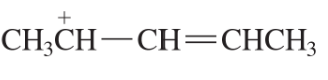
Draw resonance contributors for each of the following species and rank them in order of decreasing contribution to the resonance hybrid. Then draw the resonance hybrid. f.
Verified step by step guidance
1
Identify the species in question and determine if it has resonance structures. Resonance occurs when there are delocalized electrons, such as lone pairs, π-bonds, or charges, that can be redistributed across the molecule.
Draw all possible resonance contributors for the species. Use curved arrows to show the movement of electrons between resonance forms. Ensure that each resonance structure follows the rules of valence and does not violate the octet rule (except for exceptions like hypervalent atoms).
Evaluate the stability of each resonance contributor. Consider factors such as: (1) the number of covalent bonds (more bonds = more stable), (2) the presence of formal charges (fewer charges = more stable), (3) the placement of charges (negative charges on more electronegative atoms and positive charges on less electronegative atoms are more stable), and (4) the avoidance of charge separation.
Rank the resonance contributors in order of decreasing stability based on the evaluation in the previous step. The most stable contributor will contribute the most to the resonance hybrid, while less stable contributors will contribute less.
Draw the resonance hybrid by combining the resonance contributors. Use dashed lines to represent delocalized π-bonds or partial charges to indicate the distribution of charge across the molecule. The resonance hybrid reflects the weighted average of all contributors, with the most stable contributors having the greatest influence.
Verified video answer for a similar problem:
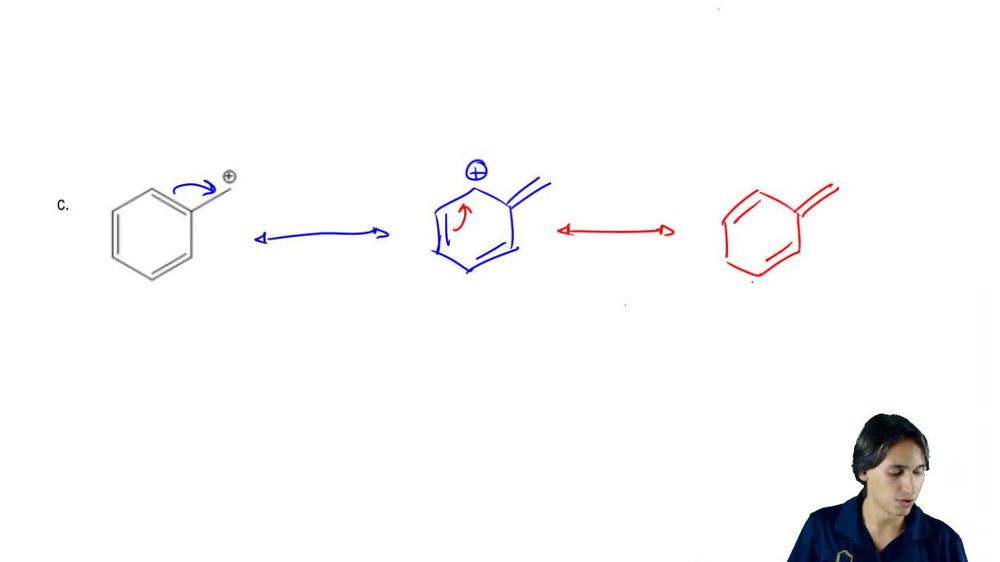
This video solution was recommended by our tutors as helpful for the problem above
Video duration:
5m
Play a video:
0 Comments
Key Concepts
Here are the essential concepts you must grasp in order to answer the question correctly.
Resonance Structures
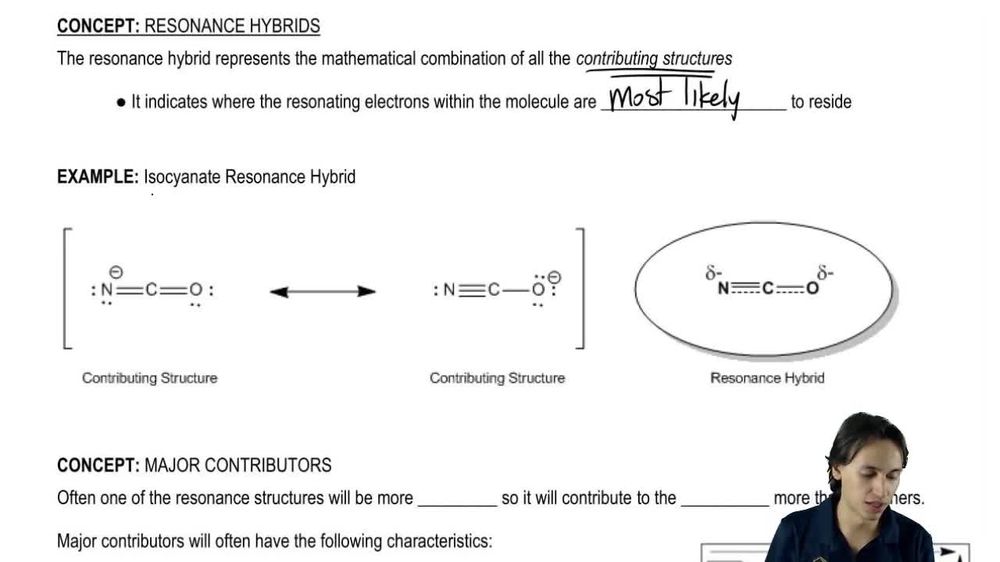
Resonance structures are different Lewis structures for the same molecule that depict the same arrangement of atoms but differ in the placement of electrons. These structures help illustrate the delocalization of electrons within a molecule, which contributes to its stability and reactivity. The actual structure of the molecule is a resonance hybrid, a weighted average of all valid resonance forms.
The resonance hybrid is the actual structure of a molecule that is represented as a combination of its resonance contributors. It reflects the delocalization of electrons across the molecule, resulting in bond lengths and angles that are intermediate between those predicted by individual resonance structures. The resonance hybrid is often more stable than any single resonance contributor due to this electron delocalization.
The stability of resonance contributors is determined by factors such as the octet rule, charge distribution, and the presence of formal charges. Contributors that have full octets, minimal formal charges, and charge separation are generally more stable and thus contribute more to the resonance hybrid. Ranking these contributors involves assessing their stability to determine which structures are more significant in representing the molecule's true electronic structure.