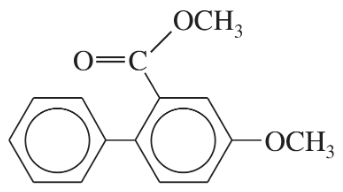
Predict the major products of bromination of the following compounds, using Br2 and FeBr3 in the dark. (c)
Verified step by step guidance
1
Step 1: Analyze the structure of the compound. The molecule contains two aromatic rings connected by a ketone group (C=O). Each aromatic ring has a methoxy group (-OCH3) attached. The methoxy group is an electron-donating group, which activates the aromatic ring towards electrophilic substitution reactions, such as bromination.
Step 2: Understand the reaction conditions. Bromination using Br2 and FeBr3 in the dark is an electrophilic aromatic substitution reaction. FeBr3 acts as a Lewis acid catalyst, facilitating the generation of the bromonium ion (Br+), which is the electrophile in this reaction.
Step 3: Determine the directing effects of substituents. The methoxy group (-OCH3) is an ortho/para-directing group due to its electron-donating nature. This means bromination will preferentially occur at the ortho and para positions relative to the methoxy group on each aromatic ring.
Step 4: Predict the major products. Bromination will occur at the most activated positions on the aromatic rings. For the ring with the methoxy group, the ortho and para positions relative to the -OCH3 group are the most reactive. Since both rings have methoxy groups, bromination can occur at these positions on both rings.
Step 5: Consider steric hindrance and regioselectivity. The para position relative to the methoxy group is less sterically hindered compared to the ortho positions. Therefore, bromination is more likely to occur at the para position on each aromatic ring, leading to the major products being para-brominated derivatives of the original compound.
Verified video answer for a similar problem:
This video solution was recommended by our tutors as helpful for the problem above
Video duration:
5m
Play a video:
0 Comments
Key Concepts
Here are the essential concepts you must grasp in order to answer the question correctly.
Electrophilic Aromatic Substitution (EAS)
Electrophilic Aromatic Substitution is a fundamental reaction in organic chemistry where an electrophile replaces a hydrogen atom on an aromatic ring. In this process, the aromatic system donates electrons to the electrophile, forming a sigma complex, which then loses a proton to restore aromaticity. Understanding EAS is crucial for predicting the products of bromination, as it involves the interaction of the aromatic compound with bromine in the presence of a catalyst.
In EAS reactions, substituents on the aromatic ring can either activate or deactivate the ring towards further substitution. Activating groups, such as -OCH3, increase the electron density of the ring, making it more reactive towards electrophiles. Conversely, deactivating groups, like -COOH, withdraw electron density and make the ring less reactive. Recognizing the nature of substituents is essential for predicting the position and rate of bromination in the given compound.
Regioselectivity refers to the preference of a chemical reaction to occur at one location over others in a molecule. In the case of bromination of aromatic compounds, the presence of activating or deactivating groups influences where the bromine will add to the ring. For the compound shown, the methoxy groups will direct bromination to the ortho and para positions relative to themselves, which is critical for predicting the major products of the reaction.