(c) Based on what you know about the relative stabilities of alkyl radicals and benzylic radicals, predict the product of addition of HBr to 1-phenylpropene in the presence of a free-radical initiator. (d) Propose a mechanism for this reaction.
Verified step by step guidance
1
Understand the context: The reaction involves the addition of HBr to 1-phenylpropene in the presence of a free-radical initiator. This indicates that the reaction will follow the anti-Markovnikov addition mechanism due to the involvement of free radicals.
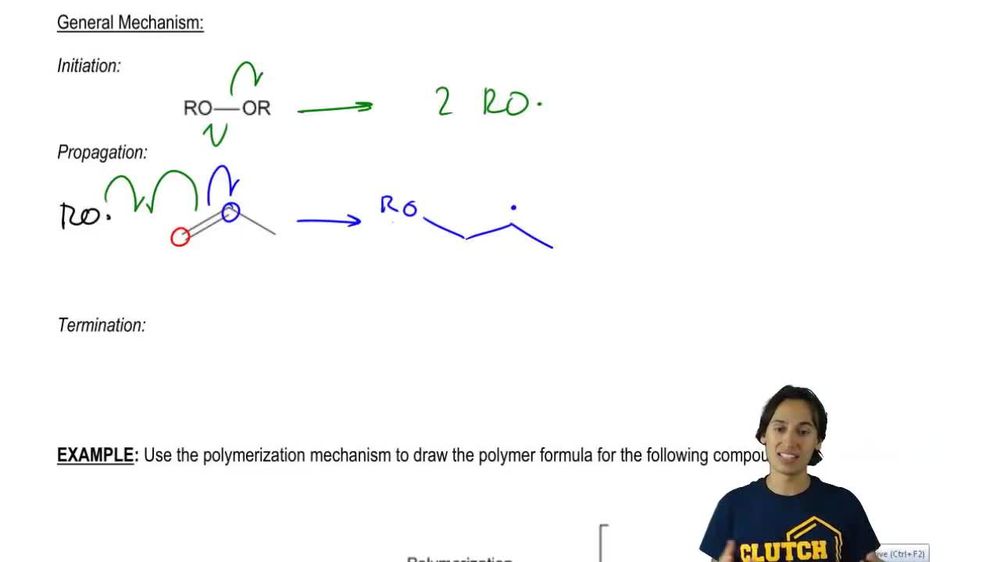
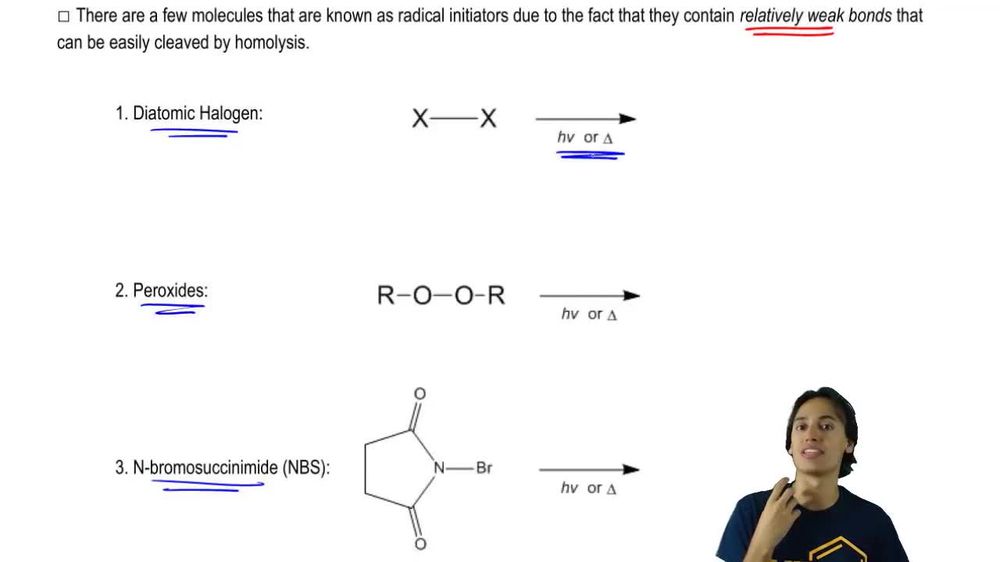
Step 1: Initiation - The free-radical initiator (e.g., peroxides) decomposes to form free radicals. These radicals react with HBr to generate a bromine radical (Br•). This step sets the stage for the propagation phase.
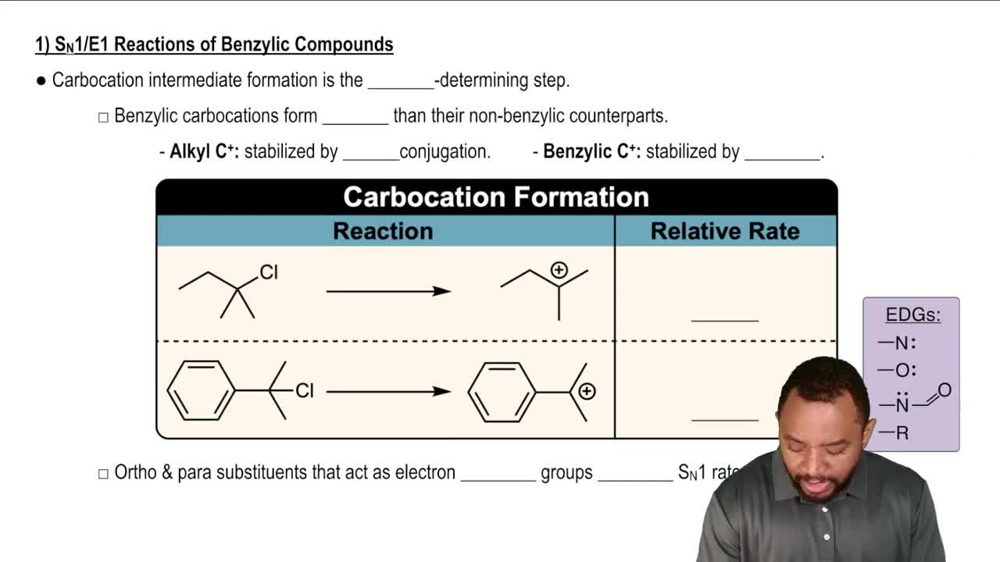
Step 2: Propagation - The bromine radical (Br•) reacts with 1-phenylpropene. The radical adds to the less substituted carbon of the double bond, forming a benzylic radical. This is because benzylic radicals are highly stabilized due to resonance with the aromatic ring.
Step 3: Propagation (continued) - The benzylic radical formed in the previous step reacts with another molecule of HBr. The radical abstracts a hydrogen atom from HBr, forming the final product and regenerating the bromine radical (Br•), which can continue the chain reaction.
Step 4: Termination - The reaction can terminate when two radicals combine, such as two bromine radicals (Br•) or a bromine radical and a benzylic radical, to form a stable molecule. This step ends the chain reaction and ensures no further radical propagation occurs.
Verified video answer for a similar problem:
This video solution was recommended by our tutors as helpful for the problem above
Video duration:
9m
Play a video:
0 Comments
Key Concepts
Here are the essential concepts you must grasp in order to answer the question correctly.
Alkyl and Benzylic Radicals
Alkyl radicals are carbon-centered radicals that are formed by the homolytic cleavage of a carbon-hydrogen bond. Benzylic radicals, on the other hand, are a specific type of alkyl radical where the radical is located on a carbon adjacent to a benzene ring. Benzylic radicals are generally more stable than simple alkyl radicals due to resonance stabilization, which allows the unpaired electron to be delocalized over the aromatic system.
The free radical addition mechanism involves the addition of a radical species to a double bond, resulting in the formation of a new radical. In the case of 1-phenylpropene reacting with HBr in the presence of a radical initiator, the initiator generates bromine radicals that add to the double bond. This process leads to the formation of a more stable radical, which can then react with another bromine molecule to form the final product.
Regioselectivity refers to the preference of a chemical reaction to yield one structural isomer over others. In the context of the addition of HBr to 1-phenylpropene, the stability of the resulting radical will influence the regioselectivity of the reaction. The more stable benzylic radical formed from the addition of the bromine radical to the double bond will be favored, leading to a specific product distribution based on the stability of the intermediates.