Indicate how each of the following factors affects an E1 reaction: 1. the strength of the base 2. the concentration of the base 3. the solvent
Verified step by step guidance
1
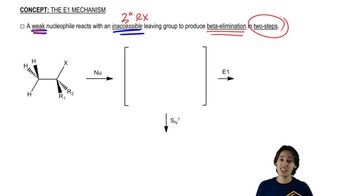
E1 reactions are unimolecular elimination reactions where the rate-determining step is the formation of a carbocation intermediate. Let's analyze each factor:
1. **Strength of the base**: The strength of the base does not significantly affect the rate of an E1 reaction. This is because the base is not involved in the rate-determining step (carbocation formation). The reaction rate depends primarily on the stability of the carbocation intermediate and the leaving group.
2. **Concentration of the base**: Similar to the strength of the base, the concentration of the base has little to no effect on the rate of an E1 reaction. The base only participates in the second step, where it abstracts a proton to form the alkene, which is not the rate-determining step.
3. **Solvent**: The solvent plays a crucial role in E1 reactions. Polar protic solvents (e.g., water, alcohols) stabilize the carbocation intermediate and the leaving group through hydrogen bonding and solvation. This stabilization lowers the activation energy for carbocation formation, thereby increasing the reaction rate.
In summary, the E1 reaction rate is primarily influenced by the stability of the carbocation intermediate and the nature of the solvent, while the strength and concentration of the base have minimal impact.
Verified video answer for a similar problem:
This video solution was recommended by our tutors as helpful for the problem above
Video duration:
4m
Play a video:
0 Comments
Key Concepts
Here are the essential concepts you must grasp in order to answer the question correctly.
E1 Reaction Mechanism
The E1 (unimolecular elimination) reaction is a two-step mechanism where the first step involves the formation of a carbocation intermediate after the leaving group departs. The rate of the reaction depends solely on the concentration of the substrate, not the base, making it a unimolecular process. Understanding this mechanism is crucial for analyzing how various factors influence the reaction.
In E1 reactions, the strength of the base is less significant than in E2 reactions because the base is not involved in the rate-determining step. However, a stronger base can facilitate the deprotonation of the carbocation intermediate in the second step, leading to the formation of the alkene product. Thus, while base strength is not a primary factor in the rate, it can influence the overall efficiency of the reaction.
The choice of solvent plays a critical role in E1 reactions, as polar protic solvents stabilize the carbocation intermediate through solvation. This stabilization lowers the activation energy for the formation of the carbocation, thereby increasing the reaction rate. Additionally, the solvent can affect the equilibrium between the reactants and products, influencing the overall yield of the reaction.