Draw the major product obtained when an alkyl halide in [PROBLEM 9-83] undergoes an E1 reaction. a. b.
Verified step by step guidance
1
Step 1: Identify the alkyl halide structure provided in the images. The first image shows 2-bromo-2-methylbutane, and the second image shows cyclohexyl chloride. Both are alkyl halides capable of undergoing an E1 elimination reaction.
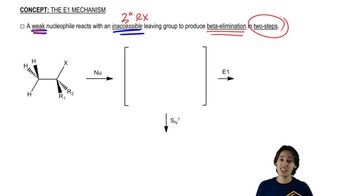
Step 2: Recall the mechanism of an E1 reaction. E1 elimination involves two steps: (1) the departure of the leaving group (e.g., Br or Cl) to form a carbocation intermediate, and (2) the elimination of a proton from a β-carbon to form a double bond.
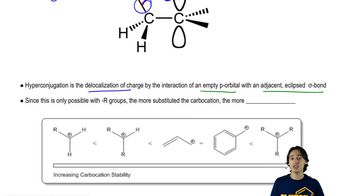
Step 3: Analyze the stability of the carbocation intermediate formed after the leaving group departs. For 2-bromo-2-methylbutane, the carbocation formed is tertiary, which is highly stable. For cyclohexyl chloride, the carbocation formed is secondary, which is moderately stable.
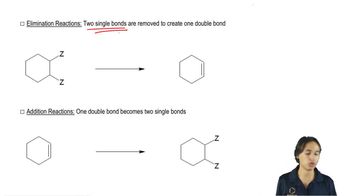
Step 4: Determine the β-hydrogens available for elimination. In 2-bromo-2-methylbutane, elimination can occur at either of the β-carbons adjacent to the carbocation, leading to the formation of an alkene. For cyclohexyl chloride, elimination occurs at one of the β-carbons in the cyclohexane ring, forming a double bond within the ring.
Step 5: Apply Zaitsev's rule to predict the major product. Zaitsev's rule states that the most substituted alkene is the major product. For 2-bromo-2-methylbutane, the major product is 2-methyl-2-butene. For cyclohexyl chloride, the major product is cyclohexene.
Verified video answer for a similar problem:
This video solution was recommended by our tutors as helpful for the problem above
Video duration:
3m
Play a video:
0 Comments
Key Concepts
Here are the essential concepts you must grasp in order to answer the question correctly.
E1 Reaction Mechanism
The E1 (unimolecular elimination) reaction is a two-step process where the first step involves the formation of a carbocation intermediate after the leaving group departs. The second step involves the elimination of a proton from a neighboring carbon, leading to the formation of a double bond. This mechanism typically occurs with tertiary alkyl halides due to their stability in forming carbocations.
Carbocation stability is crucial in determining the outcome of E1 reactions. Tertiary carbocations are more stable than secondary or primary ones due to hyperconjugation and inductive effects from surrounding alkyl groups. The stability of the carbocation influences the rate of the reaction and the major product formed, as more stable carbocations are favored in the reaction pathway.
Regioselectivity refers to the preference for the formation of one constitutional isomer over others in a chemical reaction. In E1 reactions, the elimination can lead to different alkenes depending on which hydrogen is removed. The more substituted alkene is typically favored due to greater stability, following Zaitsev's rule, which states that the more substituted alkene is the major product in elimination reactions.