For each compound, give the product(s) expected from (1) HgSO4/H2SO4 - catalyzed hydration and (2) hydroboration–oxidation. b. hex-2-yne
Verified step by step guidance
1
Step 1: Analyze the structure of hex-2-yne. Hex-2-yne is a six-carbon alkyne with a triple bond located between the second and third carbons. The structure provided confirms this arrangement.
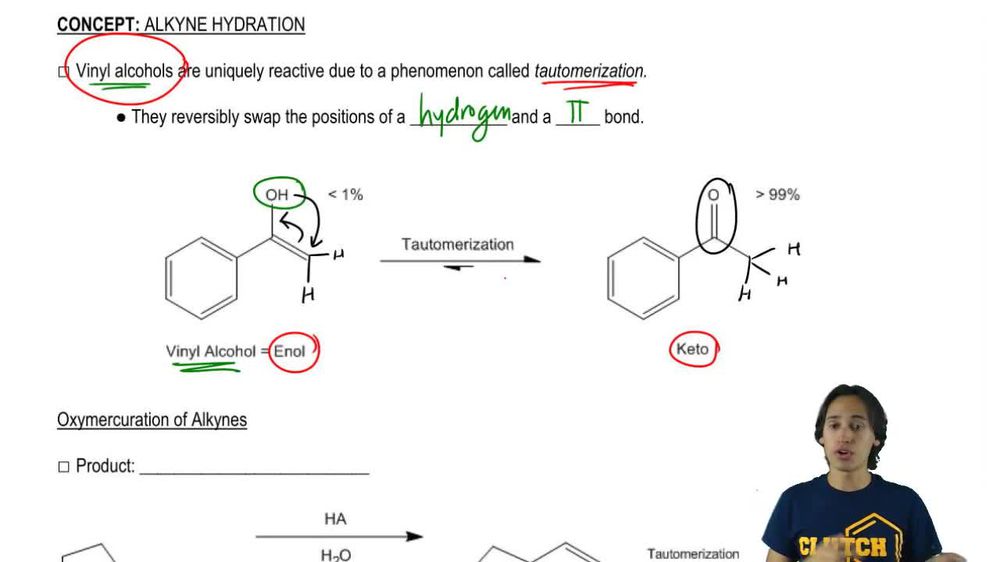
Step 2: For HgSO4/H2SO4-catalyzed hydration, recall that this reaction follows Markovnikov's rule. The triple bond will be converted into a ketone. The addition of water (H2O) across the triple bond will result in the formation of an enol intermediate, which tautomerizes to a ketone. The ketone will form on the more substituted carbon of the triple bond.
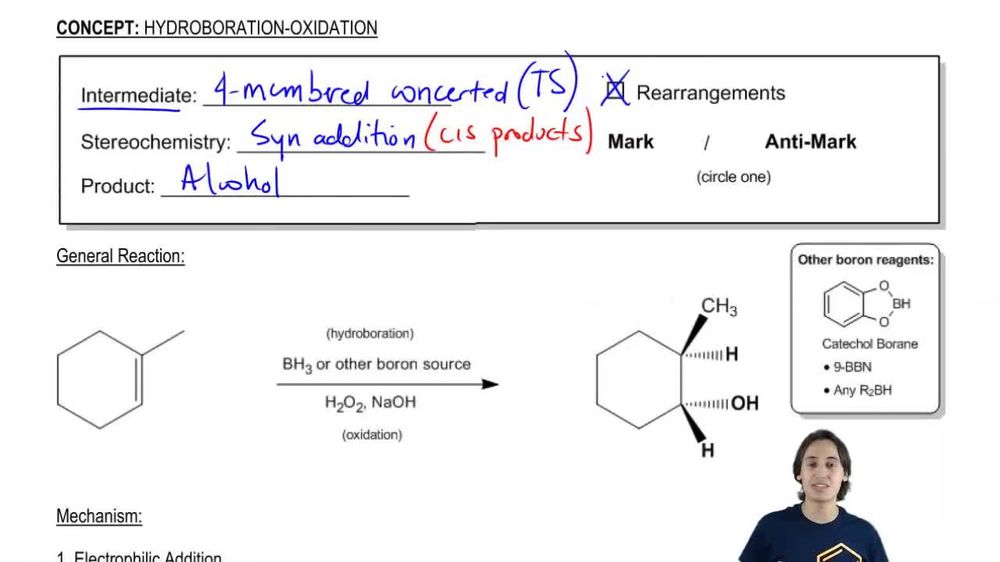
Step 3: For hydroboration–oxidation, recall that this reaction follows anti-Markovnikov's rule. The triple bond will be converted into an aldehyde. The addition of BH3 (or a similar borane reagent) followed by oxidation with H2O2/NaOH will result in the formation of an enol intermediate, which tautomerizes to an aldehyde. The aldehyde will form on the less substituted carbon of the triple bond.
Step 4: Write the expected products for each reaction. For HgSO4/H2SO4-catalyzed hydration, the product will be 3-hexanone (a ketone). For hydroboration–oxidation, the product will be hexanal (an aldehyde).
Step 5: Summarize the key concepts. HgSO4/H2SO4 hydration leads to ketone formation via Markovnikov addition, while hydroboration–oxidation leads to aldehyde formation via anti-Markovnikov addition. Both reactions involve tautomerization of an enol intermediate.
Verified video answer for a similar problem:
This video solution was recommended by our tutors as helpful for the problem above
Video duration:
11m
Play a video:
0 Comments
Key Concepts
Here are the essential concepts you must grasp in order to answer the question correctly.
Catalytic Hydration
Catalytic hydration involves the addition of water to an alkene or alkyne in the presence of an acid catalyst, such as HgSO4 or H2SO4. This process typically leads to the formation of alcohols, following Markovnikov's rule, where the more substituted carbon atom receives the hydroxyl group. In the case of hex-2-yne, this reaction will yield hexan-2-ol as the primary product.
Hydroboration-oxidation is a two-step reaction that converts alkenes and alkynes into alcohols. The first step involves the addition of borane (BH3) to the triple bond, resulting in a trialkylborane intermediate. The second step involves oxidation with hydrogen peroxide (H2O2) in a basic solution, leading to the formation of alcohols with anti-Markovnikov selectivity. For hex-2-yne, this results in the formation of hexan-1-ol.
Markovnikov's rule is a principle that predicts the regioselectivity of electrophilic addition reactions to alkenes and alkynes. It states that when HX (where X is a halogen or hydroxyl group) is added to an unsymmetrical alkene or alkyne, the hydrogen atom will attach to the carbon with the greater number of hydrogen atoms already attached. This rule is crucial for understanding the products formed during catalytic hydration and helps predict the outcome of reactions involving hex-2-yne.