Draw the following amino acids in all possible protonation states as you move from high pH to low pH. b. His
Verified step by step guidance
1
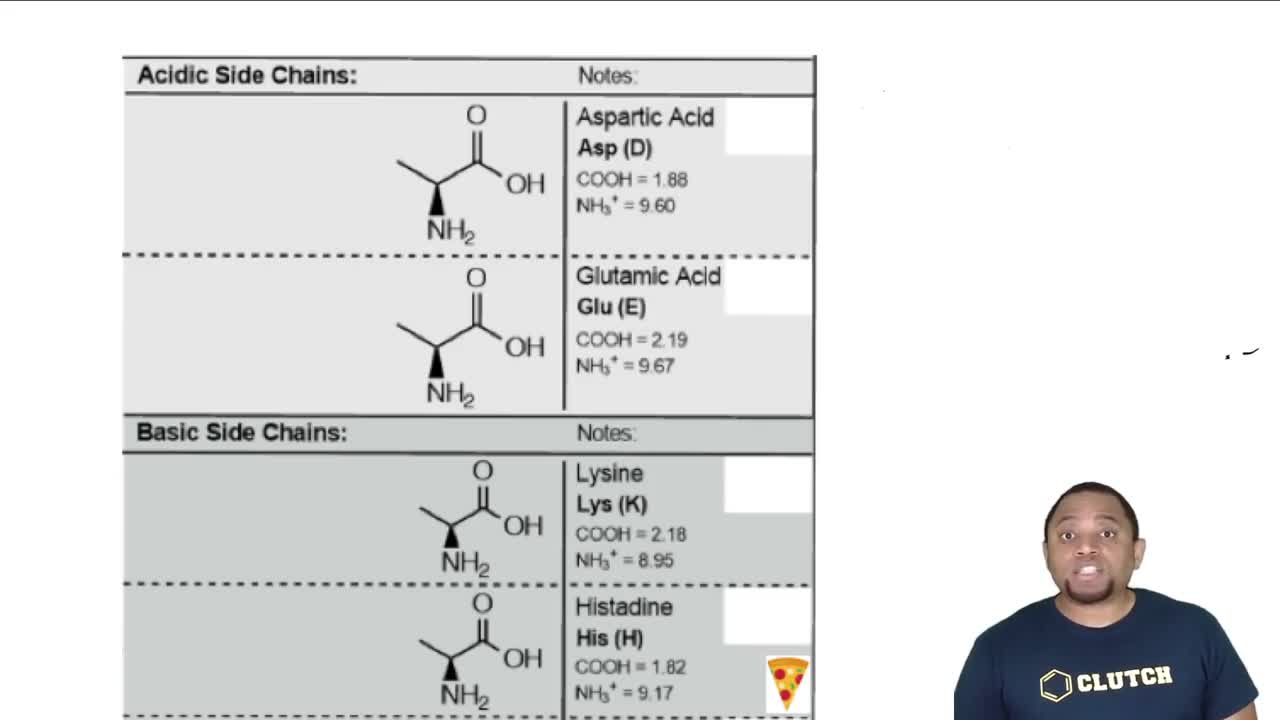
Identify the functional groups in histidine: an amino group (-NH2), a carboxyl group (-COOH), and an imidazole side chain.
At high pH, all groups are deprotonated. Draw histidine with the amino group as -NH2, the carboxyl group as -COO-, and the imidazole ring with a neutral nitrogen.
As the pH decreases, the carboxyl group will protonate first. Draw histidine with the carboxyl group as -COOH, while the amino group remains -NH2 and the imidazole ring remains neutral.
At a lower pH, the imidazole ring will protonate. Draw histidine with the imidazole ring having a positively charged nitrogen, while the carboxyl group is -COOH and the amino group is still -NH2.
At the lowest pH, the amino group will protonate. Draw histidine with the amino group as -NH3+, the carboxyl group as -COOH, and the imidazole ring with a positively charged nitrogen.
Verified video answer for a similar problem:
This video solution was recommended by our tutors as helpful for the problem above
Video duration:
3m
Play a video:
0 Comments
Key Concepts
Here are the essential concepts you must grasp in order to answer the question correctly.
Amino Acid Structure
Amino acids are organic compounds composed of an amino group, a carboxyl group, a hydrogen atom, and a distinctive side chain (R group) attached to a central carbon atom. Histidine, specifically, has an imidazole ring in its side chain, which plays a crucial role in its behavior under varying pH conditions.
Protonation states refer to the different forms an amino acid can take depending on the pH of the environment. As pH decreases, amino acids gain protons, affecting their charge and structure. Histidine can exist in multiple protonation states due to its imidazole ring, which can accept or donate protons.
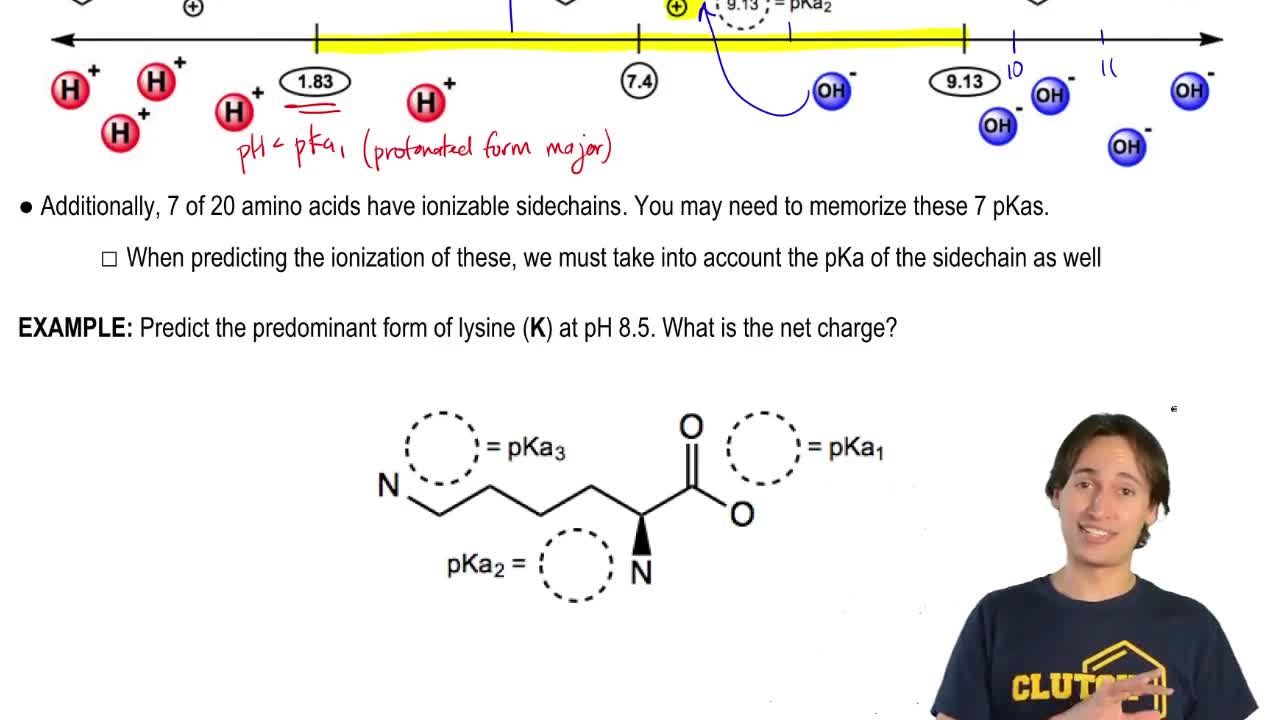
The pH of a solution influences the ionization of amino acids, affecting their charge and solubility. At high pH, amino acids tend to lose protons, becoming negatively charged, while at low pH, they gain protons, becoming positively charged. Understanding the pKa values of functional groups in histidine is essential for predicting its behavior across different pH levels.