Rank the following species in order of increasing basicity. Explain your reasons for ordering them as you do. NH3 CH3O– H2O CH3COO– NaOH NH2– HSO4–
Verified step by step guidance
1
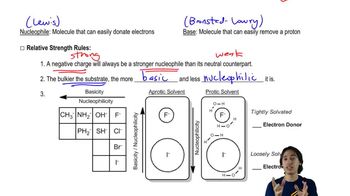
Identify the basicity of each species by considering their ability to accept protons (H+). Basicity is often related to the availability of a lone pair of electrons that can be donated to a proton.
Consider the electronegativity of the atoms involved. Species with less electronegative atoms holding the lone pair are generally more basic because they hold onto their electrons less tightly, making them more available for bonding with protons.
Evaluate the resonance stabilization of the conjugate acids. Species whose conjugate acids are more resonance-stabilized are generally less basic because the lone pair is delocalized, reducing its availability to bond with protons.
Consider the inductive effect. Electron-withdrawing groups can decrease basicity by pulling electron density away from the basic site, while electron-donating groups can increase basicity by pushing electron density towards the basic site.
Rank the species from least basic to most basic based on the above considerations: HSO4- (very weak base due to strong acid conjugate), CH3COO- (resonance-stabilized), H2O (neutral), NH3 (moderate base), CH3O- (strong base due to electron-donating group), NaOH (strong base), NH2- (very strong base due to lack of electronegative atoms and no resonance).
Verified video answer for a similar problem:
This video solution was recommended by our tutors as helpful for the problem above
Video duration:
3m
Play a video:
0 Comments
Key Concepts
Here are the essential concepts you must grasp in order to answer the question correctly.
Basicity
Basicity refers to the ability of a species to accept protons (H+ ions). It is influenced by factors such as the availability of lone pairs of electrons and the stability of the resulting conjugate acid. A stronger base will more readily accept a proton, often due to high electron density or less resonance stabilization in its conjugate acid form.
Understanding the difference between basicity and nucleophilicity.
Conjugate Acid-Base Pairs
In acid-base chemistry, a conjugate acid-base pair consists of two species that transform into each other by the gain or loss of a proton. The strength of a base is inversely related to the strength of its conjugate acid. For example, NH3 is a weak base, and its conjugate acid, NH4+, is relatively stronger, whereas NH2- is a strong base with a weak conjugate acid.
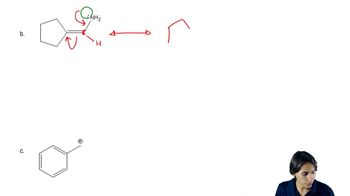
Resonance involves the delocalization of electrons across multiple atoms, which can stabilize a molecule or ion. In the context of basicity, species with resonance-stabilized conjugate acids are generally weaker bases because the delocalization of electrons makes it less favorable for the base to accept a proton. For instance, CH3COO- is less basic due to resonance stabilization of its conjugate acid, acetic acid.