Propose a mechanism for the reaction of benzyl bromide with ethanol to give benzyl ethyl ether.
Verified step by step guidance
1
Step 1: Identify the reaction type. This is a nucleophilic substitution reaction where benzyl bromide reacts with ethanol under heat to form benzyl ethyl ether. The bromine atom is replaced by the ethoxy group (-OCH2CH3).
Step 2: Analyze the structure of benzyl bromide. Benzyl bromide contains a benzyl group (C6H5CH2-) attached to a bromine atom. The benzyl group stabilizes the carbocation intermediate formed during the reaction.
Step 3: Ethanol acts as the nucleophile. The oxygen atom in ethanol has lone pairs of electrons, making it nucleophilic and capable of attacking the electrophilic carbon in benzyl bromide.
Step 4: Mechanism initiation. The reaction begins with the cleavage of the C-Br bond in benzyl bromide, forming a benzyl carbocation (C6H5CH2+). This step is facilitated by the heat provided in the reaction conditions.
Step 5: Nucleophilic attack. The lone pair of electrons on the oxygen atom of ethanol attacks the benzyl carbocation, forming a new C-O bond. This results in the formation of benzyl ethyl ether (C6H5CH2OCH2CH3) as the final product.
Verified video answer for a similar problem:
This video solution was recommended by our tutors as helpful for the problem above
Video duration:
1m
Play a video:
0 Comments
Key Concepts
Here are the essential concepts you must grasp in order to answer the question correctly.
Nucleophilic Substitution Reactions
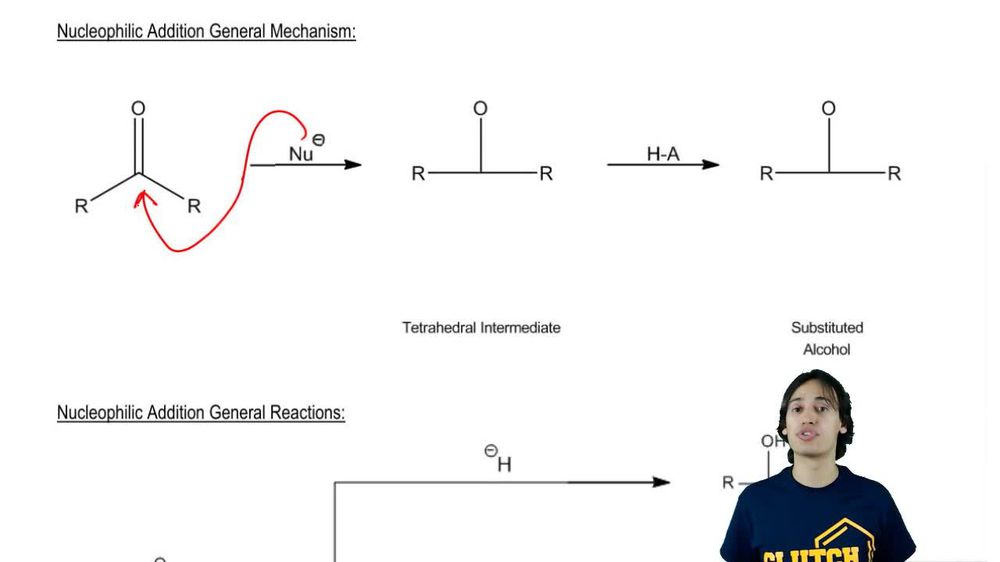
Nucleophilic substitution reactions involve the replacement of a leaving group in a molecule by a nucleophile. In this case, the bromine atom in benzyl bromide is replaced by the ethoxide ion (from ethanol) through an SN2 mechanism, where the nucleophile attacks the electrophilic carbon, leading to the formation of the new bond.
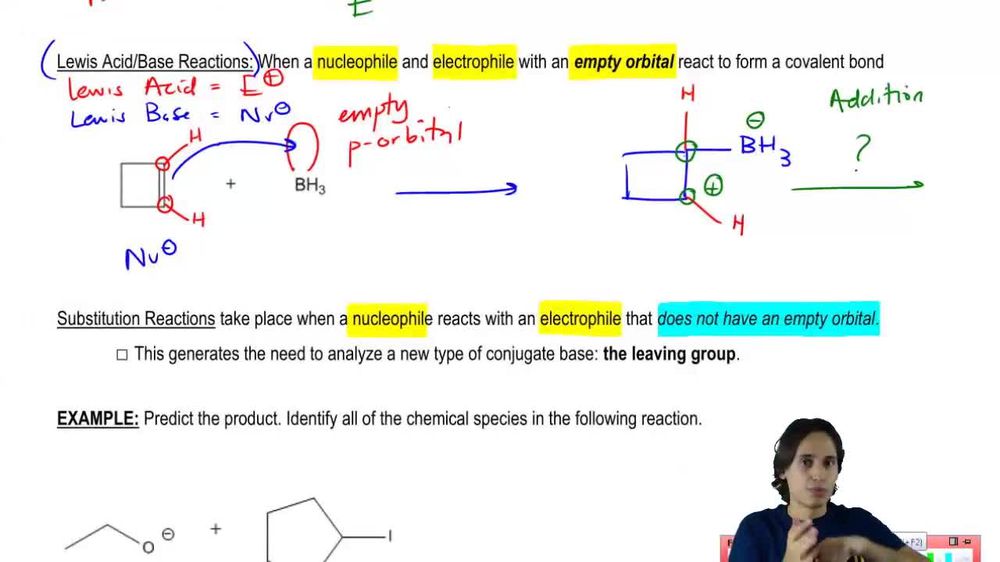
Nucleophiles and Electrophiles can react in Substitution Reactions.
Ethanol as a Nucleophile
Ethanol can act as a nucleophile due to the presence of the oxygen atom, which has a lone pair of electrons. When heated, ethanol can deprotonate to form the ethoxide ion (C2H5O-), which is a stronger nucleophile. This ion is crucial for attacking the benzyl carbon in benzyl bromide to form benzyl ethyl ether.
The reaction conditions, including heat, facilitate the nucleophilic substitution process. Heating increases the kinetic energy of the molecules, promoting the reaction rate. Understanding the mechanism, which involves the transition state where the nucleophile and leaving group interact, is essential for predicting the outcome of the reaction and the formation of benzyl ethyl ether.

 1:25 minutes
 Verified step by step guidance
 01:47
01:47