Propose a mechanism involving a hydride shift or an alkyl shift for each solvolysis reaction. Explain how each rearrangement forms a more stable intermediate. Hint: Most rearrangements convert 2° (or incipient 1°) carbocations to 3° or resonance-stabilized carbocations. (d)
Verified step by step guidance
1
The reaction begins with the ionization of the alkyl iodide (CH2I group) to form a primary carbocation. This occurs because the iodide ion (I⁻) is a good leaving group, and the reaction is facilitated by the polar protic solvent (ethanol, CH3CH2OH).
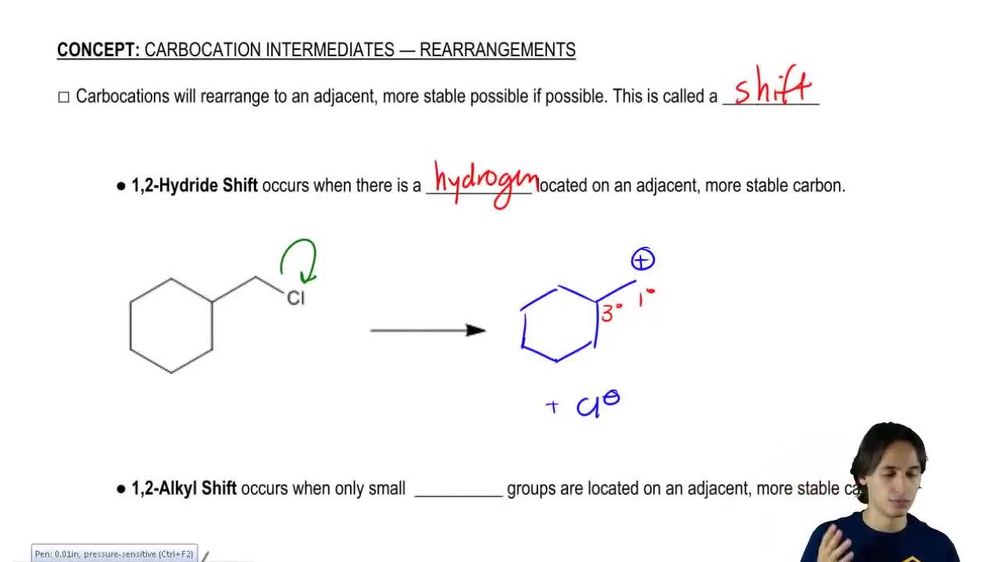
The initially formed primary carbocation is unstable. To increase stability, a hydride shift occurs. A hydrogen atom (along with its bonding electrons) from the adjacent carbon migrates to the carbocation, converting it into a more stable secondary carbocation.
The secondary carbocation undergoes further rearrangement via an alkyl shift. A methyl group (CH3) from a neighboring carbon migrates to the carbocation, forming a tertiary carbocation, which is even more stable due to hyperconjugation and inductive effects.
Once the tertiary carbocation is formed, the ethanol solvent acts as a nucleophile and attacks the carbocation. This results in the formation of an ether product (CH3CH2O group attached to the carbon).
The reaction produces two products: one where the rearranged tertiary carbocation reacts with ethanol to form the major product, and another where the primary carbocation reacts directly with ethanol to form the minor product. The major product is favored due to the stability of the tertiary carbocation intermediate.
Verified video answer for a similar problem:
This video solution was recommended by our tutors as helpful for the problem above
Video duration:
7m
Play a video:
0 Comments
Key Concepts
Here are the essential concepts you must grasp in order to answer the question correctly.
Carbocation Stability
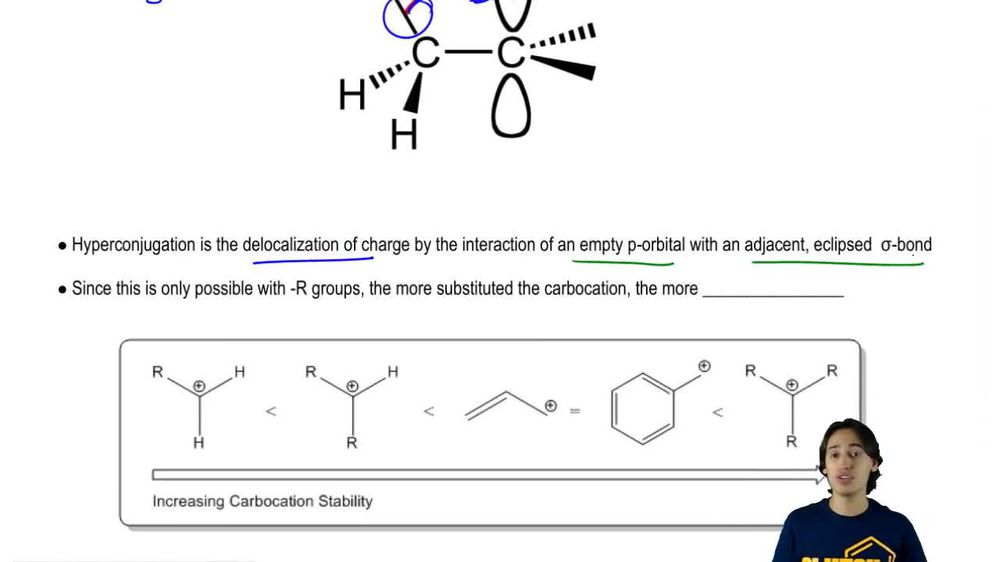
Carbocations are positively charged carbon species that can rearrange to form more stable intermediates. Stability increases from primary (1°) to secondary (2°) to tertiary (3°) carbocations due to hyperconjugation and inductive effects. In solvolysis reactions, the formation of a more stable carbocation intermediate often drives the reaction forward, allowing for subsequent nucleophilic attack.
Hydride shifts involve the migration of a hydrogen atom with its bonding electrons from one carbon to an adjacent positively charged carbon, while alkyl shifts involve the movement of an alkyl group. These shifts occur to stabilize carbocations by converting less stable carbocations into more stable ones, such as transforming a secondary carbocation into a tertiary carbocation, which is more favorable energetically.
Solvolysis is a nucleophilic substitution reaction where a solvent acts as a nucleophile, typically resulting in the formation of alcohols or ethers. In the provided reaction, the alkyl iodide undergoes solvolysis in ethanol, leading to the formation of two products. The mechanism often involves the formation of a carbocation intermediate, which can rearrange to enhance stability before the nucleophile attacks.