A nitrogen-containing compound shows no absorption band at ~3400 cm-1 and no absorption bands between ~1700 cm-1 and ~1600 cm-1 or between 2260 cm-1 and 2220 cm-1. What class of compound is it?
Verified step by step guidance
1
Analyze the absence of an absorption band at ~3400 cm⁻¹: This region typically corresponds to N-H stretching vibrations. The lack of absorption here suggests that the compound does not contain an amine (primary or secondary) or an amide functional group, as these would exhibit N-H stretching bands.
Examine the absence of absorption bands between ~1700 cm⁻¹ and ~1600 cm⁻¹: This region is characteristic of C=O stretching vibrations. The absence of absorption here indicates that the compound does not contain a carbonyl group, ruling out amides, ketones, aldehydes, esters, and carboxylic acids.
Consider the absence of absorption bands between ~2260 cm⁻¹ and ~2220 cm⁻¹: This region is associated with C≡N stretching vibrations. The lack of absorption here suggests that the compound does not contain a nitrile functional group.
Based on the absence of these characteristic absorption bands, conclude that the compound is likely a tertiary amine. Tertiary amines do not have N-H bonds, so they do not exhibit absorption at ~3400 cm⁻¹, and they lack the functional groups that would produce absorption in the other specified regions.
Verify the conclusion by considering the molecular structure of tertiary amines: Tertiary amines contain a nitrogen atom bonded to three alkyl or aryl groups, and their IR spectra typically lack the N-H and C=O stretching bands observed in other nitrogen-containing compounds.
Verified video answer for a similar problem:
This video solution was recommended by our tutors as helpful for the problem above
Video duration:
2m
Play a video:
0 Comments
Key Concepts
Here are the essential concepts you must grasp in order to answer the question correctly.
Infrared Spectroscopy
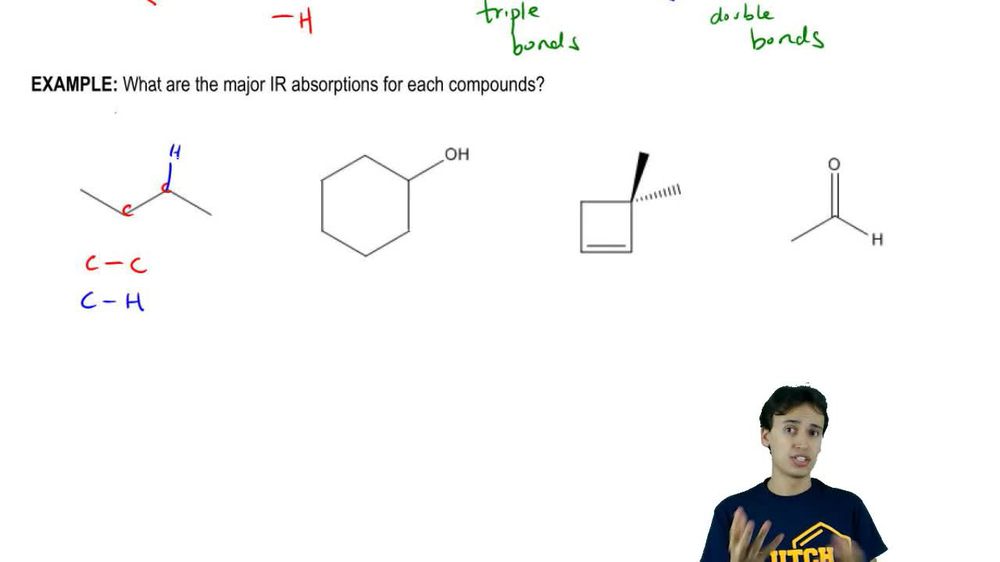
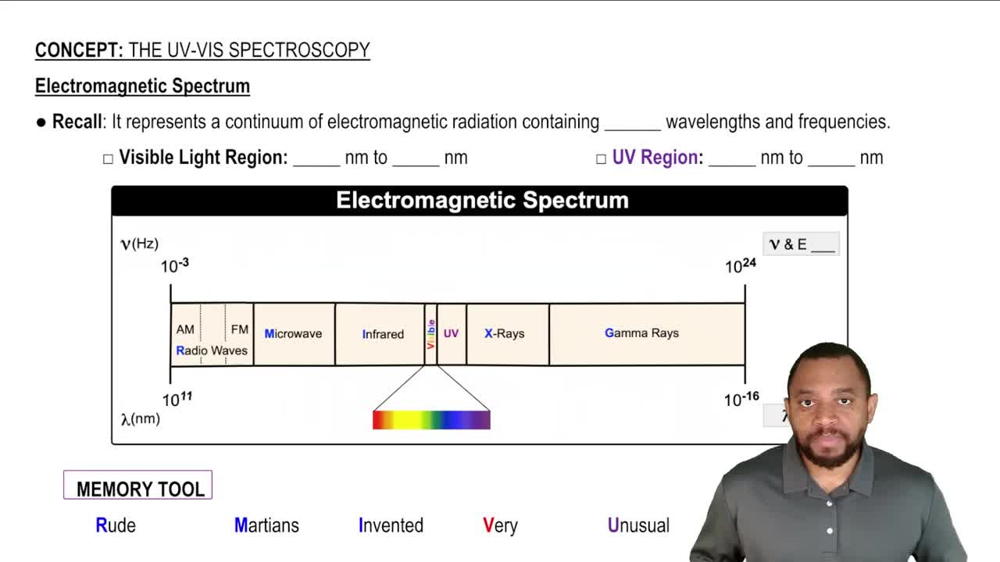
Infrared (IR) spectroscopy is a technique used to identify functional groups in organic compounds based on their absorption of infrared light. Different functional groups absorb IR radiation at characteristic wavelengths, allowing chemists to deduce the presence or absence of specific bonds and structures in a molecule.
Absorption bands in IR spectroscopy correspond to specific vibrational transitions of molecular bonds. For example, a strong absorption band around 3400 cm-1 typically indicates the presence of O-H or N-H bonds, while bands between 1700 cm-1 and 1600 cm-1 are associated with carbonyl (C=O) groups. The absence of these bands provides critical information about the compound's structure.
Functional groups are specific groups of atoms within molecules that are responsible for the characteristic chemical reactions of those molecules. In the context of nitrogen-containing compounds, the presence or absence of certain functional groups, such as amines, amides, or nitriles, can be inferred from the IR absorption patterns, guiding the identification of the compound's class.