Explain why fluorobenzene is more reactive than chlorobenzene toward electrophilic aromatic substitution but chloromethylbenzene is more reactive than fluoromethylbenzene.
Verified step by step guidance
1
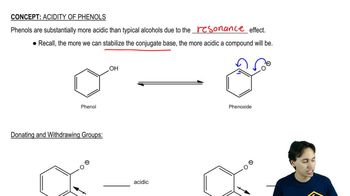
Fluorobenzene and chlorobenzene are both halobenzenes, where the halogen atom (fluorine or chlorine) is directly attached to the benzene ring. Halogens are electron-withdrawing due to their inductive effect (-I) but also donate electron density to the ring through resonance (+R).
In fluorobenzene, the fluorine atom is highly electronegative, which makes its inductive electron-withdrawing effect stronger than that of chlorine. However, fluorine is also a better resonance donor than chlorine because of its smaller size and better orbital overlap with the π-system of the benzene ring. This resonance donation increases the electron density in the ortho and para positions of the benzene ring, making fluorobenzene more reactive toward electrophilic aromatic substitution.
In chlorobenzene, the chlorine atom also exhibits both inductive withdrawal (-I) and resonance donation (+R). However, chlorine's resonance donation is weaker than that of fluorine due to its larger size and poorer orbital overlap with the benzene π-system. As a result, the electron density in the ring is not as effectively increased, making chlorobenzene less reactive than fluorobenzene toward electrophilic aromatic substitution.
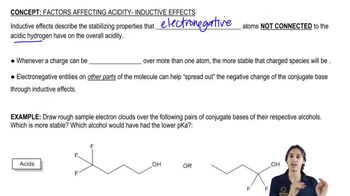
For chloromethylbenzene and fluoromethylbenzene, the halogen atom is not directly attached to the benzene ring but is instead part of the methyl group. In this case, the inductive electron-withdrawing effect of the halogen dominates because there is no resonance interaction with the benzene ring. Chlorine's inductive effect is weaker than fluorine's, so the electron density on the benzene ring is less reduced in chloromethylbenzene compared to fluoromethylbenzene.
As a result, chloromethylbenzene is more reactive than fluoromethylbenzene toward electrophilic aromatic substitution because the benzene ring in chloromethylbenzene retains more electron density, making it more attractive to electrophiles.
Verified video answer for a similar problem:
This video solution was recommended by our tutors as helpful for the problem above
Video duration:
7m
Play a video:
0 Comments
Key Concepts
Here are the essential concepts you must grasp in order to answer the question correctly.
Electrophilic Aromatic Substitution (EAS)
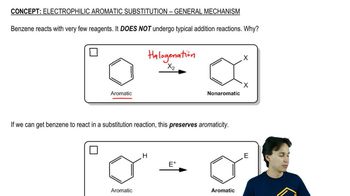
Electrophilic Aromatic Substitution is a fundamental reaction in organic chemistry where an electrophile replaces a hydrogen atom on an aromatic ring. The reactivity of the aromatic compound in EAS is influenced by the nature of substituents already present on the ring, which can either donate or withdraw electron density, affecting the stability of the intermediate carbocation formed during the reaction.
Substituents on an aromatic ring can be classified as electron-withdrawing groups (EWGs) or electron-donating groups (EDGs). EWGs, like fluorine, decrease the electron density of the ring, making it less reactive towards electrophiles, while EDGs, such as alkyl groups, increase electron density, enhancing reactivity. The balance of these effects determines the overall reactivity of substituted aromatic compounds in EAS.
Resonance and inductive effects are key factors influencing the stability of intermediates in EAS. Fluorine, despite being a strong EWG due to its electronegativity, can engage in resonance with the aromatic system, but its overall electron-withdrawing nature makes fluorobenzene less reactive than chlorobenzene. Conversely, chloromethylbenzene has a stronger electron-donating inductive effect from the alkyl group, making it more reactive than fluoromethylbenzene, which is hindered by fluorine's strong electronegativity.