Predict the product(s) that would result when the following molecules are allowed to react under the following conditions: (v) H2O; (vi) NaOH, H2O. If there is no reaction, write 'no reaction.' (f)
Verified step by step guidance
1
Step 1: Analyze the given molecule. The structure is a cyclohexane ring attached to a tert-butyl group with a chlorine atom bonded to the tertiary carbon. This molecule is a tertiary alkyl halide.
Step 2: Consider the reaction conditions (v) H2O. Tertiary alkyl halides can undergo solvolysis reactions in water via an SN1 mechanism. The chlorine atom leaves, forming a tertiary carbocation, which is stabilized by the inductive effect of the tert-butyl group.
Step 3: In the SN1 mechanism, water acts as a nucleophile and attacks the carbocation, leading to the formation of an alcohol. The product would be a tertiary alcohol where the chlorine atom is replaced by a hydroxyl group.
Step 4: Consider the reaction conditions (vi) NaOH, H2O. In the presence of a strong base like NaOH, elimination (E2) is favored for tertiary alkyl halides. The base abstracts a proton from a β-carbon, leading to the formation of an alkene. The double bond forms between the cyclohexane ring and the tert-butyl group.
Step 5: Summarize the outcomes. Under condition (v), the product is a tertiary alcohol. Under condition (vi), the product is an alkene formed via elimination. If no reaction occurs, it would be explicitly stated, but tertiary alkyl halides are reactive under these conditions.
Verified video answer for a similar problem:
This video solution was recommended by our tutors as helpful for the problem above
Video duration:
2m
Play a video:
0 Comments
Key Concepts
Here are the essential concepts you must grasp in order to answer the question correctly.
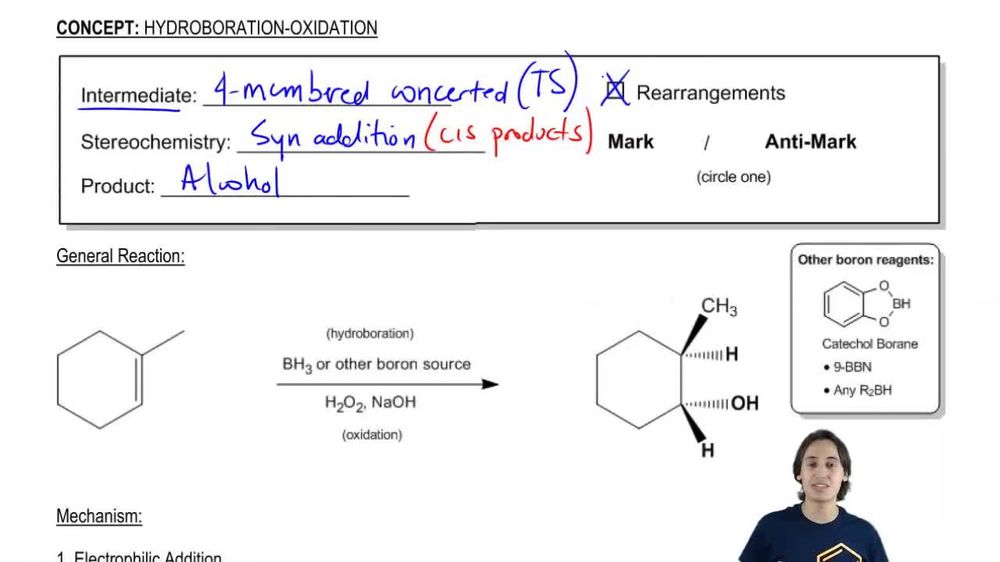
Hydroboration-Oxidation
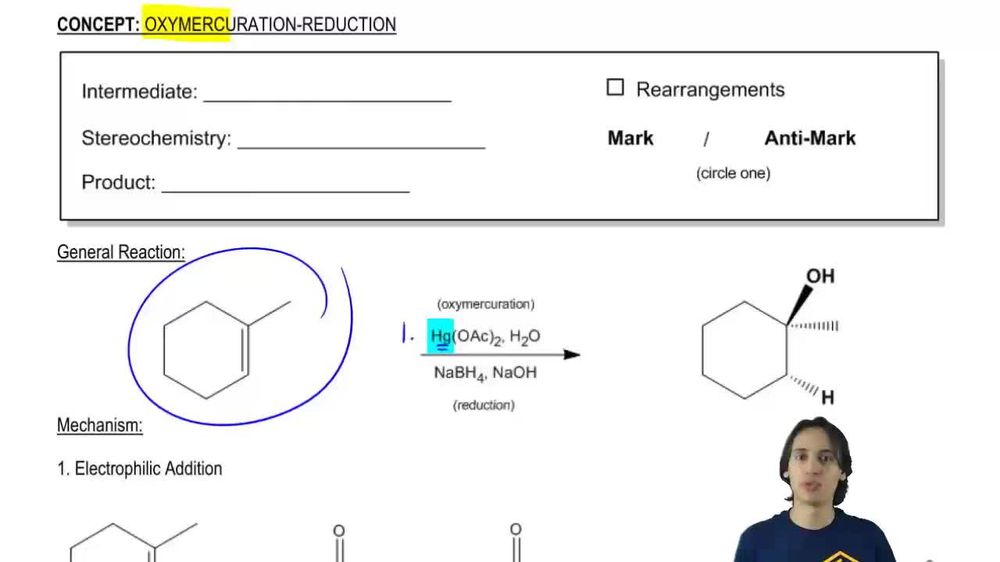
Hydroboration-oxidation is a two-step reaction process used to convert alkenes into alcohols. In the first step, BH₃ adds to the double bond of the alkene, forming a trialkylborane intermediate. The second step involves oxidation with H₂O₂ and NaOH, which converts the boron to a hydroxyl group, yielding an alcohol. This reaction is notable for its anti-Markovnikov selectivity.
Oxymercuration-demercuration is a method for converting alkenes to alcohols via mercuric acetate (Hg(OAc)₂) and sodium borohydride (NaBH₄). The alkene reacts with Hg(OAc)₂ to form a mercurial intermediate, which is then reduced by NaBH₄ to yield an alcohol. This reaction follows Markovnikov's rule, where the hydroxyl group attaches to the more substituted carbon.
The hydration of alkenes involves the addition of water across a double bond, typically catalyzed by an acid like H₂SO₄. This process results in the formation of alcohols and can follow Markovnikov's rule, where the hydrogen atom adds to the less substituted carbon. The reaction can be reversible, and the conditions can influence the product distribution.

 2:10 minutes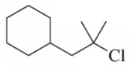
 Verified step by step guidance
 06:38
06:38