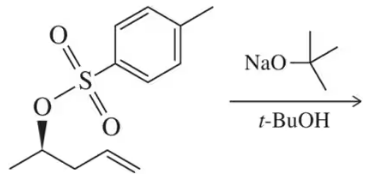
Identify whether each of the following reactions proceed by an SN1, SN2, E1, or E2 mechanism. (b)
Verified step by step guidance
1
Step 1: Analyze the substrate structure. The substrate contains a sulfonate leaving group attached to a secondary carbon. Sulfonates are excellent leaving groups, making the substrate prone to elimination or substitution reactions.
Step 2: Examine the base and solvent. The base is sodium tert-butoxide (NaO-tBu), which is a strong, bulky base. The solvent is tert-butanol (t-BuOH), which is protic. Bulky bases favor elimination reactions, particularly E2 mechanisms, because steric hindrance makes substitution less likely.
Step 3: Consider the reaction conditions. The strong base and protic solvent suggest that elimination is favored over substitution. The bulky nature of the base further supports an E2 mechanism, as it can abstract a proton from a β-carbon without requiring the formation of a carbocation intermediate.
Step 4: Evaluate the stereochemistry and regiochemistry of the elimination. In an E2 mechanism, the proton abstraction and leaving group departure occur simultaneously in a concerted process. The reaction will likely follow Zaitsev's rule, favoring the formation of the more substituted alkene as the major product.
Step 5: Conclude the mechanism. Based on the substrate, base, solvent, and reaction conditions, this reaction proceeds via an E2 mechanism.
Verified video answer for a similar problem:
This video solution was recommended by our tutors as helpful for the problem above
Play a video:
0 Comments
Key Concepts
Here are the essential concepts you must grasp in order to answer the question correctly.
Nucleophilic Substitution Mechanisms
Nucleophilic substitution reactions can occur via two primary mechanisms: SN1 and SN2. SN1 is a two-step process where the leaving group departs first, forming a carbocation intermediate, followed by nucleophilic attack. In contrast, SN2 is a one-step mechanism where the nucleophile attacks the substrate simultaneously as the leaving group departs, leading to a concerted reaction.
Nucleophiles and Electrophiles can react in Substitution Reactions.
Elimination Reactions
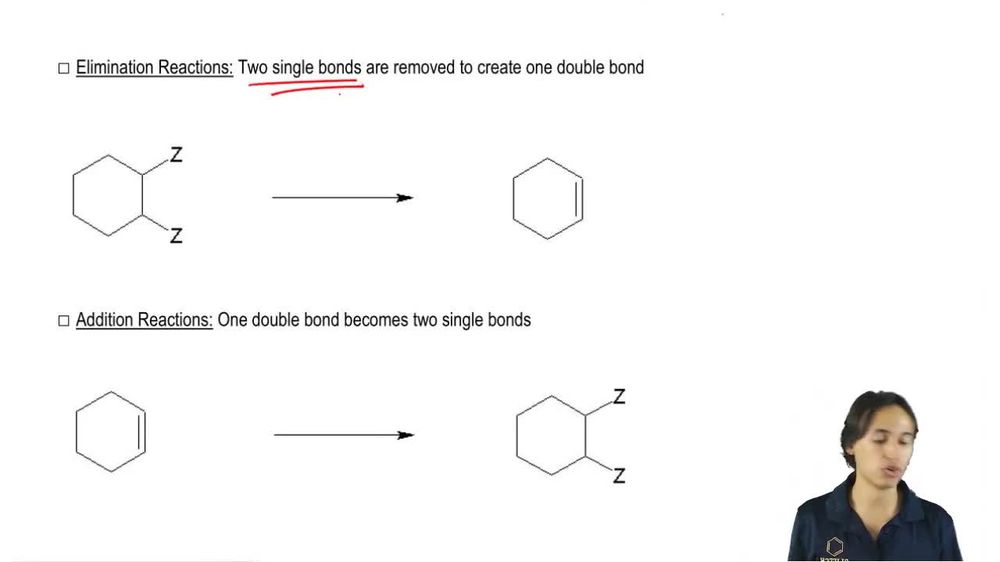
Elimination reactions can also occur through two mechanisms: E1 and E2. E1 involves a two-step process similar to SN1, where the leaving group first forms a carbocation, followed by the removal of a proton to form a double bond. E2 is a concerted mechanism where the base removes a proton while the leaving group departs, resulting in the formation of a double bond in a single step.
The choice between SN1, SN2, E1, and E2 mechanisms depends on several factors, including the structure of the substrate (primary, secondary, or tertiary), the strength and concentration of the nucleophile or base, and the solvent used. Polar protic solvents favor SN1 and E1 mechanisms, while polar aprotic solvents favor SN2 and E2 mechanisms due to their ability to stabilize ions and facilitate nucleophilic attack.

 Verified step by step guidance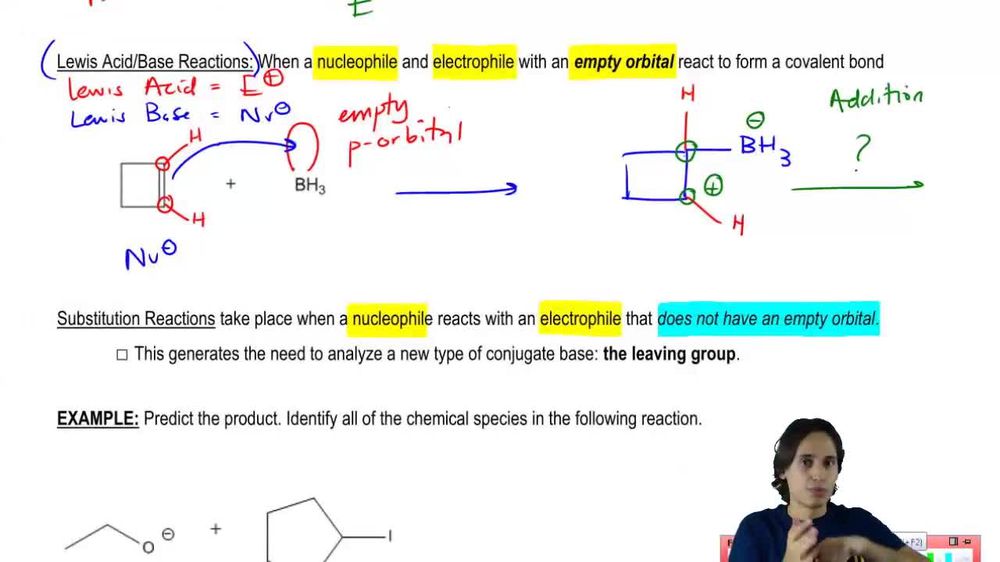
 01:47
01:47