
For each of the following reactions, suggest which solvent(s) would be compatible with the acids and bases involved. (We will ignore any other possible reactions for now.) Your choices of solvents are pentane, diethyl ether, ethanol, water, and ammonia. Refer to Appendix 4 for any needed values of pKa, or estimate them. c. d.
Verified step by step guidance
1
Identify the nature of the reactants and products in each reaction. In the first reaction, pyrrole (a weak base) reacts with ethylsulfonium ion (a strong acid) to form a pyrrole cation and ethyl sulfide. In the second reaction, sodium amide (a strong base) reacts with tert-butanol (a weak acid) to form ammonia and sodium tert-butoxide.
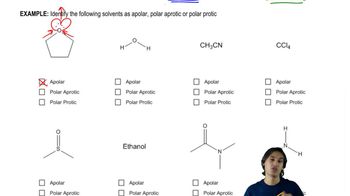
Consider the polarity and protic/aprotic nature of the solvents. Polar protic solvents like water and ethanol can stabilize ions through hydrogen bonding, while polar aprotic solvents like diethyl ether can stabilize ions through dipole interactions without hydrogen bonding.
For the first reaction, a polar protic solvent like water or ethanol would be suitable as they can stabilize the charged intermediates and products. However, ethanol might be preferred over water to avoid excessive solvation of the pyrrole cation.
For the second reaction, a polar aprotic solvent like diethyl ether or a non-polar solvent like pentane could be used to avoid protonation of the strong base sodium amide. Ammonia could also be a suitable solvent as it is a common solvent for reactions involving sodium amide.
Evaluate the compatibility of the solvents with the reactants and products. Ensure that the chosen solvent does not participate in side reactions or interfere with the desired reaction pathway.
Verified video answer for a similar problem:
This video solution was recommended by our tutors as helpful for the problem above
Video duration:
9m
Play a video:
0 Comments
Key Concepts
Here are the essential concepts you must grasp in order to answer the question correctly.
Solvent Polarity
Solvent polarity is crucial in determining the compatibility of solvents with acids and bases in a reaction. Polar solvents, like water and ethanol, can stabilize charged species through solvation, while non-polar solvents, like pentane, are better suited for reactions involving neutral molecules. Understanding the polarity helps predict solvent effects on reaction rates and equilibria.
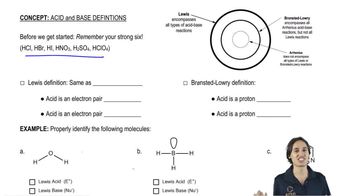
Acid-base chemistry involves the transfer of protons between molecules, which is central to many organic reactions. The strength of acids and bases, often measured by pKa values, influences their reactivity and the choice of solvent. Strong acids and bases require solvents that can stabilize ions, while weaker ones may be compatible with less polar solvents.
Solvent compatibility refers to the ability of a solvent to dissolve reactants and facilitate the desired reaction without interfering. Factors like solvent polarity, boiling point, and chemical inertness are considered. For example, ammonia can act as a base and solvent, while diethyl ether is a common choice for reactions needing a non-polar environment.