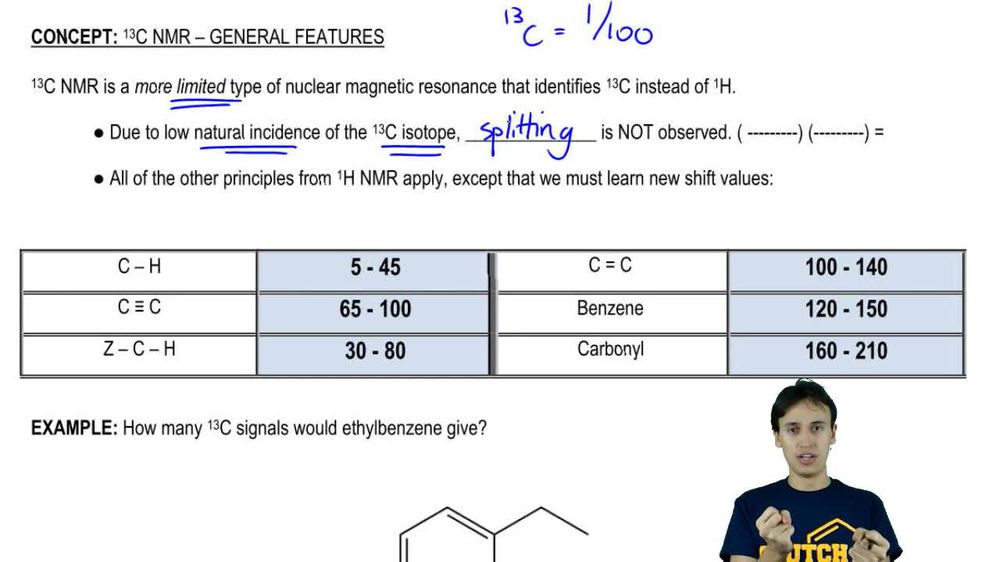
Identify each compound below from its molecular formula and its 13C NMR spectrum. a. C11H22O <IMAGE>
Verified step by step guidance
1
Step 1: Calculate the degree of unsaturation (also known as the index of hydrogen deficiency, IHD) for the molecular formula C11H22O. Use the formula: IHD = (2C + 2 - H + N - X)/2, where C = number of carbons, H = number of hydrogens, N = number of nitrogens, and X = number of halogens. For C11H22O, there are no nitrogens or halogens, so IHD = (2(11) + 2 - 22)/2 = 0. This indicates the compound is fully saturated with no double bonds, triple bonds, or rings.
Step 2: Analyze the 13C NMR spectrum. Look for the number of distinct carbon signals, which corresponds to the number of unique carbon environments in the molecule. For example, if the spectrum shows 11 signals, it suggests all 11 carbons are in unique environments. Fewer signals would indicate symmetry in the molecule.
Step 3: Consider the presence of the oxygen atom in the molecular formula. The oxygen could be part of a functional group such as an alcohol (-OH), ether (R-O-R), or carbonyl group (C=O). Use the chemical shift values in the 13C NMR spectrum to identify the functional group. For example, carbons attached to an alcohol or ether typically appear in the range of 50-90 ppm, while carbonyl carbons appear in the range of 160-220 ppm.
Step 4: Use the splitting patterns and integration of the 13C NMR signals to deduce the structure. For instance, if the spectrum shows signals for a quaternary carbon (no hydrogens attached), it might indicate a branching point in the molecule. Additionally, the presence of methyl (CH3), methylene (CH2), or methine (CH) groups can be inferred from the chemical shifts and intensities.
Step 5: Propose a structure for the compound that matches the molecular formula (C11H22O), the degree of unsaturation (IHD = 0), and the 13C NMR data. Ensure the structure accounts for all observed signals and is consistent with the chemical shifts and splitting patterns in the spectrum.
Verified video answer for a similar problem:
This video solution was recommended by our tutors as helpful for the problem above
Video duration:
4m
Play a video:
0 Comments
Key Concepts
Here are the essential concepts you must grasp in order to answer the question correctly.
Molecular Formula Interpretation
The molecular formula provides essential information about the number and types of atoms in a compound. For C11H22O, it indicates there are 11 carbon (C) atoms, 22 hydrogen (H) atoms, and 1 oxygen (O) atom. Understanding how to interpret this formula is crucial for deducing the compound's structure and potential functional groups.
13C NMR (Nuclear Magnetic Resonance) spectroscopy is a powerful analytical technique used to determine the structure of organic compounds. It provides information about the carbon environment in a molecule, including the number of distinct carbon atoms and their chemical surroundings. Analyzing the peaks in the 13C NMR spectrum helps identify the types of carbon present and their connectivity.
Functional groups are specific groups of atoms within molecules that are responsible for the characteristic chemical reactions of those molecules. In the case of C11H22O, the presence of an oxygen atom suggests possible functional groups like alcohols or ethers. Understanding isomerism, where compounds with the same molecular formula can have different structures, is also vital for identifying the correct compound.