Draw resonance contributors for the following ions: d.
Verified step by step guidance
1
Identify the ion in the given structure. The image shows a carbocation (positively charged carbon atom) located at the allylic position, adjacent to a double bond.
Recognize that resonance contributors involve the delocalization of electrons. In this case, the positive charge can be delocalized across the π-system of the conjugated double bonds.
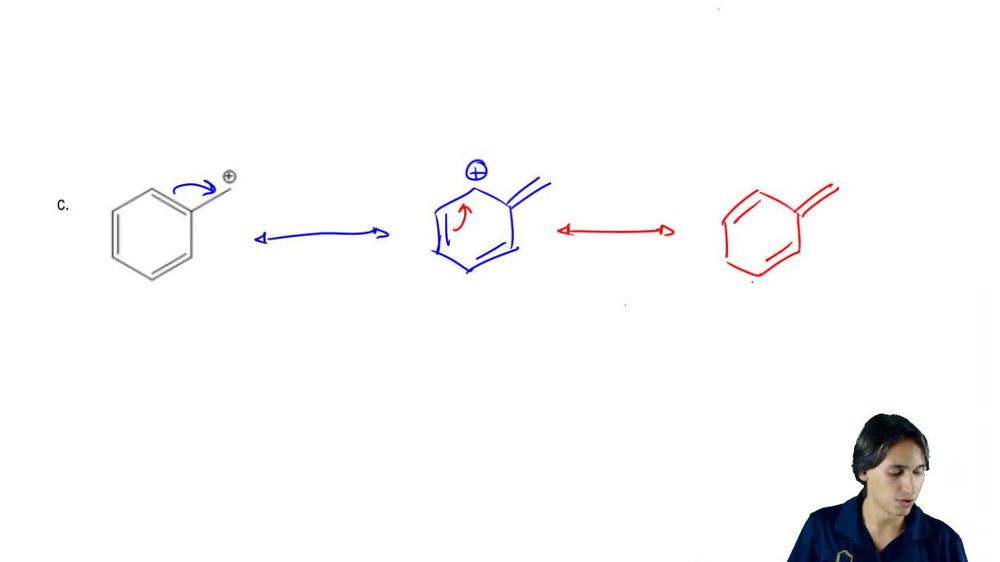
Draw the first resonance structure by moving the π-electrons of the double bond closest to the carbocation toward the carbocation. This will result in the positive charge shifting to the next carbon in the chain.
Draw the second resonance structure by moving the π-electrons of the next double bond toward the newly formed carbocation. This will further delocalize the positive charge to the next carbon in the conjugated system.
Ensure that all resonance structures follow the rules of resonance: the overall charge remains the same, the connectivity of atoms does not change, and all atoms obey the octet rule where applicable.
Verified video answer for a similar problem:
This video solution was recommended by our tutors as helpful for the problem above
Video duration:
4m
Play a video:
0 Comments
Key Concepts
Here are the essential concepts you must grasp in order to answer the question correctly.
Resonance Structures
Resonance structures are different Lewis structures for the same molecule that depict the same arrangement of atoms but differ in the distribution of electrons. These structures help illustrate the delocalization of electrons within a molecule, which can stabilize the ion or molecule. The actual structure is a hybrid of these resonance forms, contributing to the overall stability and reactivity of the compound.
Delocalization of electrons refers to the phenomenon where electrons are spread over several atoms rather than being localized between two atoms. This occurs in systems with conjugated double bonds or lone pairs adjacent to double bonds, allowing for greater stability. Delocalization is a key factor in resonance, as it lowers the energy of the molecule and influences its chemical properties.
Formal charge is a theoretical charge assigned to an atom in a molecule, calculated based on the number of valence electrons, the number of bonds, and the number of non-bonding electrons. It helps in determining the most stable resonance structure, as structures with lower formal charges are generally more favorable. Understanding formal charge is essential for evaluating the contribution of each resonance structure to the overall hybrid.

 4:50 minutes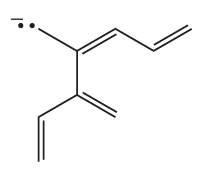
 Verified step by step guidance
 03:04
03:04