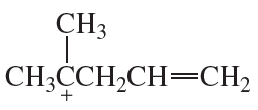
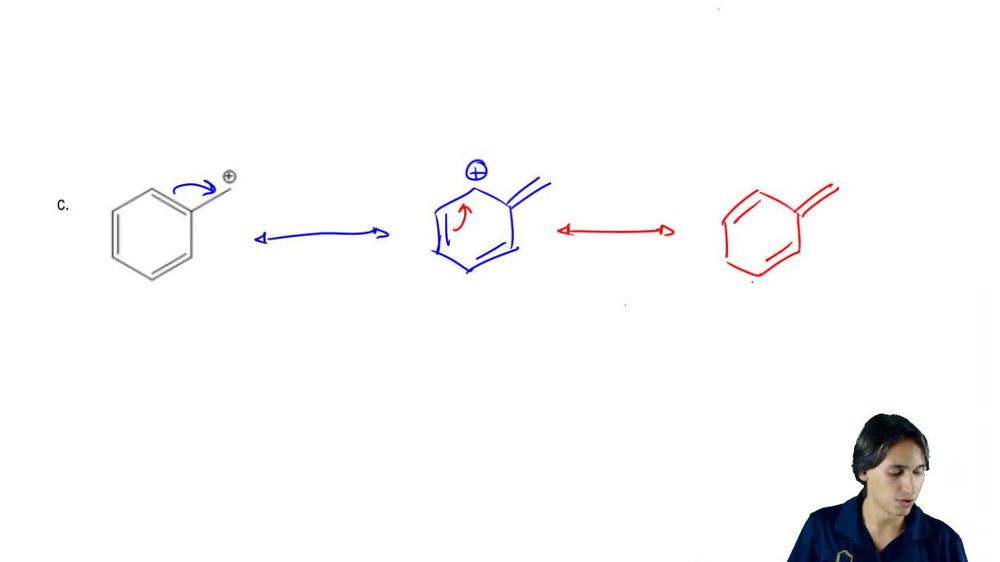
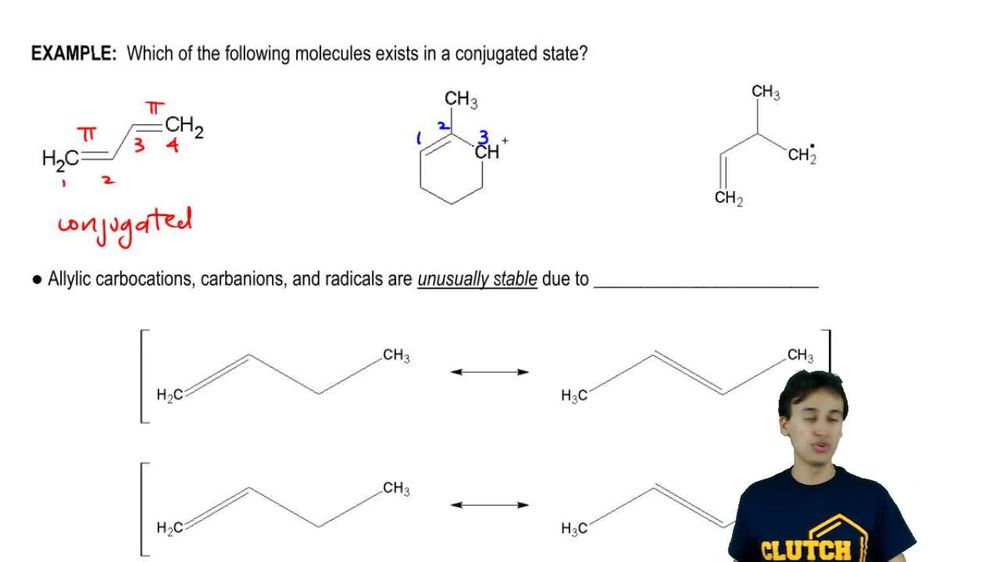
Which of the following has delocalized electrons? g. h. i.
Verified step by step guidance
1
Step 1: Understand the concept of delocalized electrons. Delocalized electrons are electrons that are not confined to a single atom or bond but are spread across multiple atoms, typically in conjugated systems or resonance structures.
Step 2: Analyze structure (a). Structure (a) contains alternating double bonds (a conjugated system) and a positively charged carbon atom. The conjugated system allows for delocalization of π-electrons across the double bonds.
Step 3: Analyze structure (b). Structure (b) has a positively charged carbon atom, but the double bonds are not conjugated (they are separated by a single bond). This lack of conjugation prevents delocalization of electrons.
Step 4: Analyze structure (c). Structure (c) contains a nitrogen atom with a lone pair and a double bond nearby. However, the lone pair on nitrogen is not part of a conjugated system, and the double bond does not interact with the lone pair to create delocalization.
Step 5: Conclude that structure (a) has delocalized electrons due to the conjugated system, while structures (b) and (c) do not exhibit delocalization of electrons.
Verified video answer for a similar problem:
This video solution was recommended by our tutors as helpful for the problem above
Video duration:
4m
Play a video:
0 Comments
Key Concepts
Here are the essential concepts you must grasp in order to answer the question correctly.
Delocalized Electrons
Delocalized electrons are electrons that are not associated with a single atom or a single bond but are spread over several atoms. This phenomenon occurs in molecules with conjugated systems or resonance structures, where electrons can move freely between multiple bonding sites, contributing to the stability and reactivity of the molecule.
Resonance structures are different ways of drawing the same molecule that illustrate the delocalization of electrons. These structures help chemists understand the actual electron distribution in a molecule, which is often a hybrid of the resonance forms. The true structure is a blend of these forms, leading to increased stability.
Conjugation refers to the overlap of p-orbitals across adjacent double or triple bonds, allowing for the delocalization of electrons. This arrangement stabilizes the molecule and can affect its reactivity and color. Conjugated systems are often found in organic compounds, such as dyes and pigments, where they contribute to unique properties.