Rank the following compounds from easiest to hardest at removing a proton from its methyl substituent:
Verified step by step guidance
1
Step 1: Analyze the chemical structures provided. The compounds are pyridine derivatives with methyl substituents. The first compound is 2-methylpyridine, the second is 4-methylpyridine, and the third is 2-methylpyridinium iodide.
Step 2: Consider the factors affecting the acidity of the methyl group. The ease of removing a proton from the methyl group depends on the stability of the resulting carbanion. Electron-withdrawing groups or resonance stabilization can increase the acidity.
Step 3: Evaluate the influence of the nitrogen atom in the pyridine ring. In 2-methylpyridine and 4-methylpyridine, the nitrogen atom can stabilize the carbanion formed after deprotonation through resonance. However, the position of the methyl group relative to the nitrogen affects the extent of stabilization.
Step 4: Examine the third compound, 2-methylpyridinium iodide. The positively charged nitrogen in the pyridinium ring significantly reduces the electron density, making the methyl group less acidic compared to the neutral pyridine derivatives.
Step 5: Rank the compounds based on the ease of removing a proton from the methyl group. Consider the resonance effects and the electron-withdrawing nature of the nitrogen atom in each case. The order is likely: 4-methylpyridine (most acidic), 2-methylpyridine, and 2-methylpyridinium iodide (least acidic).
Verified video answer for a similar problem:
This video solution was recommended by our tutors as helpful for the problem above
Video duration:
9m
Play a video:
0 Comments
Key Concepts
Here are the essential concepts you must grasp in order to answer the question correctly.
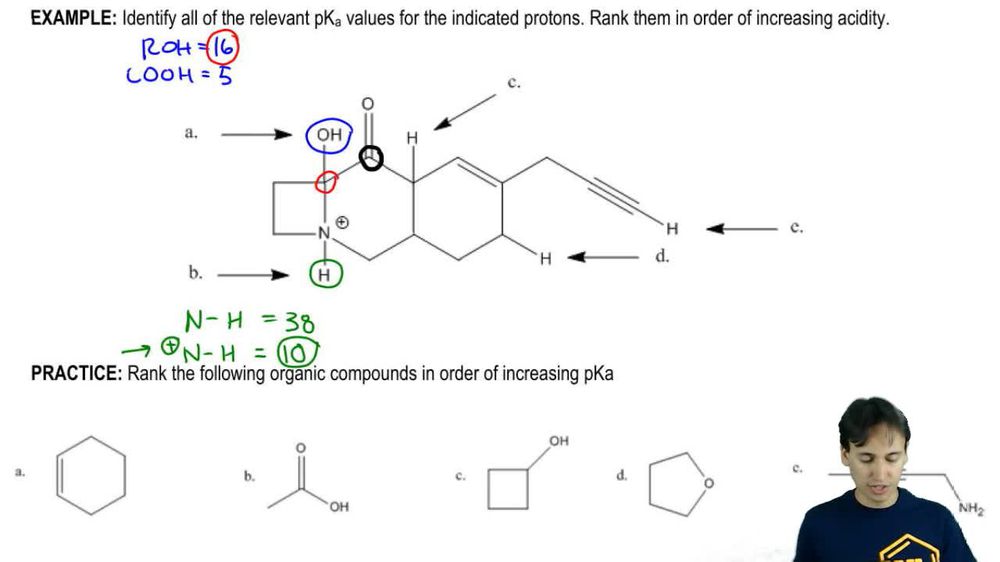
Acidity and pKa
Acidity refers to the tendency of a compound to donate a proton (H+). The strength of an acid is often measured by its pKa value; lower pKa values indicate stronger acids. Understanding the pKa of the compounds in question is essential for ranking them based on how easily they can lose a proton from their methyl substituent.
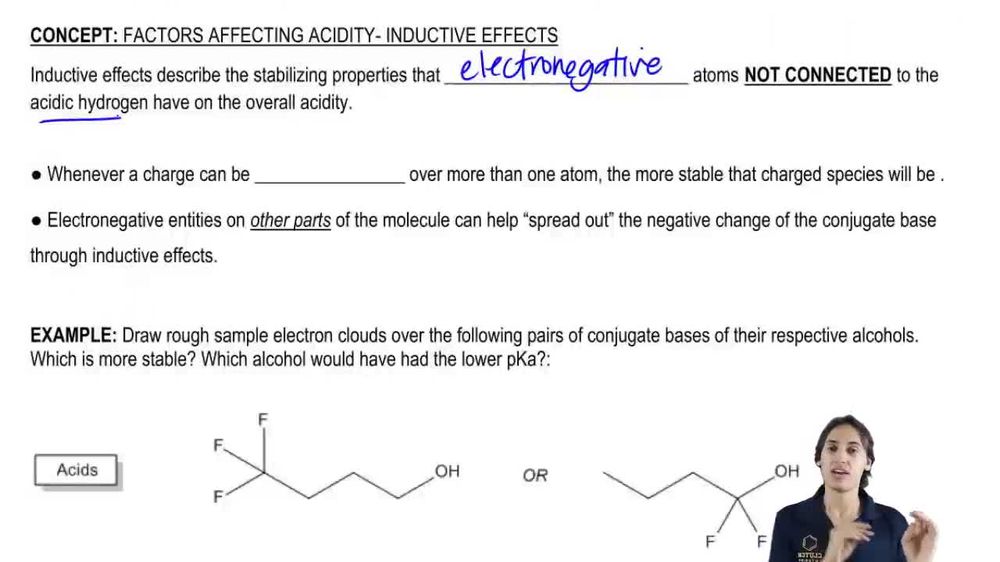
The inductive effect describes how the presence of electronegative atoms or groups can stabilize or destabilize a negative charge in a molecule. Electron-withdrawing groups can increase acidity by stabilizing the conjugate base formed after deprotonation, while electron-donating groups can decrease acidity. Recognizing these effects is crucial for predicting the ease of proton removal.
Resonance stabilization occurs when a molecule can distribute its electron density across multiple structures, leading to increased stability. In the context of acidity, if the conjugate base formed after deprotonation can be resonance-stabilized, it will be more favorable for the compound to lose a proton. This concept is vital for understanding the relative acidity of the compounds being compared.

 9:12 minutes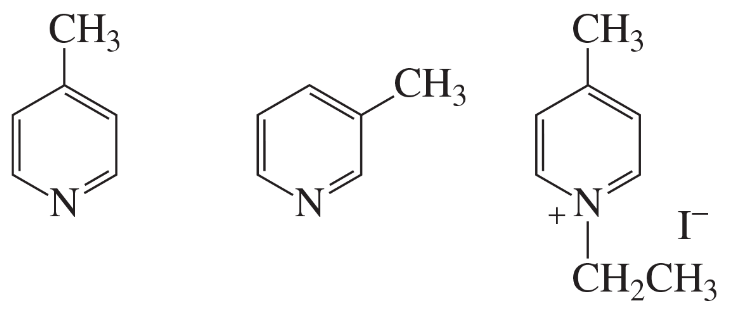
 Verified step by step guidance
 07:45
07:45