Which is the most stable base in each pair? (c) NH3 vs. H2O
Verified step by step guidance
1
Compare the basicity of NH₃ (ammonia) and H₂O (water) by analyzing their ability to donate a lone pair of electrons to accept a proton (H⁺). A stronger base will have a greater tendency to donate its lone pair.
Examine the electronegativity of the central atoms in each molecule. Nitrogen (N) in NH₃ is less electronegative than oxygen (O) in H₂O. This means nitrogen holds onto its lone pair less tightly, making it more available for protonation.
Consider the stability of the conjugate acids formed when each base accepts a proton. NH₃ forms NH₄⁺ (ammonium ion), while H₂O forms H₃O⁺ (hydronium ion). The stability of the conjugate acid can influence the basicity of the original base.
Analyze the molecular structure and hydrogen bonding. H₂O can form stronger hydrogen bonds due to its higher electronegativity, which can stabilize the molecule and reduce its basicity compared to NH₃.
Conclude that NH₃ is the more stable base in this pair because its lone pair is more readily available for protonation, and its conjugate acid (NH₄⁺) is relatively stable.
Verified video answer for a similar problem:
This video solution was recommended by our tutors as helpful for the problem above
Play a video:
0 Comments
Key Concepts
Here are the essential concepts you must grasp in order to answer the question correctly.
Acid-Base Theory
Acid-base theory explains the behavior of acids and bases in chemical reactions. According to the Brønsted-Lowry theory, an acid is a proton donor, while a base is a proton acceptor. Understanding this concept is crucial for determining the stability of bases, as it helps to identify which species can effectively accept protons in a given context.
Electronegativity is a measure of an atom's ability to attract and hold onto electrons. In the context of bases, a more electronegative atom can stabilize the negative charge that results from proton acceptance. Comparing the electronegativities of nitrogen in ammonia (NH3) and oxygen in water (H2O) is essential for assessing their relative basicity and stability.
Resonance stabilization refers to the delocalization of electrons across multiple structures, which can enhance the stability of a molecule. In the case of bases, resonance can help distribute the negative charge more evenly, making the base more stable. Understanding how resonance applies to the conjugate acids of NH3 and H2O can provide insight into their relative stabilities as bases.

 Verified step by step guidance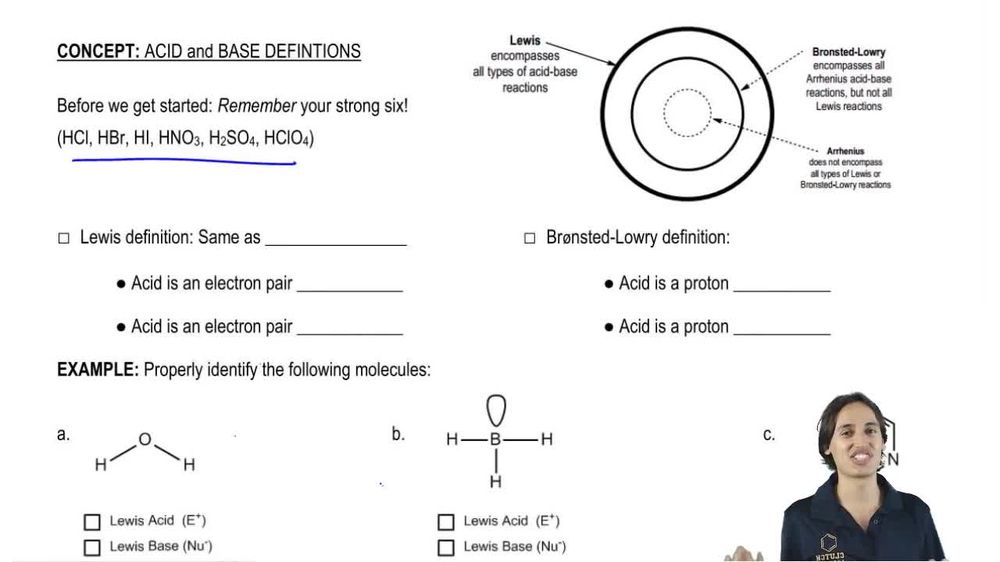
 02:49
02:49