Propose mechanisms for the following reactions. (c)
Verified step by step guidance
1
Step 1: Protonation of the alcohol group - The reaction begins with the protonation of the hydroxyl (-OH) group of 2-methylcyclohexanol by sulfuric acid (H2SO4). This converts the hydroxyl group into a better leaving group, forming water (H2O). The intermediate is now a protonated alcohol.
Step 2: Formation of the carbocation - The water molecule leaves, generating a carbocation intermediate. The carbocation forms at the carbon where the hydroxyl group was originally attached. In this case, the carbocation is at the 2-position of the cyclohexane ring.
Step 3: Carbocation rearrangement - The carbocation may undergo hydride or methyl shifts to form more stable carbocations. For example, a hydride shift can occur to move the positive charge to a tertiary carbon, which is more stable than a secondary carbocation.
Step 4: Elimination to form alkenes - The carbocation undergoes elimination (E1 mechanism) to form double bonds. A proton is removed from a β-carbon (adjacent to the carbocation), resulting in the formation of alkenes. Depending on which β-hydrogen is removed, different alkenes are formed: 1-methylcyclohexene, 3-methylcyclohexene, and methylenecyclohexane.
Step 5: Product distribution - The reaction produces a mixture of alkenes due to the possibility of forming different double bond positions. The major product is typically the more substituted alkene (Zaitsev's rule), but all three products (1-methylcyclohexene, 3-methylcyclohexene, and methylenecyclohexane) are observed.
Verified video answer for a similar problem:
This video solution was recommended by our tutors as helpful for the problem above
Video duration:
11m
Play a video:
0 Comments
Key Concepts
Here are the essential concepts you must grasp in order to answer the question correctly.
Elimination Reactions
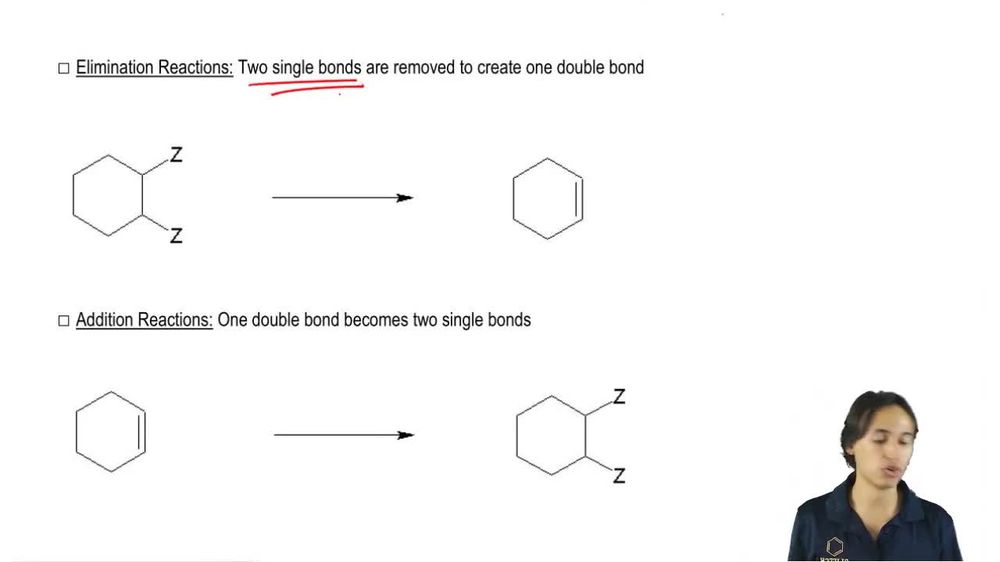
Elimination reactions involve the removal of atoms or groups from a molecule, resulting in the formation of a double bond. In this case, the dehydration of 2-methylcyclohexanol leads to the formation of alkenes. The reaction typically requires an acid catalyst, such as sulfuric acid, and heat to facilitate the elimination of water.
Regioselectivity refers to the preference of a chemical reaction to yield one structural isomer over others when multiple possibilities exist. In the dehydration of 2-methylcyclohexanol, the formation of different alkenes (1-methylcyclohexene, 3-methylcyclohexene, and methylenecyclohexane) illustrates how the stability of the resulting double bond influences the major products formed.
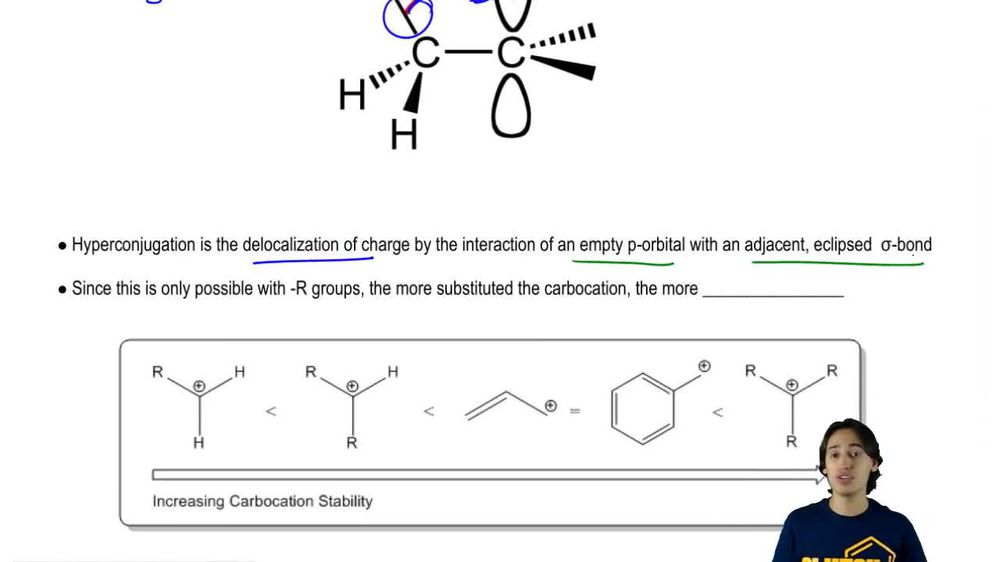
Carbocation stability is a key factor in determining the outcome of elimination reactions. More stable carbocations, such as tertiary or secondary, are favored during the reaction pathway. In this case, the formation of alkenes from 2-methylcyclohexanol involves the generation of carbocations, where the stability of these intermediates influences which alkene is predominantly formed.

 11:48 minutes
 Verified step by step guidance
 00:40
00:40