
Ch. 7 - Structure and Synthesis of Alkenes; Elimination
Wade - Organic Chemistry 9th Edition
Wade9th EditionOrganic ChemistryISBN: 9780135213728Not the one you use?Change textbook
Chapter 7, Problem 38c

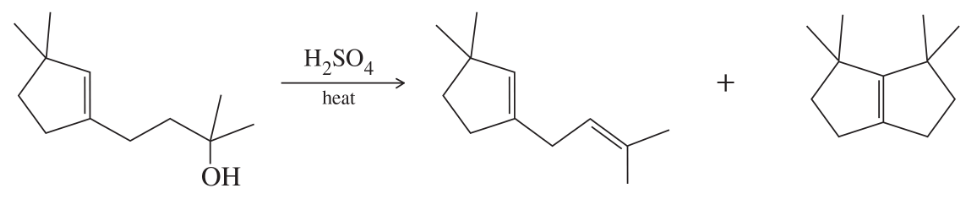
Propose mechanisms for the following reactions. Additional products may be formed, but your mechanism only needs to explain the products shown.
(c)

Verified step by step guidance
1
Step 1: Protonation of the alcohol group - The reaction begins with the protonation of the hydroxyl (-OH) group by sulfuric acid (H2SO4). This converts the alcohol into a better leaving group, forming water.
Step 2: Formation of a carbocation - The water molecule leaves, generating a carbocation at the carbon where the hydroxyl group was originally attached. The stability of the carbocation is crucial, and rearrangements may occur to form a more stable carbocation.
Step 3: Elimination to form product A - The carbocation undergoes elimination (E1 mechanism) where a proton is removed from a neighboring carbon, forming a double bond. This leads to the formation of the first product, A, which is an alkene.
Step 4: Intramolecular cyclization to form product B - The carbocation can also undergo intramolecular cyclization. A neighboring double bond attacks the carbocation, forming a new ring structure. This leads to the formation of product B, which is a bicyclic compound.
Step 5: Final stabilization - Both products, A and B, are stabilized through resonance or hyperconjugation, ensuring their stability under the reaction conditions. The reaction is driven by the heat and the acidic environment provided by H2SO4.

Verified video answer for a similar problem:

This video solution was recommended by our tutors as helpful for the problem above.
Video duration:
11m
Was this helpful?

Key Concepts

Here are the essential concepts you must grasp in order to answer the question correctly.

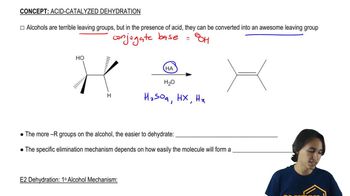
Acid-Catalyzed Dehydration

Acid-catalyzed dehydration is a reaction where an alcohol is converted into an alkene through the removal of a water molecule, facilitated by an acid such as sulfuric acid (H2SO4). The acid protonates the hydroxyl group, making it a better leaving group, which then departs, leading to the formation of a carbocation. This carbocation can then undergo rearrangement or elimination to form the double bond in the alkene product.
Recommended video:
Guided course
06:01
General features of acid-catalyzed dehydration.

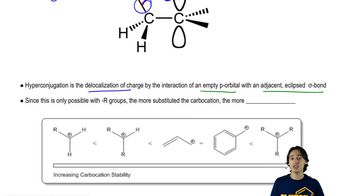
Carbocation Stability

Carbocation stability is a crucial concept in organic chemistry, as the stability of the carbocation intermediate influences the reaction pathway. Carbocations are classified as primary, secondary, or tertiary based on the number of alkyl groups attached to the positively charged carbon. Tertiary carbocations are the most stable due to hyperconjugation and inductive effects from surrounding alkyl groups, which can stabilize the positive charge.
Recommended video:
Guided course
05:58
Determining Carbocation Stability

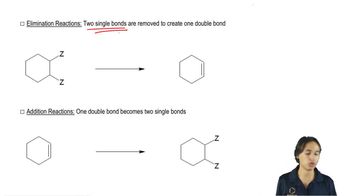
Elimination Reactions

Elimination reactions involve the removal of two substituents from a molecule, resulting in the formation of a double bond. In the context of dehydration, the reaction typically follows either an E1 or E2 mechanism. E1 involves the formation of a carbocation intermediate, while E2 is a concerted process where the base abstracts a proton as the leaving group departs. Understanding these mechanisms is essential for predicting the products of the reaction.
Recommended video:
Guided course
00:40
Recognizing Elimination Reactions.