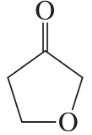
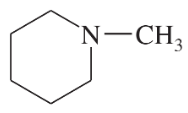
Draw a Lewis structure, and classify each of the following compounds: (i) (j)
Verified step by step guidance
1
Step 1: Identify the functional groups in each compound. Compound (i) contains an ester group, characterized by a carbonyl group (C=O) adjacent to an ether linkage (C-O-C). Compound (j) contains a secondary amine group, characterized by a nitrogen atom bonded to two carbon atoms, one of which is part of a methyl group (CH₃).
Step 2: Draw the Lewis structure for compound (i). Start by drawing the carbon skeleton of the five-membered ring. Add the carbonyl group (C=O) to one of the carbon atoms, and the ether linkage (C-O-C) to the adjacent carbon atom. Ensure that each atom has a complete octet, except for hydrogen, which should have a duet.
Step 3: Draw the Lewis structure for compound (j). Begin by drawing the six-membered ring. Add the nitrogen atom to one of the carbon atoms in the ring. Attach the methyl group (CH₃) to the nitrogen atom. Ensure that each atom has a complete octet, except for hydrogen, which should have a duet.
Step 4: Classify compound (i) as an ester due to the presence of the carbonyl group adjacent to an ether linkage. Esters are characterized by the functional group RCOOR', where R and R' are hydrocarbon chains.
Step 5: Classify compound (j) as a secondary amine due to the presence of the nitrogen atom bonded to two carbon atoms. Secondary amines are characterized by the functional group R₂NH, where R represents hydrocarbon chains.
Verified video answer for a similar problem:
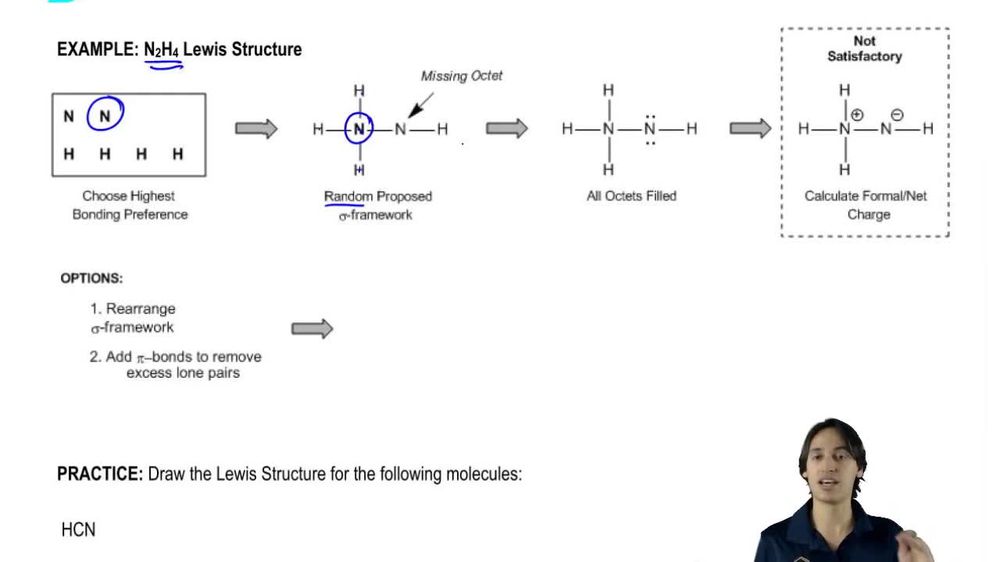
This video solution was recommended by our tutors as helpful for the problem above
Video duration:
3m
Play a video:
0 Comments
Key Concepts
Here are the essential concepts you must grasp in order to answer the question correctly.
Lewis Structures
Lewis structures are diagrams that represent the bonding between atoms in a molecule and the lone pairs of electrons that may exist. They use dots to represent electrons and lines to represent bonds, allowing chemists to visualize the arrangement of atoms and the distribution of electrons. Understanding how to draw Lewis structures is essential for predicting molecular geometry and reactivity.
Functional groups are specific groups of atoms within molecules that are responsible for the characteristic chemical reactions of those molecules. They determine the properties and reactivity of organic compounds. Recognizing functional groups, such as carbonyls, alcohols, and amines, is crucial for classifying compounds and predicting their behavior in chemical reactions.
Molecular geometry refers to the three-dimensional arrangement of atoms in a molecule. It is influenced by the number of electron pairs around the central atom, which can affect bond angles and overall shape. Understanding molecular geometry is important for predicting the physical and chemical properties of compounds, as well as their interactions with other molecules.