
a. Draw the two chair conformations of cis-1,3-dimethylcyclohexane, and label all the positions as axial or equatorial. b. Label the higher-energy conformation and the lower-energy conformation. c. The energy difference in these two conformations has been measured to be about 23 kJ (5.4 kcal) per mole. How much of this energy difference is due to the torsional energy of gauche relationships? d. How much energy is due to the additional steric strain of the 1,3-diaxial interaction?
Verified step by step guidance
1
Step 1: Begin by understanding the structure of cyclohexane and its chair conformation. Cyclohexane can adopt a chair conformation where carbon atoms alternate between axial and equatorial positions. In cis-1,3-dimethylcyclohexane, both methyl groups are on the same side of the ring.
Step 2: Draw the first chair conformation of cis-1,3-dimethylcyclohexane. Place one methyl group at the axial position on carbon 1 and the other methyl group at the equatorial position on carbon 3. Label all positions on the cyclohexane ring as axial or equatorial.
Step 3: Draw the second chair conformation by flipping the ring. This involves converting axial positions to equatorial and vice versa. Place one methyl group at the equatorial position on carbon 1 and the other methyl group at the axial position on carbon 3. Again, label all positions as axial or equatorial.
Step 4: Compare the two conformations to determine which is higher in energy. The conformation with both methyl groups in axial positions will have higher energy due to increased steric strain from 1,3-diaxial interactions. The conformation with both methyl groups in equatorial positions will be lower in energy.
Step 5: Analyze the energy difference. The energy difference of 23 kJ/mol (5.4 kcal/mol) is due to both torsional energy from gauche interactions and steric strain from 1,3-diaxial interactions. Calculate the energy contribution from gauche interactions by considering typical values for gauche butane interactions, and subtract this from the total energy difference to find the steric strain contribution.
Verified video answer for a similar problem:
This video solution was recommended by our tutors as helpful for the problem above
Video duration:
9m
Play a video:
0 Comments
Key Concepts
Here are the essential concepts you must grasp in order to answer the question correctly.
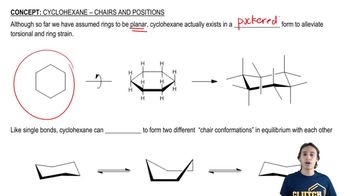
Chair Conformation of Cyclohexane
Cyclohexane can adopt a chair conformation, which is the most stable due to minimized torsional strain. In this conformation, carbon atoms alternate between axial and equatorial positions. Axial positions are perpendicular to the ring plane, while equatorial positions are parallel, affecting steric interactions and stability.
Gauche interactions occur when two substituents on adjacent carbons are 60 degrees apart, leading to torsional strain. In cyclohexane derivatives, these interactions contribute to the overall energy of the molecule, as they are less favorable than anti conformations where substituents are 180 degrees apart.
Interactions within the Tertiary Structure Concept 2
1,3-Diaxial Interaction
1,3-Diaxial interactions are steric strains that occur when axial substituents on cyclohexane are in close proximity, leading to increased energy due to repulsion. These interactions are significant in determining the stability of different conformations, with equatorial positions generally preferred to minimize steric hindrance.