
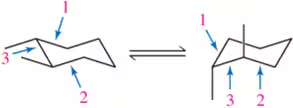
For each pair of conformations shown, choose which is most stable. If both are equally stable, then write 'no difference.' [If both conformations have the same number of axial substituents, choose the one with the smallest axial substituents.]
(g)

Mullins 1st Edition
Ch. 3 - Alkanes and Cycloalkanes: Properties and Conformational Analysis
Problem 61b
Verified step by step guidance
For each pair of conformations shown, choose which is most stable. If both are equally stable, then write 'no difference.' [If both conformations have the same number of axial substituents, choose the one with the smallest axial substituents.]
(g)
For each structure shown, draw the two chair conformations and choose which is most stable. Be sure that your second chair is the flipped version of the first. [Make sure that wedged substituents are up in the chair, regardless of whether up is equatorial or axial.]
(g)
In contrast to ethane and other alkanes studied in this chapter, there is no free rotation around any bonds in cyclopentane (shown below). Why?
Looking ahead In Chapter 5, we explain that the equilibrium constant (Keq) for a reaction can be calculated based on the difference in energy between reactants and products, according to the following equation:
Using this equation, calculate the equilibrium constant for the 'reaction' shown. [For the rest of the book, if not otherwise specified, assume room temperature (298K).]
For each structure shown, draw the two chair conformations and choose which is most stable. Be sure that your second chair is the flipped version of the first. [Make sure that wedged substituents are up in the chair, regardless of whether up is equatorial or axial.]
(e)
The normal C(sp3)–C(sp3) bond length is 1.54 Å. The normal bond angle for an sp3-hybridized carbon is 109.5°. The following molecule experiences large deviations from these normal values. Explain these deviations. [Molecular models would be helpful here.]