Acetylide ions also add to ethylene oxide much like Grignard and organolithium reagents. Predict the products obtained by adding the following acetylide ions to ethylene oxide, followed by a dilute acid workup. (a) HC≡C:– (b) CH3CH2–C≡C:–
Verified step by step guidance
1
Step 1: Understand the reaction mechanism. Acetylide ions are strong nucleophiles that attack the electrophilic carbon in ethylene oxide, opening the three-membered ring. This results in the formation of an alkoxide intermediate.
Step 2: Analyze the acetylide ions provided. In part (a), the acetylide ion is HC≡C⁻, and in part (b), the acetylide ion is CH₃CH₂C≡C⁻. These ions will act as nucleophiles in the reaction.
Step 3: Predict the intermediate formed after the nucleophilic attack. The acetylide ion attacks the less sterically hindered carbon of ethylene oxide, breaking the ring and forming a linear alkoxide intermediate. For part (a), the intermediate will have a terminal alkyne group, and for part (b), the intermediate will have a substituted alkyne group.
Step 4: Perform the acid workup. The alkoxide intermediate is protonated by dilute acid, converting it into an alcohol. The alcohol will be located on the carbon adjacent to the alkyne group.
Step 5: Write the general product structure. For part (a), the product will be HC≡C-CH₂CH₂OH. For part (b), the product will be CH₃CH₂C≡C-CH₂CH₂OH. These products are formed after the acid workup step.
Verified video answer for a similar problem:
This video solution was recommended by our tutors as helpful for the problem above
Video duration:
5m
Play a video:
0 Comments
Key Concepts
Here are the essential concepts you must grasp in order to answer the question correctly.
Acetylide Ions
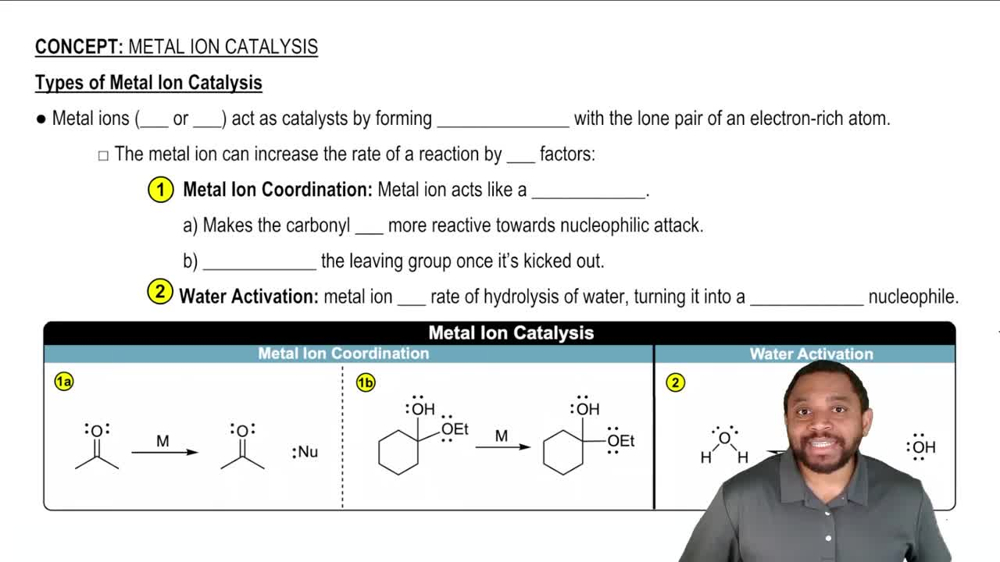
Acetylide ions are negatively charged species formed from terminal alkynes by deprotonation. They are strong nucleophiles, capable of attacking electrophilic centers, such as carbon atoms in epoxides. In this context, acetylide ions react with ethylene oxide to open the epoxide ring, leading to the formation of alcohols after subsequent acid workup.
Ethylene oxide is a three-membered cyclic ether that is highly reactive due to its strained ring structure. It can undergo nucleophilic attack at the less hindered carbon atom, leading to ring opening. This property makes it a suitable substrate for reactions with nucleophiles like acetylide ions, resulting in the formation of alcohols after hydrolysis.
A dilute acid workup is a common procedure in organic synthesis used to protonate and stabilize reaction products. After the nucleophilic addition of acetylide ions to ethylene oxide, the dilute acid helps to convert the alkoxide intermediate into the corresponding alcohol. This step is crucial for ensuring that the final product is in its stable, protonated form.