Show how you would synthesize the following alcohol by adding Grignard reagents to ethylene oxide. (a) 2-phenylethanol
Verified step by step guidance
1
Step 1: Understand the reaction mechanism. Grignard reagents are organomagnesium compounds (R-MgX) that act as nucleophiles. They attack electrophilic centers, such as the carbon in ethylene oxide, to form new carbon-carbon bonds.
Step 2: Identify the Grignard reagent needed. To synthesize 2-phenylethanol, the Grignard reagent should contain a phenyl group (C₆H₅). Therefore, the Grignard reagent to use is phenylmagnesium bromide (C₆H₅-MgBr).
Step 3: React the Grignard reagent with ethylene oxide. The phenylmagnesium bromide will attack the electrophilic carbon in ethylene oxide, opening the epoxide ring and forming a new bond between the phenyl group and one of the carbons in the ethylene oxide.
Step 4: Perform hydrolysis. After the Grignard reagent reacts with ethylene oxide, the intermediate product is treated with water or dilute acid to protonate the oxygen atom, resulting in the formation of 2-phenylethanol.
Step 5: Verify the product structure. The final product should have a phenyl group attached to a two-carbon chain ending in an alcohol group (-OH), which matches the structure of 2-phenylethanol.
Verified video answer for a similar problem:
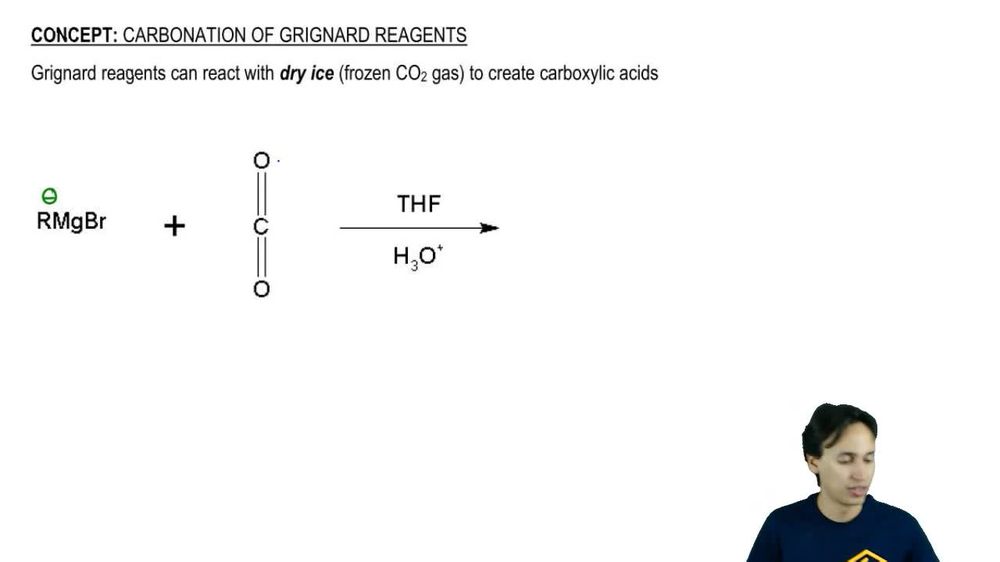
This video solution was recommended by our tutors as helpful for the problem above
Video duration:
5m
Play a video:
0 Comments
Key Concepts
Here are the essential concepts you must grasp in order to answer the question correctly.
Grignard Reagents
Grignard reagents are organomagnesium compounds represented as R-MgX, where R is an organic group and X is a halogen. They are highly reactive and serve as nucleophiles in organic synthesis, allowing for the formation of carbon-carbon bonds. When reacted with electrophiles, such as carbonyl compounds or epoxides, they can lead to the formation of alcohols, making them essential in synthetic organic chemistry.
Ethylene oxide is a three-membered cyclic ether that is highly reactive due to its strained ring structure. It can undergo nucleophilic attack, making it a useful substrate for Grignard reagents. When a Grignard reagent attacks ethylene oxide, it opens the epoxide ring, leading to the formation of an alcohol after subsequent protonation, which is crucial for synthesizing specific alcohols like 2-phenylethanol.
The synthesis of alcohols often involves the addition of nucleophiles to electrophiles. In this case, the nucleophilic Grignard reagent adds to the electrophilic carbon of the ethylene oxide, resulting in the formation of a new carbon-carbon bond. This process is fundamental in organic chemistry, as it allows for the construction of complex molecules and the introduction of functional groups, such as hydroxyl groups in alcohols.