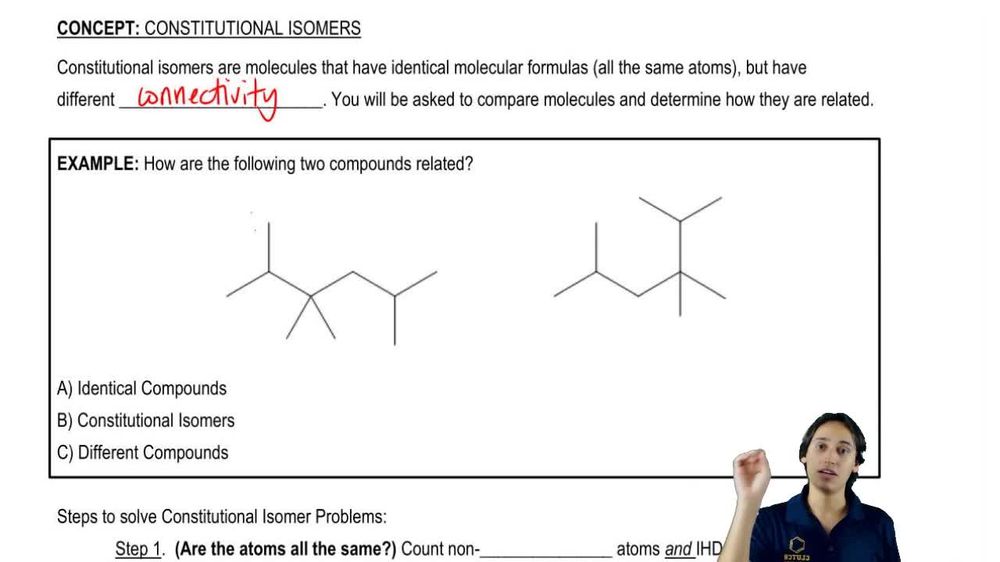
The following compounds have the same molecular formula as benzene. How many monobrominated products could each form? 1. HC≡CC≡CCH2CH3 2. CH2=CHC≡CCH=CH2
Verified step by step guidance
1
Step 1: Analyze the molecular formula of benzene (C6H6) and confirm that the given compounds have the same molecular formula. Both compounds are unsaturated hydrocarbons with six carbons and six hydrogens.
Step 2: For compound 1 (HC≡CC≡CCH2CH3), identify the structure. This is a linear alkyne with two triple bonds and an ethyl group (-CH2CH3) attached. Determine the number of unique positions where bromine can be added to form monobrominated products. Consider symmetry and equivalent positions.
Step 3: For compound 2 (CH2=CHC≡CCH=CH2), identify the structure. This is a conjugated system with two double bonds and one triple bond. Determine the number of unique positions where bromine can be added to form monobrominated products. Again, consider symmetry and equivalent positions.
Step 4: Use the concept of regioselectivity to evaluate how bromine can add to each compound. Bromine typically reacts with unsaturated bonds (double or triple bonds) via electrophilic addition. For each compound, identify the specific carbon atoms involved in the unsaturated bonds and assess their uniqueness.
Step 5: Count the number of unique monobrominated products for each compound based on the analysis of symmetry and regioselectivity. Ensure that equivalent positions are not double-counted.
Verified video answer for a similar problem:
This video solution was recommended by our tutors as helpful for the problem above
Video duration:
7m
Play a video:
0 Comments
Key Concepts
Here are the essential concepts you must grasp in order to answer the question correctly.
Monobromination
Monobromination refers to the substitution reaction where one bromine atom replaces a hydrogen atom in an organic compound. In the context of aromatic compounds like benzene, this reaction typically occurs at the carbon atoms of the ring. Understanding the regioselectivity of this reaction is crucial, as it determines the position of the bromine substitution and the number of distinct products formed.
Alkyne and Alkene Reactivity
Alkynes and alkenes are unsaturated hydrocarbons that contain triple and double bonds, respectively. Their reactivity differs significantly from that of aromatic compounds. In the given question, the presence of these multiple bonds in the compounds suggests potential sites for bromination, which can lead to different monobrominated products depending on the structure and position of the double or triple bonds.
Structural isomers are compounds that have the same molecular formula but differ in the arrangement of atoms. In the context of the question, the compounds provided can yield multiple monobrominated products due to the possibility of forming different structural isomers. Recognizing how the position of bromination affects the overall structure is essential for determining the total number of unique products.

 7:22 minutes
 Verified step by step guidance
 01:55
01:55