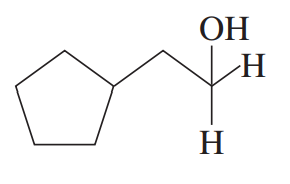
Show how this 1° alcohol can be made from the following: (b) formaldehyde
Verified step by step guidance
1
Step 1: Recognize that the target molecule is a primary alcohol (1° alcohol) with a hydroxyl group (-OH) attached to a carbon that is bonded to only one other carbon atom.
Step 2: Formaldehyde (HCHO) can act as a starting material for the synthesis of primary alcohols through nucleophilic addition reactions. Identify the need for a Grignard reagent to introduce the desired carbon chain.
Step 3: Prepare the Grignard reagent by reacting an alkyl halide (e.g., cyclobutyl bromide or cyclopentyl bromide) with magnesium in dry ether to form cyclobutyl magnesium bromide or cyclopentyl magnesium bromide.
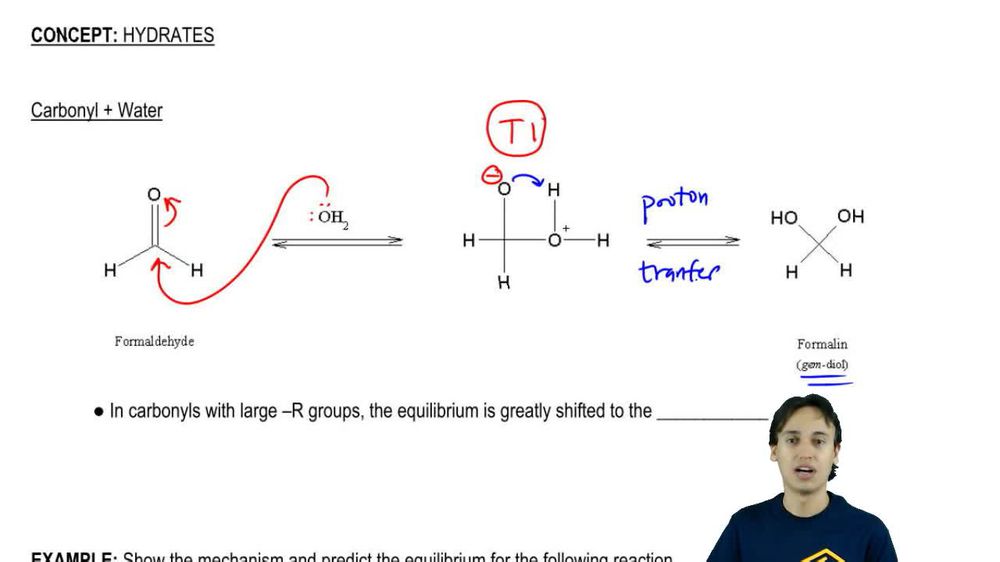
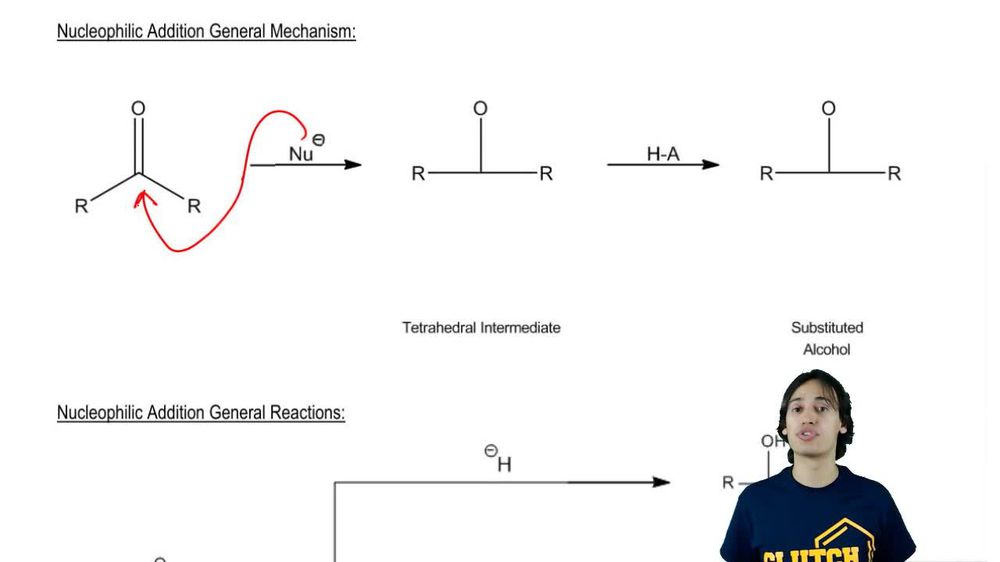
Step 4: React the Grignard reagent with formaldehyde in an anhydrous environment. The nucleophilic carbon of the Grignard reagent attacks the electrophilic carbonyl carbon of formaldehyde, forming a new C-C bond and resulting in an alkoxide intermediate.
Step 5: Perform an acid workup (e.g., using dilute HCl or H2O) to protonate the alkoxide intermediate, yielding the desired primary alcohol.
Verified video answer for a similar problem:
This video solution was recommended by our tutors as helpful for the problem above
Video duration:
3m
Play a video:
0 Comments
Key Concepts
Here are the essential concepts you must grasp in order to answer the question correctly.
1° Alcohols
Primary (1°) alcohols are organic compounds where the hydroxyl (-OH) group is attached to a carbon atom that is connected to only one other carbon atom. This structure influences their reactivity and properties, making them more susceptible to oxidation compared to secondary or tertiary alcohols.
Formaldehyde (HCHO) is a simple aldehyde that can be used in organic synthesis to produce alcohols. In the presence of a suitable reducing agent, formaldehyde can react with Grignard reagents or organolithium compounds to yield primary alcohols, making it a key starting material in alcohol synthesis.
Nucleophilic addition reactions are fundamental in organic chemistry, where a nucleophile attacks an electrophilic carbon atom, leading to the formation of new bonds. In the context of synthesizing alcohols from aldehydes, the nucleophile (like a Grignard reagent) adds to the carbonyl carbon of formaldehyde, resulting in the formation of a primary alcohol after subsequent protonation.