Every number in Pascal’s triangle is the sum of the two numbers above it. Given this, fill in the missing numbers.
Verified step by step guidance
1
Identify the pattern in Pascal's triangle: each number is the sum of the two numbers directly above it.
To find the value of (a), add the two numbers above it: 1 and 2. So, (a) = 1 + 2.
To find the value of (b), add the two numbers above it: 3 and (a). So, (b) = 3 + (a).
To find the value of (c), add the two numbers above it: (a) and 1. So, (c) = (a) + 1.
To find the value of (d), add the two numbers above it: 1 and 4. So, (d) = 1 + 4. To find the value of (e), add the two numbers above it: 10 and 5. So, (e) = 10 + 5.
Verified video answer for a similar problem:
This video solution was recommended by our tutors as helpful for the problem above
Video duration:
2m
Play a video:
0 Comments
Key Concepts
Here are the essential concepts you must grasp in order to answer the question correctly.
Pascal's Triangle
Pascal's Triangle is a triangular array of binomial coefficients, where each number is the sum of the two directly above it. The triangle starts with a '1' at the top, and each subsequent row corresponds to the coefficients of the binomial expansion. Understanding its structure is essential for solving problems related to combinatorics and algebra.
Binomial coefficients are the numbers that appear in Pascal's Triangle and represent the coefficients in the expansion of a binomial expression (a + b)^n. They are denoted as C(n, k) or 'n choose k', indicating the number of ways to choose k elements from a set of n elements. This concept is crucial for understanding the relationships between the numbers in the triangle.
Breaking down the different terms of the Gibbs Free Energy equation.
Recursion in Mathematics
Recursion in mathematics refers to defining a sequence or function in terms of itself. In the context of Pascal's Triangle, each entry can be calculated using the recursive formula: C(n, k) = C(n-1, k-1) + C(n-1, k). This principle allows for the systematic filling of the triangle and is fundamental for solving problems that involve patterns and sequences.

 2:55 minutes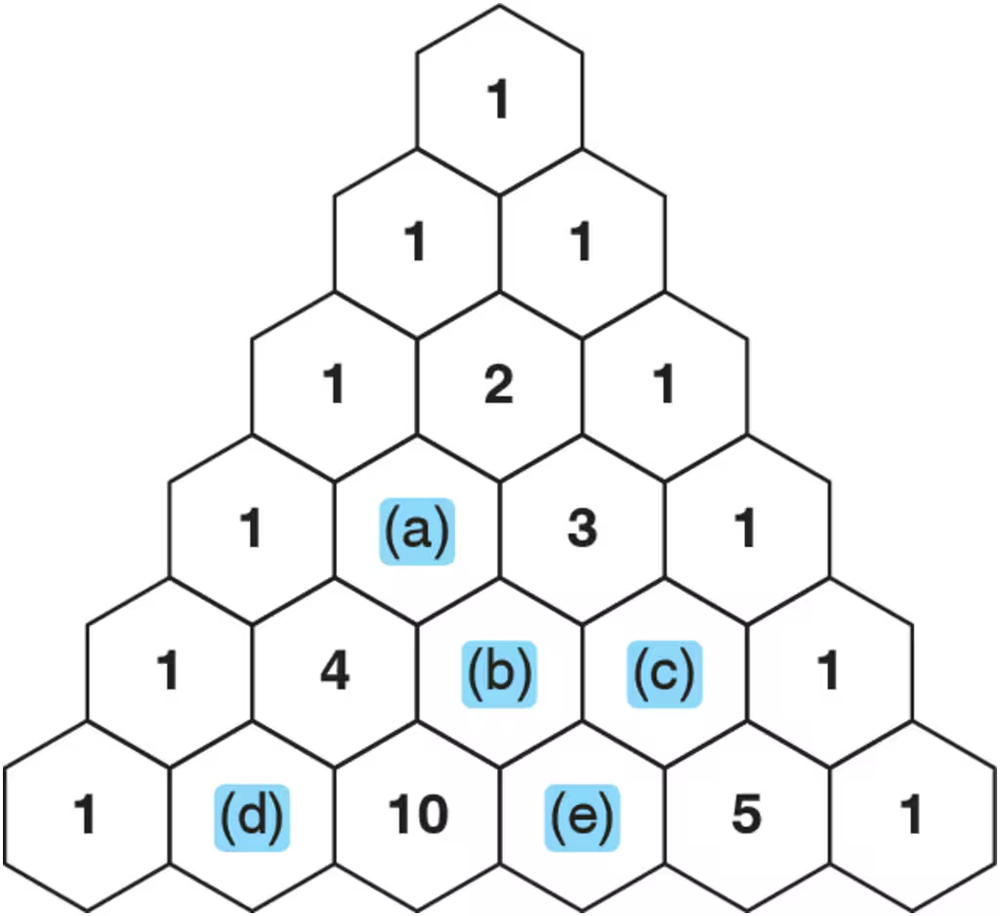
 Verified step by step guidance
 11:03
11:03