Though Figure 15.34 was concerned with the appearance of Ha, how would Hb appear in the spectrum?
Verified step by step guidance
1
Identify the molecule in question and locate the hydrogen atom labeled as H₆. This will help in understanding its chemical environment.
Determine the electronic environment around H₆. Consider factors such as the presence of electronegative atoms, pi bonds, or aromatic rings that might influence the chemical shift.
Consider the splitting pattern of H₆. Analyze the number of neighboring hydrogen atoms (n) using the n+1 rule to predict the multiplicity of the signal.
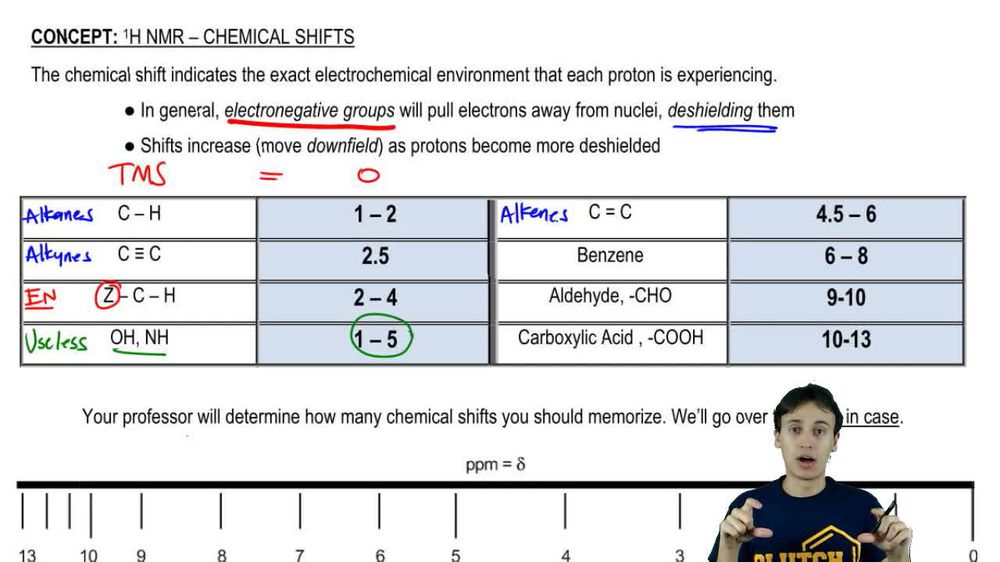
Estimate the chemical shift range for H₆ based on its environment. Use known chemical shift ranges for different types of hydrogen environments (e.g., alkane, alkene, aromatic) as a reference.
Consider any coupling constants that might affect the appearance of H₆ in the spectrum. This includes analyzing the coupling with nearby hydrogen atoms and how it might affect the signal's appearance.
Verified video answer for a similar problem:
This video solution was recommended by our tutors as helpful for the problem above
Video duration:
3m
Play a video:
0 Comments
Key Concepts
Here are the essential concepts you must grasp in order to answer the question correctly.
NMR Spectroscopy
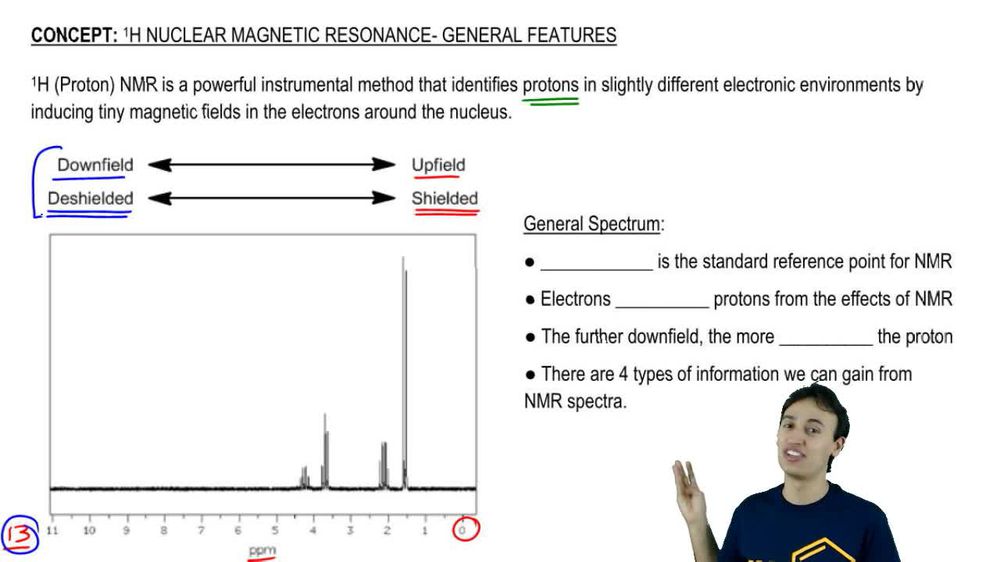
Nuclear Magnetic Resonance (NMR) Spectroscopy is a technique used to determine the structure of organic compounds by observing the magnetic properties of atomic nuclei. In the context of the question, understanding how different hydrogen atoms (like Hₐ and H₆) appear in the spectrum is crucial for interpreting molecular structure.
Chemical shift refers to the variation in the resonance frequency of a nucleus due to its electronic environment. In NMR spectroscopy, different hydrogen atoms in a molecule will have different chemical shifts, which helps in identifying their positions and environments within the molecule.
Spin-spin coupling is the interaction between nuclear spins that leads to splitting of NMR signals into multiple peaks. This phenomenon provides information about the number of neighboring hydrogen atoms and their arrangement, which is essential for understanding how H₆ would appear in the spectrum.

 3:40 minutes
 Verified step by step guidance
 10:06
10:06