a. Propose a mechanism for the following reaction (show all curved arrows):
Verified step by step guidance
1
Step 1: Protonation of the alcohol group - The sulfuric acid (H₂SO₄) acts as a strong acid and donates a proton (H⁺) to the hydroxyl group (-OH) of ethanol, forming a protonated alcohol (CH₃CH₂OH₂⁺). This step increases the electrophilicity of the alcohol, making it a better leaving group.
Step 2: Formation of the carbocation - The protonated alcohol undergoes elimination of water (H₂O), leaving behind a carbocation intermediate. This carbocation is formed on the carbon attached to the hydroxyl group.
Step 3: Electrophilic addition of the alkene - The alkene (2-methyl-2-butene) acts as a nucleophile and attacks the carbocation, forming a new bond between the carbocation and one of the carbons in the double bond of the alkene. This step generates a new intermediate.
Step 4: Rearrangement and stabilization - If necessary, the intermediate may undergo rearrangement to form a more stable carbocation. This is common in reactions involving carbocations, as they tend to stabilize through hydride or alkyl shifts.
Step 5: Deprotonation to form the final product - A base (often the bisulfate ion, HSO₄⁻, from the sulfuric acid) removes a proton from the intermediate, leading to the formation of the ether product. The final product is an ether with the alkyl group from the alcohol and the alkene combined.
Verified video answer for a similar problem:
This video solution was recommended by our tutors as helpful for the problem above
Video duration:
3m
Play a video:
0 Comments
Key Concepts
Here are the essential concepts you must grasp in order to answer the question correctly.
Acid-Catalyzed Reactions
Acid-catalyzed reactions involve the use of an acid to increase the rate of a chemical reaction. In this context, sulfuric acid (H2SO4) acts as a catalyst, protonating the alcohol to enhance its electrophilicity. This step is crucial for facilitating the nucleophilic attack by the alkene, leading to ether formation.
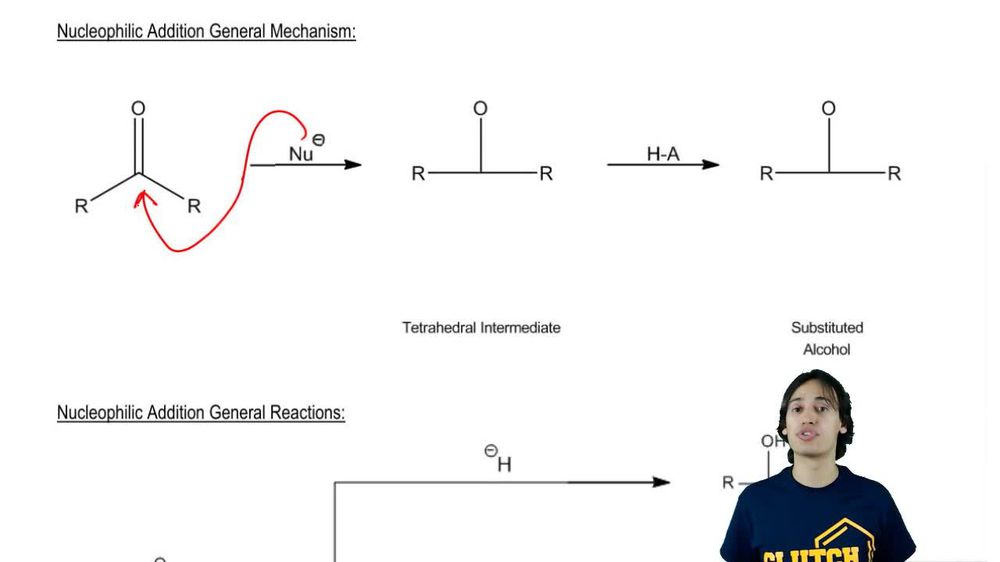
Nucleophilic attack is a fundamental concept in organic chemistry where a nucleophile, a species with a high electron density, attacks an electrophile, a species with a low electron density. In this reaction, the alkene acts as a nucleophile, attacking the protonated alcohol, which is now a better electrophile due to protonation, resulting in the formation of an ether.
Curved arrows are used in organic chemistry to illustrate the movement of electrons during chemical reactions. They indicate the flow of electron pairs from nucleophiles to electrophiles or from bonds to atoms. Accurately depicting these arrows is essential for understanding the mechanism of the reaction, as they show how bonds are formed and broken throughout the process.

 3:57 minutes
 Verified step by step guidance
 03:09
03:09