Ch. 9 - Substitution and Elimination Reactions of Alkyl Halides
Bruice - Organic Chemistry 8th Edition
Bruice8th EditionOrganic ChemistryISBN: 9780135213711Not the one you use?Change textbook
Chapter 10, Problem 130

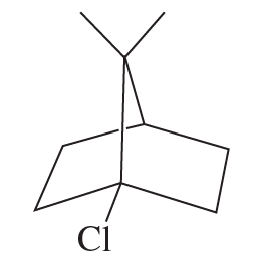
Explain why the following alkyl halide does not undergo a substitution reaction, regardless of the base that is used.
Skeletal structure of an alkyl halide with a chlorine atom, illustrating its inability to undergo substitution reactions.

Verified step by step guidance
1
Analyze the structure of the alkyl halide provided in the image. The molecule contains a bromine atom attached to a highly sterically hindered carbon center, which is part of a bicyclic system.
Understand the mechanism of substitution reactions. Substitution reactions, such as SN1 and SN2, require either the formation of a carbocation intermediate (SN1) or direct attack by a nucleophile (SN2). Both mechanisms are affected by steric hindrance and the stability of intermediates.
For an SN1 reaction, the bromine would need to leave, forming a carbocation. However, the carbon attached to bromine is part of a rigid bicyclic structure, making carbocation formation highly unstable due to strain and steric hindrance. This prevents the SN1 pathway.
For an SN2 reaction, the nucleophile would need to directly attack the carbon bonded to bromine. The bulky bicyclic structure creates significant steric hindrance, blocking the nucleophile from accessing the carbon atom. This prevents the SN2 pathway.
Conclude that the combination of steric hindrance and the instability of potential intermediates makes this alkyl halide unreactive in substitution reactions, regardless of the base or nucleophile used.

Verified video answer for a similar problem:

This video solution was recommended by our tutors as helpful for the problem above.
Video duration:
5m
Was this helpful?

Key Concepts

Here are the essential concepts you must grasp in order to answer the question correctly.

Steric Hindrance

Steric hindrance refers to the prevention of chemical reactions due to the spatial arrangement of atoms within a molecule. In bulky alkyl halides, such as the one shown, the presence of large groups around the reactive site can obstruct the approach of nucleophiles, making substitution reactions less favorable or impossible.
Recommended video:
Guided course
02:53
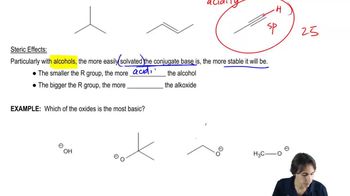
Understanding steric effects.

Substitution Mechanisms (SN1 and SN2)

Substitution reactions can occur via two primary mechanisms: SN1 and SN2. SN1 reactions involve a two-step process where the leaving group departs first, forming a carbocation, while SN2 reactions involve a single concerted step where the nucleophile attacks the substrate as the leaving group departs. The structure of the alkyl halide influences which mechanism is favored; in this case, steric hindrance may prevent both mechanisms from occurring.
Recommended video:
Guided course
03:32
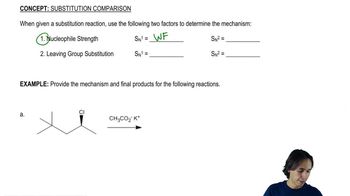
How do we predict if the mechanism is SN1 or SN2?

Carbocation Stability

Carbocation stability is crucial in determining the feasibility of substitution reactions. Tertiary carbocations are more stable than secondary or primary ones due to hyperconjugation and inductive effects from surrounding alkyl groups. If the alkyl halide cannot form a stable carbocation due to steric hindrance, it will not undergo substitution, regardless of the base used.
Recommended video:
Guided course
05:58
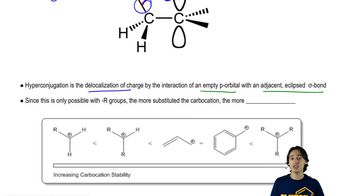
Determining Carbocation Stability