When pent-2-yne reacts with mercuric sulfate in dilute sulfuric acid, the product is a mixture of two ketones. Give the structures of these products, and use mechanisms to show how they are formed.
Verified step by step guidance
1
Step 1: Recognize the reaction type. This is a hydration reaction of an alkyne in the presence of mercuric sulfate (HgSO₄) and dilute sulfuric acid (H₂SO₄). The reaction follows Markovnikov's rule and proceeds via the formation of an enol intermediate, which tautomerizes to a ketone.
Step 2: Identify the starting material. Pent-2-yne is a symmetrical internal alkyne with the triple bond located between carbons 2 and 3. This symmetry will lead to the formation of two possible ketones due to the tautomerization of the enol intermediates.
Step 3: Describe the mechanism. The reaction begins with the electrophilic addition of H⁺ (from H₂SO₄) to one of the carbons in the triple bond, forming a carbocation. The triple bond electrons attack the proton, and the positive charge is stabilized by the adjacent carbon.
Step 4: Explain the role of water and Hg²⁺. Water (H₂O) acts as a nucleophile and attacks the carbocation, forming an enol intermediate. The enol is unstable and undergoes keto-enol tautomerization, where the hydroxyl group (-OH) is converted into a carbonyl group (C=O), resulting in a ketone. This process occurs for both possible enol intermediates, leading to two ketone products.
Step 5: Draw the structures of the products. The two ketones formed are 2-pentanone and 3-pentanone. These result from the tautomerization of the enol intermediates formed at carbons 2 and 3 of pent-2-yne. Ensure to visualize the structures to confirm the placement of the carbonyl groups.
Verified video answer for a similar problem:
This video solution was recommended by our tutors as helpful for the problem above
Video duration:
14m
Play a video:
0 Comments
Key Concepts
Here are the essential concepts you must grasp in order to answer the question correctly.
Alkyne Hydration
Alkyne hydration is a chemical reaction where an alkyne reacts with water in the presence of an acid catalyst to form an alcohol. In the case of terminal alkynes, this reaction typically leads to the formation of a ketone or aldehyde, depending on the position of the triple bond. The reaction involves the addition of water across the triple bond, followed by tautomerization to yield the final carbonyl compound.
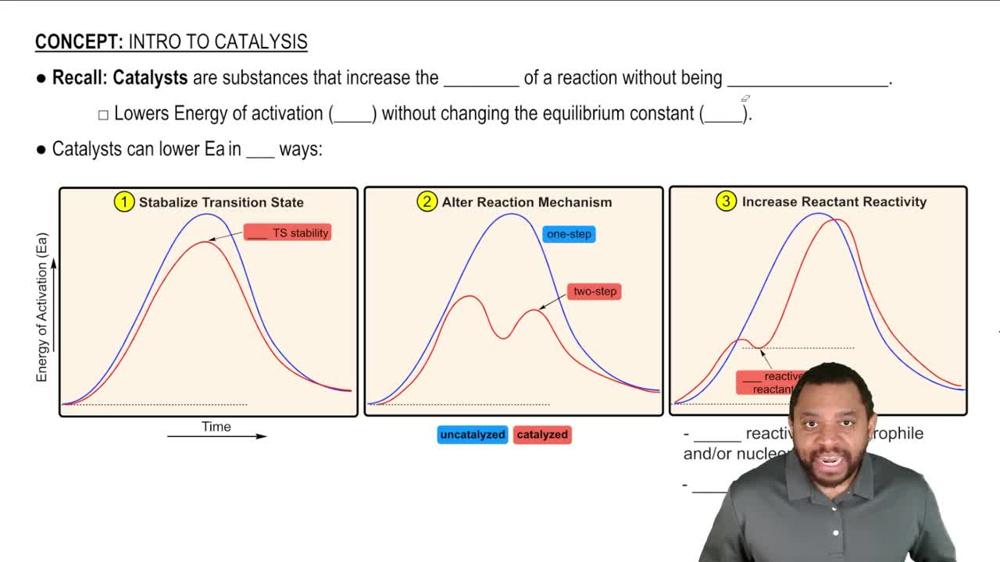
Mercuric sulfate (HgSO4) acts as a catalyst in the hydration of alkynes, facilitating the addition of water to the alkyne. It forms a mercuric enol intermediate, which is crucial for the reaction pathway. This catalyst helps stabilize the transition state and promotes the formation of the more stable ketone product through subsequent rearrangement.
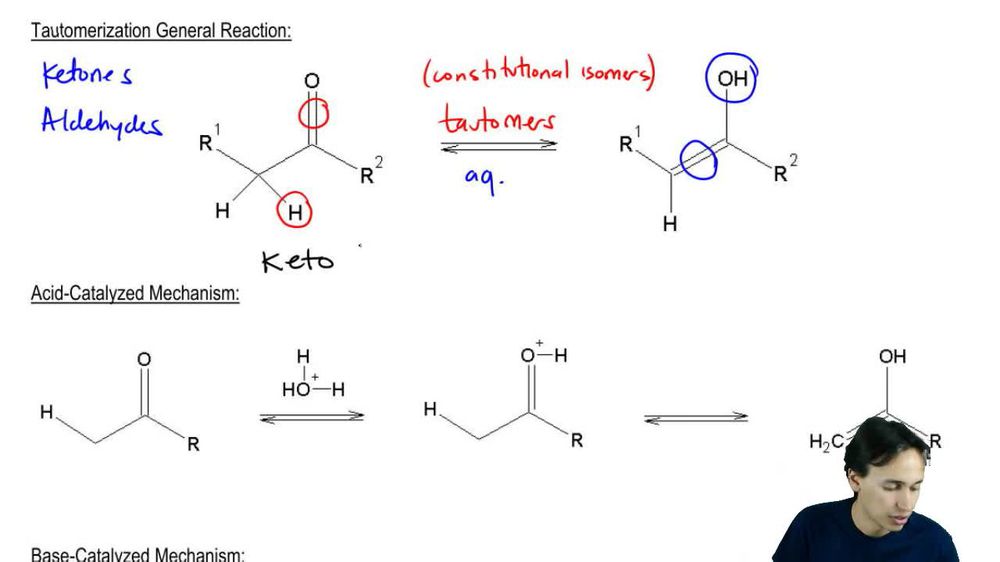
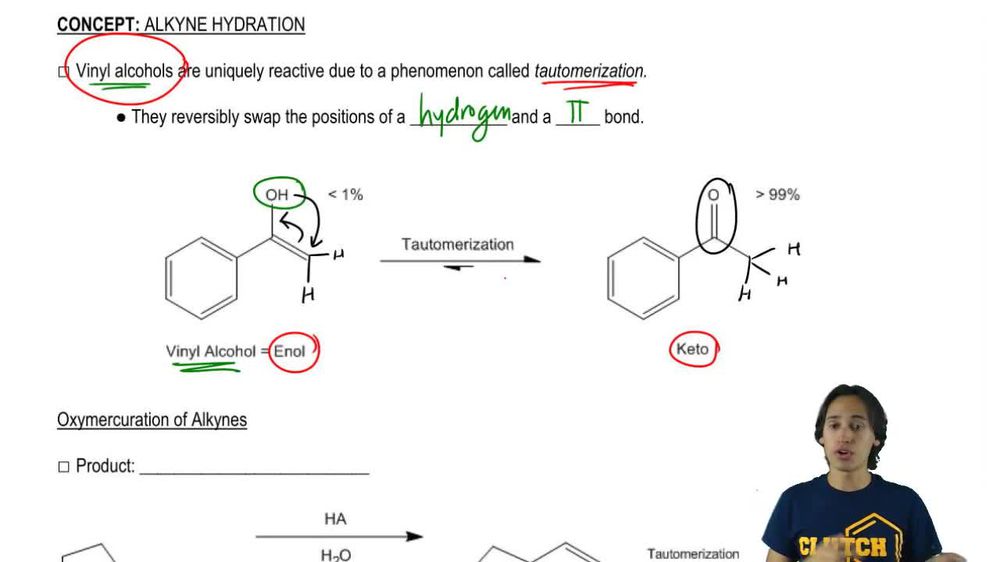
Tautomerization is a chemical process where a compound exists in two interconvertible forms, typically involving the migration of a hydrogen atom and a shift in the double bond. In the context of alkyne hydration, the enol form produced initially can rearrange to form a more stable ketone. This process is essential for understanding the final products of the reaction, as it explains the formation of the two distinct ketones from pent-2-yne.

 14:20 minutes
 Verified step by step guidance
 09:11
09:11