Show how each of the following compounds can be prepared using the given starting material, any needed inorganic reagents, and any organic compound that has no more than four carbons: e.
Verified step by step guidance
1
Step 1: Analyze the starting material and the target compound. The starting material is cyclohexylacetylene (cyclohexane with a terminal alkyne group), and the target compound is cyclohexyl methyl ketone (cyclohexane with a methyl ketone group). This transformation involves converting the terminal alkyne into a methyl ketone.
Step 2: Recognize the reaction type. The conversion of a terminal alkyne to a methyl ketone can be achieved through hydration of the alkyne followed by tautomerization. This reaction typically uses a catalyst such as HgSO₄ (mercuric sulfate) in the presence of H₂SO₄ (sulfuric acid) and water.
Step 3: Write the reaction mechanism. The terminal alkyne undergoes electrophilic addition of water in the presence of the Hg²⁺ catalyst. This forms an enol intermediate (a compound with a hydroxyl group attached to a double-bonded carbon). The enol then tautomerizes to form the ketone.
Step 4: Specify the reagents. To perform this reaction, use HgSO₄, H₂SO₄, and H₂O. These reagents facilitate the hydration of the alkyne and the subsequent tautomerization to yield the methyl ketone.
Step 5: Confirm the carbon count. Since the target compound has a methyl group (one carbon) added to the cyclohexane ring, the reaction adheres to the restriction of using organic compounds with no more than four carbons.
Verified video answer for a similar problem:
This video solution was recommended by our tutors as helpful for the problem above
Video duration:
2m
Play a video:
0 Comments
Key Concepts
Here are the essential concepts you must grasp in order to answer the question correctly.
Functional Groups
Functional groups are specific groups of atoms within molecules that are responsible for the characteristic chemical reactions of those molecules. Understanding the functional groups present in both the starting materials and the target compounds is essential for predicting the types of reactions that can occur and for designing synthetic pathways.
Reaction mechanisms describe the step-by-step sequence of elementary reactions by which overall chemical change occurs. Familiarity with common mechanisms, such as nucleophilic substitution or elimination reactions, is crucial for determining how to convert starting materials into desired products effectively.
The choice of reagents and reaction conditions (such as temperature, solvent, and pressure) significantly influences the outcome of a chemical reaction. Knowing which inorganic reagents and organic compounds can be used, along with the appropriate conditions, is vital for successfully synthesizing the target compounds from the given starting materials.

 2:43 minutes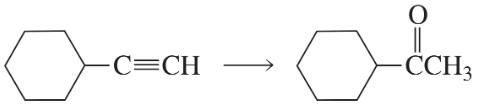
 Verified step by step guidance
 02:36
02:36