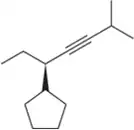
Name the following alkynes according to the IUPAC rules of nomenclature. (b)
Verified step by step guidance
1
Step 1: Identify the longest continuous carbon chain that includes the triple bond. This will serve as the parent chain. In this case, the longest chain containing the triple bond has 6 carbons.
Step 2: Number the parent chain starting from the end closest to the triple bond to ensure the lowest possible number for the triple bond. The triple bond starts at carbon 2.
Step 3: Identify and name the substituents attached to the parent chain. Here, there is a cyclopentyl group attached to carbon 3 and a methyl group attached to carbon 5.
Step 4: Combine the names of the substituents with the parent chain name. Use the appropriate locants (numbers) to indicate the positions of the substituents and the triple bond. The parent chain name is 'hex-2-yne' because of the triple bond starting at carbon 2.
Step 5: Write the full IUPAC name by listing the substituents in alphabetical order, followed by the parent chain name. Ensure proper punctuation and formatting, such as using hyphens to separate numbers and names.
Verified video answer for a similar problem:
This video solution was recommended by our tutors as helpful for the problem above
Play a video:
0 Comments
Key Concepts
Here are the essential concepts you must grasp in order to answer the question correctly.
IUPAC Nomenclature
The International Union of Pure and Applied Chemistry (IUPAC) nomenclature provides a systematic method for naming organic compounds. It involves identifying the longest carbon chain, determining the type of functional groups present, and assigning locants to indicate the position of these groups. For alkynes, which contain at least one carbon-carbon triple bond, the suffix '-yne' is used, and the chain is numbered to give the triple bond the lowest possible number.
Alkynes are a class of hydrocarbons characterized by the presence of one or more carbon-carbon triple bonds. They follow the general formula CnH2n-2, where 'n' is the number of carbon atoms. Alkynes can be linear or branched and are typically less stable than alkenes and alkanes due to the high energy of the triple bond. Understanding the structure and reactivity of alkynes is essential for proper nomenclature and chemical behavior.
Functional groups are specific groups of atoms within molecules that are responsible for the characteristic chemical reactions of those molecules. In the context of alkynes, the triple bond itself acts as a functional group, influencing the compound's reactivity and properties. Recognizing functional groups is crucial for naming compounds accurately, as they dictate the suffix and sometimes the prefix used in IUPAC nomenclature.

 Verified step by step guidance
 03:43
03:43