Complete the structure of each of these so that it matches the (R) or (S) configuration associated with the name. (d)
Verified step by step guidance
1
Analyze the structure of suvorexant provided in the image. Identify the stereocenter marked with the (R) configuration.
Recall the Cahn-Ingold-Prelog priority rules to assign priorities to the substituents attached to the stereocenter. Assign priorities based on atomic number and connectivity.
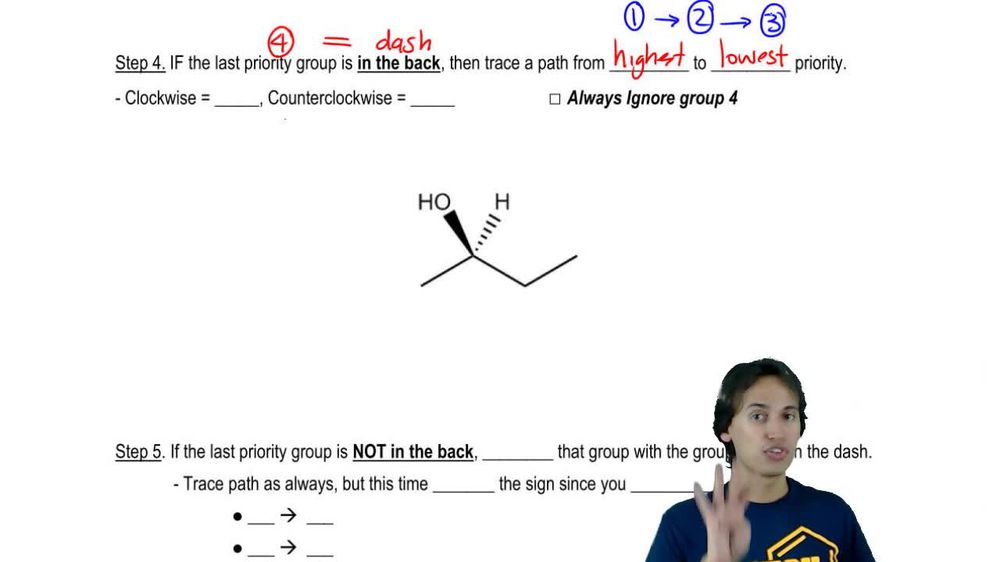
Orient the molecule so that the lowest priority group is pointing away from you (into the plane of the paper). This is typically represented as a dashed bond.
Determine the order of the remaining three substituents (1, 2, 3) around the stereocenter. If the sequence is clockwise, the configuration is (R); if counterclockwise, it is (S).
Adjust the substituents or bonds in the structure to ensure the stereocenter matches the (R) configuration as specified in the problem.
Verified video answer for a similar problem:
This video solution was recommended by our tutors as helpful for the problem above
Video duration:
5m
Play a video:
0 Comments
Key Concepts
Here are the essential concepts you must grasp in order to answer the question correctly.
Chirality
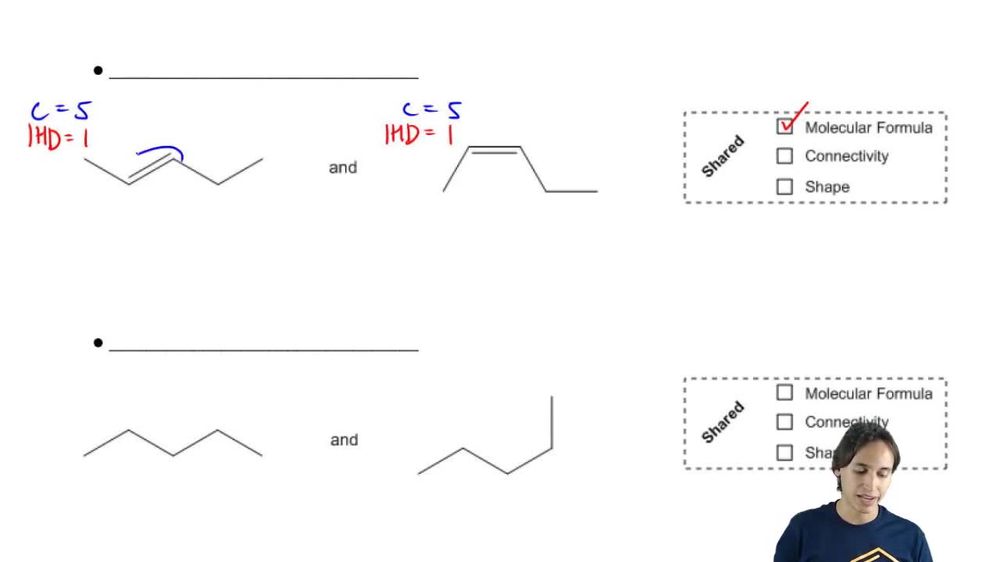
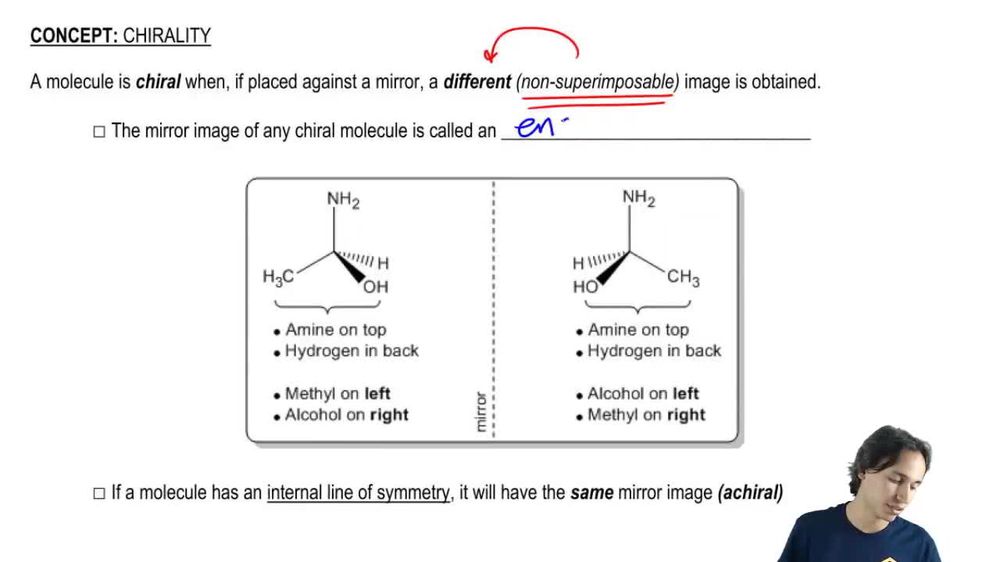
Chirality refers to the geometric property of a molecule that makes it non-superimposable on its mirror image. Molecules that possess chirality have at least one chiral center, typically a carbon atom bonded to four different substituents. This property is crucial in organic chemistry as chiral molecules can exhibit different biological activities, making it essential to determine their (R) or (S) configurations.
The (R) and (S) designations are used to describe the absolute configuration of chiral centers in a molecule. The Cahn-Ingold-Prelog priority rules are applied to assign priorities to the substituents attached to the chiral carbon. If the sequence of priority decreases in a clockwise direction, the configuration is (R); if it decreases counterclockwise, it is (S). This classification is vital for understanding the stereochemistry of compounds.
Stereoisomerism is a form of isomerism where molecules have the same molecular formula and connectivity but differ in the spatial arrangement of atoms. This includes both geometric isomers (cis/trans) and optical isomers (enantiomers). Understanding stereoisomerism is essential in organic chemistry, particularly in drug design, as different stereoisomers can have vastly different pharmacological effects.

 5:34 minutes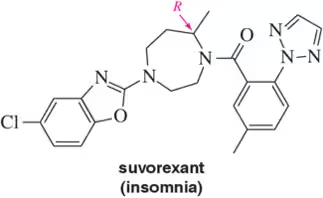
 Verified step by step guidance
 05:10
05:10