Ch. 7 - The Reactions of Alkynes • An Introduction to Multistep Synthesis
Bruice - Organic Chemistry 8th Edition
Bruice8th EditionOrganic ChemistryISBN: 9780135213711Not the one you use?Change textbook
Chapter 8, Problem 21

Which of the following bases can remove a proton from a terminal alkyne in a reaction that favors products?
Chemical structures of five bases: CH3O−, NH3, CH3CH2−, H2C=CH−, and F−, with a focus on proton removal.

Verified step by step guidance
1
Step 1: Understand the acidity of terminal alkynes. Terminal alkynes have a hydrogen atom attached to the sp-hybridized carbon. This hydrogen is relatively acidic compared to hydrogens attached to sp2 or sp3 carbons due to the high s-character of the sp orbital, which stabilizes the negative charge on the conjugate base.
Step 2: Recall the concept of acid-base reactions. For a base to remove a proton from a terminal alkyne in a reaction that favors products, the base must be strong enough to deprotonate the alkyne. The reaction will favor products if the conjugate acid of the base is weaker (less acidic) than the terminal alkyne.
Step 3: Compare the pKa values. Terminal alkynes typically have a pKa of around 25. Bases with conjugate acids having pKa values higher than 25 are strong enough to deprotonate terminal alkynes. For example, CH3O− (methoxide) has a conjugate acid (CH3OH) with a pKa of ~16, making it too weak to favor the reaction. NH3 (ammonia) has a conjugate acid (NH4+) with a pKa of ~9, also too weak.
Step 4: Evaluate the bases provided. CH3CH2− (ethyl anion) has a conjugate acid (ethane) with a pKa of ~50, making it strong enough to deprotonate a terminal alkyne. HC≡C− (acetylide ion) has a conjugate acid (acetylene) with a pKa of ~25, which is comparable to the terminal alkyne, so it can also deprotonate the alkyne. F− (fluoride ion) has a conjugate acid (HF) with a pKa of ~3, making it too weak.
Step 5: Conclude which bases can deprotonate the terminal alkyne. Based on the analysis, CH3CH2− and HC≡C− are strong enough bases to remove a proton from a terminal alkyne in a reaction that favors products.

Verified video answer for a similar problem:

This video solution was recommended by our tutors as helpful for the problem above.
Video duration:
7m
Was this helpful?

Key Concepts

Here are the essential concepts you must grasp in order to answer the question correctly.

Acidity of Terminal Alkynes

Terminal alkynes, such as HC≡CH, are weak acids due to the presence of a hydrogen atom bonded to a sp-hybridized carbon. The acidity is attributed to the high s-character of the sp orbital, which holds the electrons closer to the nucleus, stabilizing the negative charge on the conjugate base (alkynide ion) formed after deprotonation.
Recommended video:
Guided course
02:43
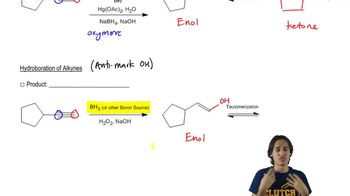
Anti-Markovnikov addition of alcohols to terminal alkynes yields aldehydes

Basicity of Compounds

The ability of a compound to act as a base is determined by its capacity to accept protons (H+). Strong bases, such as CH3O− (methoxide) and CH3CH2− (ethyl), are more effective at deprotonating terminal alkynes compared to weaker bases like NH3 (ammonia) or F− (fluoride), which are less likely to favorably react in this context.
Recommended video:
Guided course
01:40
Defining meso compounds.

Equilibrium and Reaction Favorability

In organic reactions, the position of equilibrium determines whether products or reactants are favored. A reaction that favors products will have a stronger base that can effectively remove a proton from the terminal alkyne, leading to the formation of a more stable alkynide ion. Understanding the relative strengths of acids and bases is crucial for predicting the outcome of such reactions.
Recommended video:
Guided course
04:00
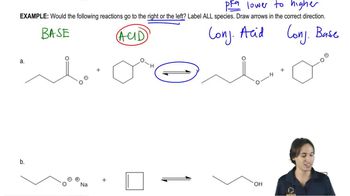
Determining Acid/Base Equilibrium