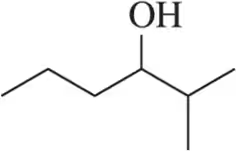
For each of the following molecules, draw one 3-D representation at only the necessary atoms (that is, the ones with four different atoms/groups attached). (a)
Verified step by step guidance
1
Identify the chiral centers in the molecule. A chiral center is a carbon atom that is attached to four different atoms or groups. Look for tetrahedral carbons with four distinct substituents.
Once the chiral centers are identified, assign priorities to the four groups attached to each chiral center based on the Cahn-Ingold-Prelog (CIP) priority rules. These rules prioritize groups based on atomic number, with higher atomic numbers receiving higher priority.
Orient the molecule so that the group with the lowest priority (priority 4) is pointing away from you (into the plane of the paper or screen). This is typically represented with a dashed wedge.
Determine the configuration of the chiral center by tracing a path from priority 1 to priority 2 to priority 3. If the path is clockwise, the configuration is R (rectus). If the path is counterclockwise, the configuration is S (sinister).
Draw the 3-D representation of the molecule, using solid wedges to represent bonds coming out of the plane (toward the viewer) and dashed wedges for bonds going into the plane (away from the viewer). Ensure that the stereochemistry (R or S) is correctly represented for each chiral center.
Verified video answer for a similar problem:
This video solution was recommended by our tutors as helpful for the problem above
Video duration:
1m
Play a video:
0 Comments
Key Concepts
Here are the essential concepts you must grasp in order to answer the question correctly.
Chirality
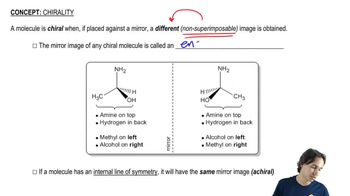
Chirality refers to the geometric property of a molecule that makes it non-superimposable on its mirror image, much like left and right hands. A chiral center, typically a carbon atom, is bonded to four different substituents, leading to two distinct enantiomers. Understanding chirality is crucial for predicting the behavior of molecules in biological systems, as enantiomers can have different effects.
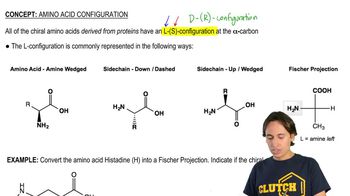
3-D molecular representation involves depicting the spatial arrangement of atoms within a molecule, which is essential for understanding its reactivity and interactions. Techniques such as ball-and-stick models or wedge-dash notation are used to illustrate the three-dimensional structure, highlighting bond angles and the orientation of substituents around chiral centers.
Stereochemistry is the study of the spatial arrangement of atoms in molecules and how this arrangement affects their chemical properties and reactions. It encompasses concepts like chirality, geometric isomerism, and conformational isomerism. A solid grasp of stereochemistry is vital for accurately drawing and interpreting 3-D representations of molecules, especially those with chiral centers.