Draw all possible stereoisomers for each of the following. Indicate those compounds for which no stereoisomers are possible. e. 1-bromo-4-chlorocyclohexane f. 1,2-dimethylcyclopropane
Verified step by step guidance
1
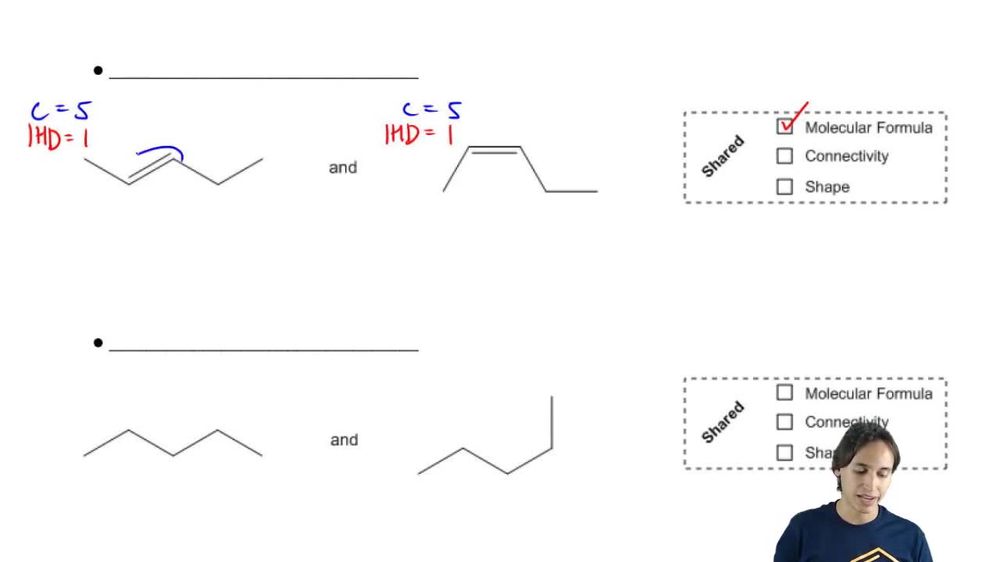
Step 1: Understand the concept of stereoisomers. Stereoisomers are compounds with the same molecular formula and connectivity of atoms but differ in the spatial arrangement of atoms. For cyclic compounds, stereoisomers often arise due to restricted rotation around bonds and the presence of chiral centers or cis/trans (E/Z) isomerism.
Step 2: Analyze 1-bromo-4-chlorocyclohexane. The cyclohexane ring can adopt a chair conformation, and the substituents (bromo and chloro) can occupy axial or equatorial positions. Determine if the molecule has chiral centers or cis/trans isomerism. Draw the possible configurations (cis: both substituents on the same side of the ring, and trans: substituents on opposite sides).
Step 3: Determine if 1-bromo-4-chlorocyclohexane has stereoisomers. Check if the molecule has symmetry or if the substituents create chiral centers. If chiral centers are present, use R/S nomenclature to assign configurations to each stereoisomer.
Step 4: Analyze 1,2-dimethylcyclopropane. The cyclopropane ring is planar, and the two methyl groups can be on the same side (cis) or opposite sides (trans) of the ring. Draw both the cis and trans configurations. Check if the molecule has chiral centers in either configuration.
Step 5: Determine if 1,2-dimethylcyclopropane has stereoisomers. For the trans isomer, check if the molecule is chiral (non-superimposable on its mirror image). Assign R/S configurations to any chiral centers and count the total number of stereoisomers. Indicate if any configuration lacks stereoisomers due to symmetry.
Verified video answer for a similar problem:
This video solution was recommended by our tutors as helpful for the problem above
Video duration:
6m
Play a video:
0 Comments
Key Concepts
Here are the essential concepts you must grasp in order to answer the question correctly.
Stereoisomerism
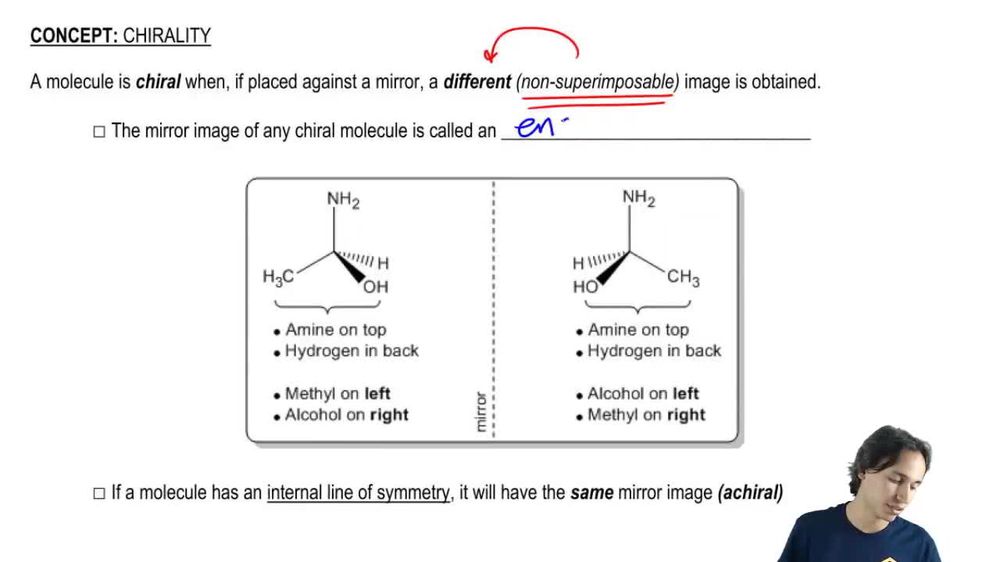
Stereoisomerism refers to the phenomenon where compounds have the same molecular formula and connectivity of atoms but differ in the spatial arrangement of their atoms. This can lead to different physical and chemical properties. Stereoisomers can be further classified into enantiomers, which are non-superimposable mirror images, and diastereomers, which are not mirror images of each other.
Chirality is a property of a molecule that makes it non-superimposable on its mirror image, often due to the presence of a chiral center, typically a carbon atom bonded to four different substituents. Molecules that are chiral can exist as two enantiomers, which can have significantly different biological activities. Identifying chiral centers is crucial for determining the number of stereoisomers.
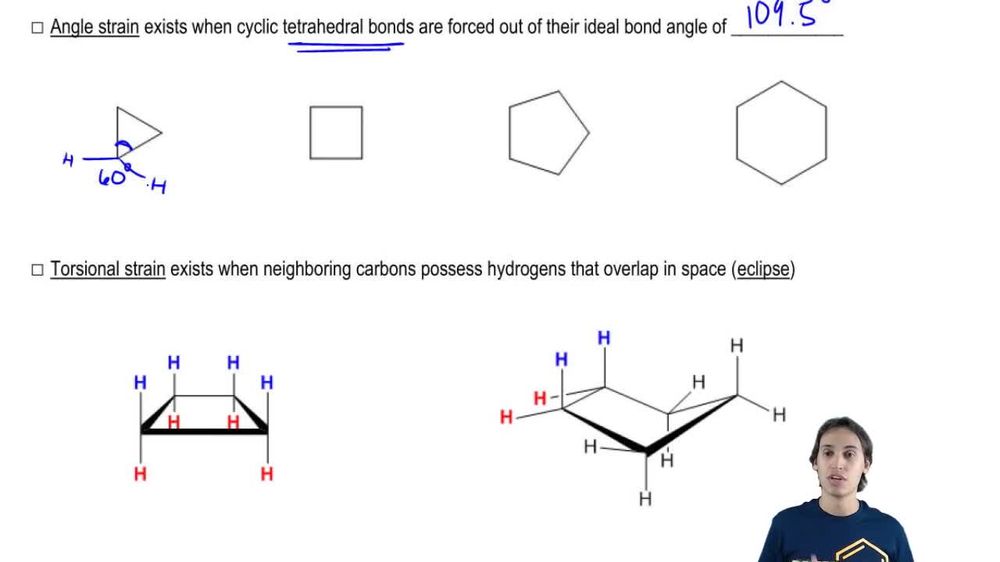
Cycloalkanes are saturated hydrocarbons with carbon atoms arranged in a ring structure. The stability and stereochemistry of cycloalkanes can be influenced by ring strain, which arises from angle strain and torsional strain. In the case of 1-bromo-4-chlorocyclohexane and 1,2-dimethylcyclopropane, understanding the ring structure helps in predicting the possible stereoisomers based on the substituents' positions and the ring's conformation.

 6:29 minutes
 Verified step by step guidance
 01:58
01:58