Ch. 16 - Reactions of Aldehydes and Ketones • More Reactions of Carboxylic Acid Derivatives
Bruice - Organic Chemistry 8th Edition
Bruice8th EditionOrganic ChemistryISBN: 9780135213711Not the one you use?Change textbook
Chapter 17, Problem 49a(1)

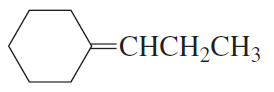
What two sets of reagents (each consisting of a carbonyl compound and phosphonium ylide) can be used for the synthesis of the following alkene?
1. Chemical structure of an alkene with a hexagonal ring and a propyl group attached, illustrating a synthetic reaction.

Verified step by step guidance
1
Step 1: Understand the problem. The question involves the Wittig reaction, which is a method to synthesize alkenes by reacting a carbonyl compound (aldehyde or ketone) with a phosphonium ylide. The goal is to determine two possible sets of reagents (carbonyl compound and ylide) that could produce the given alkene.
Step 2: Analyze the structure of the target alkene. Identify the two groups attached to the double bond (R1 and R2) and determine how the molecule can be split into two fragments: one derived from the carbonyl compound and the other from the ylide.
Step 3: Assign one fragment to the carbonyl compound and the other to the ylide. Recall that the carbonyl compound contributes the carbonyl carbon and its attached group, while the ylide contributes the carbon atom of the double bond and its attached group. Write the structures of the two reagents for the first set.
Step 4: Reverse the roles of the fragments. Assign the other fragment to the carbonyl compound and the remaining fragment to the ylide. Write the structures of the two reagents for the second set.
Step 5: Verify the proposed reagents. Ensure that each set of reagents, when reacted via the Wittig reaction, would produce the target alkene. This involves confirming that the connectivity and stereochemistry (if applicable) match the given alkene.

Verified video answer for a similar problem:

This video solution was recommended by our tutors as helpful for the problem above.
Video duration:
3m
Was this helpful?

Key Concepts

Here are the essential concepts you must grasp in order to answer the question correctly.

Carbonyl Compounds

Carbonyl compounds are organic molecules that contain a carbon atom double-bonded to an oxygen atom (C=O). They are key intermediates in various organic reactions, including nucleophilic addition and condensation reactions. Understanding the reactivity of carbonyl compounds is essential for predicting the outcomes of synthetic pathways, such as those involving the formation of alkenes.
Recommended video:
Guided course
01:40
Defining meso compounds.

Phosphonium Ylides

Phosphonium ylides are reactive intermediates formed by the deprotonation of phosphonium salts, which contain a positively charged phosphorus atom. They are crucial in the Wittig reaction, where they react with carbonyl compounds to form alkenes. The stability and structure of the ylide influence the selectivity and yield of the resulting alkene, making them vital for synthetic strategies in organic chemistry.
Recommended video:
Guided course
15:39
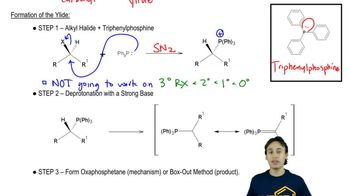
Box-Out Method and Full-Mechanism

Wittig Reaction

The Wittig reaction is a chemical reaction that allows for the synthesis of alkenes from carbonyl compounds and phosphonium ylides. This reaction involves the formation of an alkene through the nucleophilic attack of the ylide on the carbonyl carbon, followed by the elimination of a phosphine oxide. Mastery of this reaction is essential for organic chemists, as it provides a powerful method for constructing double bonds in complex molecules.
Recommended video:
Guided course
15:39
Box-Out Method and Full-Mechanism