Show how the following compounds can be synthesized from benzene: h. p-nitro-N-methylaniline
Verified step by step guidance
1
Step 1: Begin with benzene as the starting material. The first step is to introduce a nitro group (-NO₂) onto the benzene ring. This can be achieved through an electrophilic aromatic substitution reaction called nitration. Use a mixture of concentrated H₂SO₄ (sulfuric acid) and HNO₃ (nitric acid) to generate the nitronium ion (NO₂⁺), which acts as the electrophile. This reaction will yield nitrobenzene.
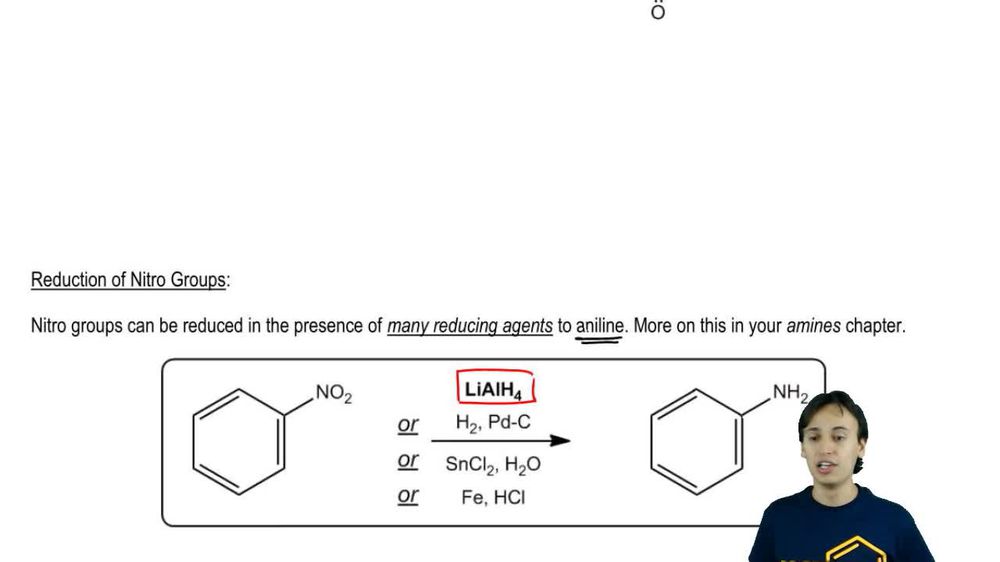
Step 2: Reduce the nitro group (-NO₂) on nitrobenzene to an amino group (-NH₂). This can be done using a reducing agent such as Sn (tin) and HCl, or Fe (iron) and HCl, followed by neutralization with a base. The product of this step is aniline (C₆H₅NH₂).
Step 3: Protect the amino group (-NH₂) on aniline to prevent unwanted side reactions during subsequent steps. This can be done by acetylation, where aniline reacts with acetic anhydride (CH₃CO)₂O to form acetanilide (C₆H₅NHCOCH₃).
Step 4: Introduce a methyl group (-CH₃) onto the nitrogen atom of the protected amino group. This can be achieved by reacting acetanilide with methyl iodide (CH₃I) in the presence of a base such as K₂CO₃. This step forms N-methylacetanilide.
Step 5: Hydrolyze the N-methylacetanilide to remove the acetyl protecting group and regenerate the free amino group. This can be done using aqueous acid or base. Finally, introduce a para-nitro group (-NO₂) onto the benzene ring of N-methylaniline through nitration (as described in Step 1), ensuring the nitro group is directed to the para position due to the electron-donating nature of the N-methyl group.
Verified video answer for a similar problem:
This video solution was recommended by our tutors as helpful for the problem above
Video duration:
3m
Play a video:
0 Comments
Key Concepts
Here are the essential concepts you must grasp in order to answer the question correctly.
Electrophilic Aromatic Substitution
Electrophilic aromatic substitution (EAS) is a fundamental reaction in organic chemistry where an electrophile replaces a hydrogen atom on an aromatic ring, such as benzene. This process is crucial for synthesizing various derivatives of benzene, including p-nitro-N-methylaniline. Understanding the mechanism of EAS, including the role of catalysts and the stability of intermediates, is essential for predicting the outcomes of reactions involving aromatic compounds.
Nitration is a specific type of electrophilic aromatic substitution where a nitro group (NO2) is introduced into an aromatic ring. This reaction typically involves the use of a nitrating mixture, such as concentrated nitric acid and sulfuric acid, to generate the nitronium ion (NO2+), the active electrophile. Recognizing the conditions and regioselectivity of nitration is vital for synthesizing compounds like p-nitro-N-methylaniline from benzene.
The reduction of nitro compounds is a key transformation in organic synthesis, where a nitro group is converted into an amine. This process can be achieved using various reducing agents, such as iron and hydrochloric acid or catalytic hydrogenation. Understanding the reduction mechanism is important for synthesizing p-nitro-N-methylaniline, as it involves the conversion of the nitro group to an amino group, which is essential for the final product.

 3:39 minutes
 Verified step by step guidance
 03:07
03:07