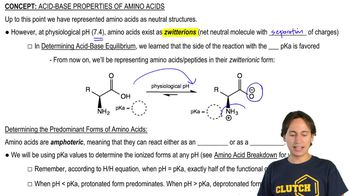
Alanine has pKa values of 2.34 and 9.69. Therefore, alanine exists predominately as a zwitterion in an aqueous solution with pH >____ and pH <____.
Verified step by step guidance
1
Identify the pKa values of alanine: pKa1 = 2.34 (carboxylic acid group) and pKa2 = 9.69 (amino group). These values indicate the pH at which each functional group is 50% ionized.
Understand the concept of a zwitterion: A zwitterion is a molecule with both positive and negative charges but is overall neutral. For alanine, this occurs when the carboxylic acid group is deprotonated (-COO⁻) and the amino group is protonated (-NH₃⁺).
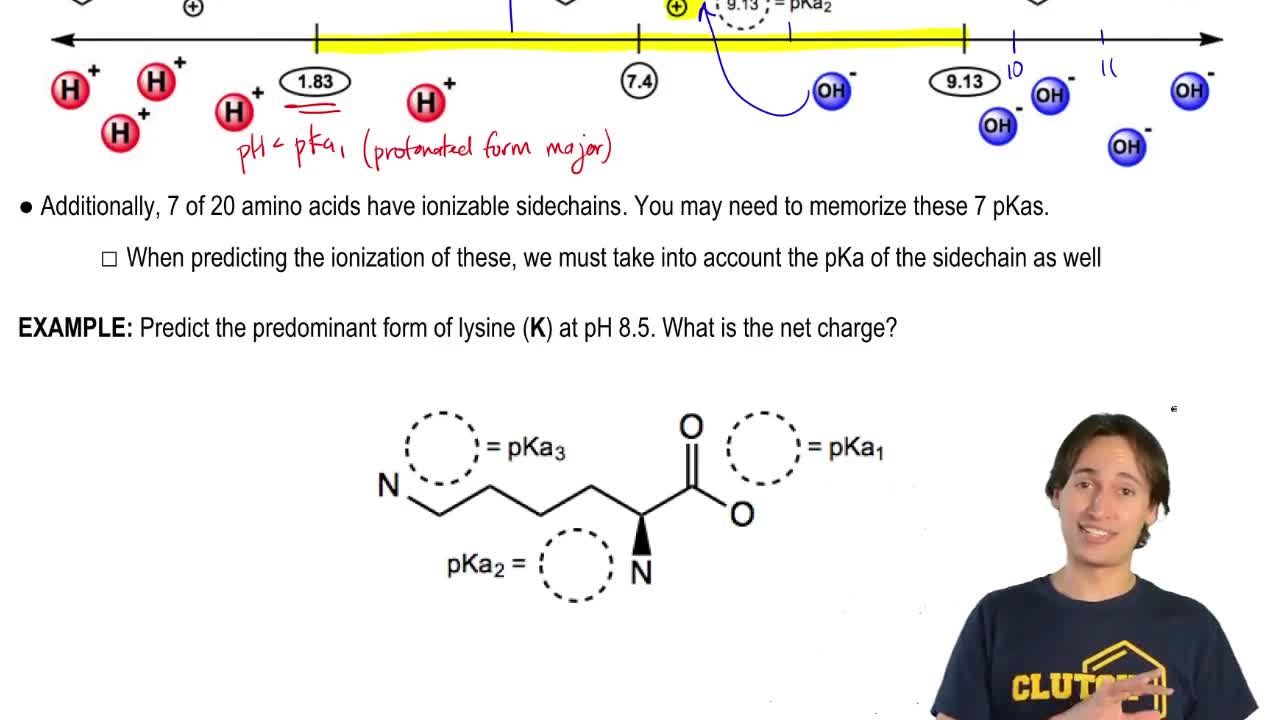
Determine the pH range where alanine exists predominantly as a zwitterion: This occurs between the pKa values of the carboxylic acid group (2.34) and the amino group (9.69).
Analyze the pH conditions: Alanine will exist predominantly as a zwitterion in an aqueous solution with pH greater than 2.34 (where the carboxylic acid group is deprotonated) and less than 9.69 (where the amino group remains protonated).
Conclude the pH range: Alanine exists predominantly as a zwitterion in the range 2.34 < pH < 9.69. For the given problem, the blanks should be filled with pH > 2.34 and pH < 9.69.
Verified video answer for a similar problem:
This video solution was recommended by our tutors as helpful for the problem above
Video duration:
4m
Play a video:
0 Comments
Key Concepts
Here are the essential concepts you must grasp in order to answer the question correctly.
Zwitterion
A zwitterion is a molecule that has both positive and negative charges but is overall electrically neutral. In the case of amino acids like alanine, the zwitterionic form occurs when the amino group is protonated (positively charged) and the carboxyl group is deprotonated (negatively charged). This form is significant in biological systems and influences the solubility and reactivity of the molecule.
pKa is a measure of the acidity of a compound, indicating the pH at which half of the species are deprotonated. For alanine, the two pKa values represent the ionization of the carboxyl and amino groups. The pH of a solution relative to these pKa values determines the predominant form of alanine, with pH values below the lower pKa leading to a cationic form and above the higher pKa leading to an anionic form.
Amino acids can exist in different ionic forms depending on the pH of the solution. At low pH, amino acids are protonated and exist as cations, while at high pH, they can lose protons and exist as anions. The isoelectric point (pI) is the pH at which the amino acid has no net charge, and for alanine, this occurs between its two pKa values, indicating that it will predominantly exist as a zwitterion in a neutral to slightly basic environment.