Draw the form of aspartate that predominates at the following pH values: d. pH=11.0
Verified step by step guidance
1
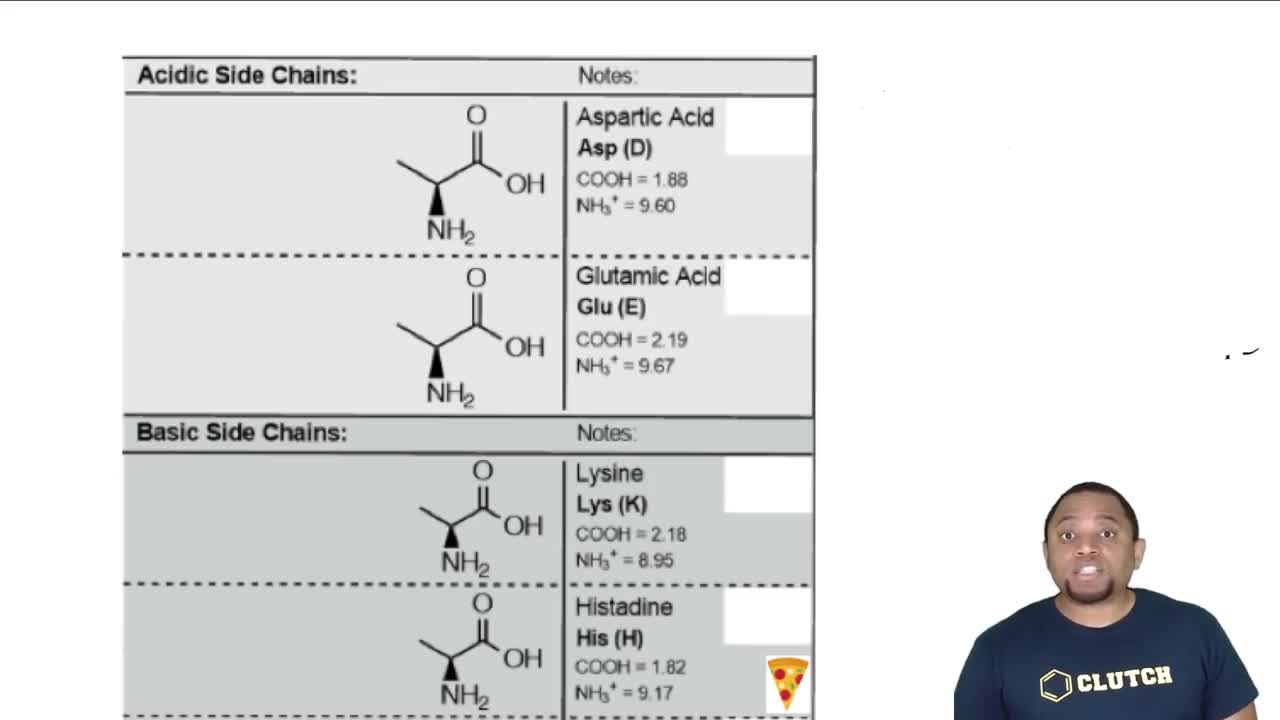
Determine the pKa values of the functional groups in aspartate. Aspartate has three ionizable groups: the α-carboxyl group (pKa ≈ 2.1), the α-amino group (pKa ≈ 9.8), and the side-chain carboxyl group (pKa ≈ 3.9).
Compare the given pH (11.0) to each pKa value to determine the protonation state of each functional group. If the pH is higher than the pKa, the group will be deprotonated. If the pH is lower than the pKa, the group will remain protonated.
At pH 11.0, the α-carboxyl group (pKa ≈ 2.1) will be deprotonated, forming a negatively charged carboxylate ion \( \text{COO}^- \).
At pH 11.0, the side-chain carboxyl group (pKa ≈ 3.9) will also be deprotonated, forming another negatively charged carboxylate ion \( \text{COO}^- \).
At pH 11.0, the α-amino group (pKa ≈ 9.8) will be deprotonated, losing its proton and becoming a neutral \( \text{NH}_2 \) group. Combine these observations to draw the predominant form of aspartate at pH 11.0.
Verified video answer for a similar problem:
This video solution was recommended by our tutors as helpful for the problem above
Video duration:
4m
Play a video:
0 Comments
Key Concepts
Here are the essential concepts you must grasp in order to answer the question correctly.
Amino Acid Structure
Amino acids, the building blocks of proteins, consist of a central carbon atom bonded to an amino group (-NH2), a carboxyl group (-COOH), a hydrogen atom, and a variable R group (side chain). Aspartate, specifically, has a carboxyl group in its side chain, which influences its ionization state depending on the pH of the environment.
pH is a measure of the acidity or basicity of a solution, affecting the ionization of functional groups in amino acids. At higher pH levels, such as pH 11.0, the environment is more basic, leading to the deprotonation of carboxyl groups and the potential protonation of amino groups, which alters the overall charge and form of the amino acid.
A zwitterion is a molecule that has both positive and negative charges but is overall neutral. At physiological pH, aspartate exists predominantly as a zwitterion, but at pH 11.0, the carboxyl groups are fully deprotonated, resulting in a negatively charged form. Understanding this concept is crucial for predicting the predominant form of aspartate at different pH levels.

 4:37 minutes
 Verified step by step guidance
 11:14
11:14