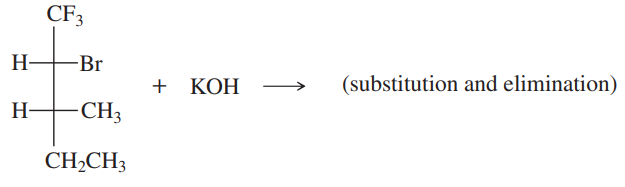
Make models of the following compounds, and predict the products formed when they react with the strong bases shown. (a)
Verified step by step guidance
1
Step 1: Analyze the structure of the given compound. The molecule contains a bromine atom (Br) attached to a carbon that is also bonded to a CF3 group, a CH3 group, and a CH2CH3 group. This is a tertiary alkyl halide, which is prone to elimination reactions due to steric hindrance.
Step 2: Understand the role of KOH. Potassium hydroxide (KOH) is a strong base, which can promote elimination reactions (E2 mechanism) by abstracting a proton from a β-carbon (a carbon adjacent to the carbon bonded to the leaving group, Br).
Step 3: Consider the anti-coplanar geometry required for E2 elimination. For the elimination to occur, the β-hydrogen and the leaving group (Br) must be in an anti-coplanar arrangement. Identify the β-hydrogens available on the adjacent carbons (CH3 and CH2CH3 groups).
Step 4: Predict the major product of the elimination reaction. The base (OH⁻) will abstract a β-hydrogen, and the bromine atom will leave, forming a double bond between the α-carbon (the carbon bonded to Br) and the β-carbon. The most substituted alkene (Zaitsev product) is typically favored.
Step 5: Consider substitution as a competing reaction. While elimination is favored due to the tertiary structure, substitution (SN1 mechanism) may occur if the reaction conditions allow for the formation of a carbocation intermediate. This would lead to the replacement of Br with OH, forming an alcohol.
Verified video answer for a similar problem:

This video solution was recommended by our tutors as helpful for the problem above
Video duration:
10m
Play a video:
0 Comments
Key Concepts
Here are the essential concepts you must grasp in order to answer the question correctly.
E2 Elimination Mechanism
The E2 elimination mechanism involves the simultaneous removal of a leaving group and a hydrogen atom from adjacent carbon atoms, resulting in the formation of a double bond. This process requires the anti-coplanar arrangement of the leaving group and the hydrogen atom, which is crucial for the reaction to proceed efficiently. Understanding this mechanism is essential for predicting the products of reactions involving strong bases like KOH.
Substitution reactions occur when one functional group in a molecule is replaced by another. In the context of the provided reaction, KOH can act as a nucleophile, replacing the bromine atom in the alkyl halide. This type of reaction is important to consider alongside elimination reactions, as both can occur simultaneously, leading to a mixture of products.
Steric hindrance refers to the repulsion between bulky groups in a molecule that can affect the reactivity and outcome of chemical reactions. In the case of the compound shown, the presence of the trifluoromethyl (CF3) group can create steric hindrance, influencing whether substitution or elimination is favored. Recognizing the impact of steric factors is vital for predicting the major products in reactions involving complex organic molecules.