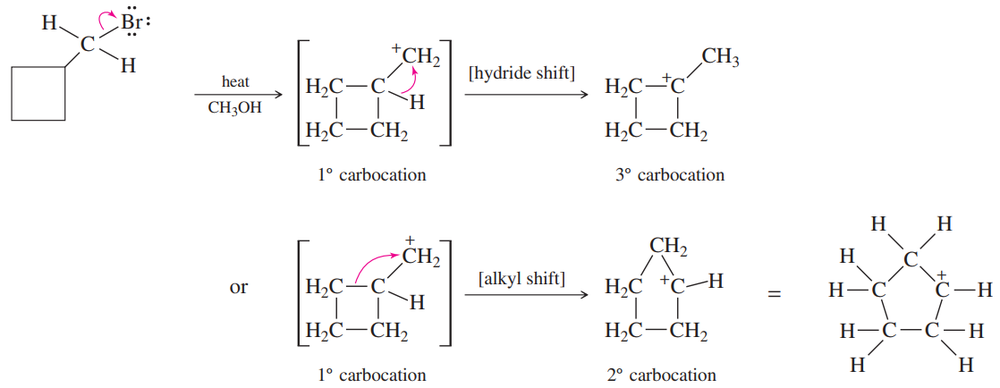
Finish Solved Problem 7-3 by showing how the rearranged carbocations give the four products shown in the problem. Be careful when using curved arrows to show deprotonation and/or nucleophilic attack by the solvent. The curved arrows always show movement of electrons, not movement of protons or other species.
Verified step by step guidance
1
Step 1: Begin by analyzing the provided reaction. The starting material is a brominated cyclobutane derivative, which undergoes a reaction in the presence of heat and methanol (CH₃OH). The first step involves the departure of the bromide ion (Br⁻), leading to the formation of a primary carbocation.
Step 2: The primary carbocation is unstable, so it undergoes rearrangement. Two possible rearrangements can occur: (a) a hydride shift, where a hydrogen atom with its bonding electrons moves to stabilize the carbocation, forming a tertiary carbocation, or (b) an alkyl shift, where a methyl group moves to stabilize the carbocation, forming a secondary carbocation.
Step 3: Once the rearranged carbocations are formed, the solvent (methanol, CH₃OH) acts as a nucleophile. Methanol attacks the positively charged carbon in the carbocation, forming an intermediate where the oxygen of methanol is bonded to the carbon.
Step 4: After the nucleophilic attack, deprotonation occurs. A proton (H⁺) is removed from the oxygen atom of the methanol group, leading to the formation of the final product. The curved arrows in the mechanism should clearly show the movement of electrons during deprotonation.
Step 5: The reaction yields four possible products based on the rearranged carbocations and subsequent nucleophilic attack by methanol. Ensure that the curved arrows in the mechanism accurately depict the electron flow during each step, including rearrangement, nucleophilic attack, and deprotonation.
Verified video answer for a similar problem:
This video solution was recommended by our tutors as helpful for the problem above
Video duration:
4m
Play a video:
0 Comments
Key Concepts
Here are the essential concepts you must grasp in order to answer the question correctly.
Carbocation Stability
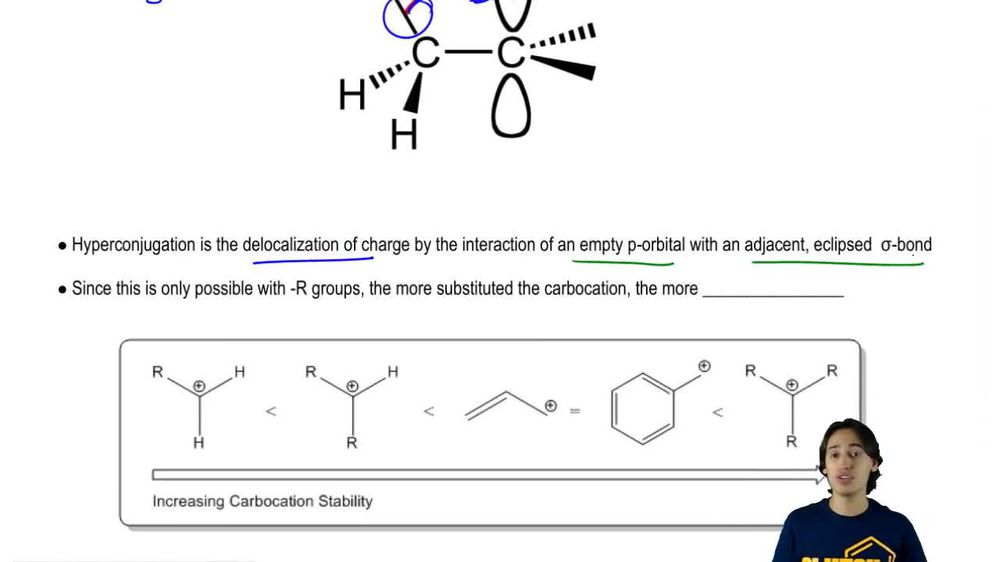
Carbocations are positively charged carbon species that can rearrange to form more stable structures. The stability of carbocations increases with the degree of substitution: tertiary (3°) carbocations are more stable than secondary (2°), which are more stable than primary (1°). This stability is due to hyperconjugation and the inductive effect of alkyl groups, which help to stabilize the positive charge.
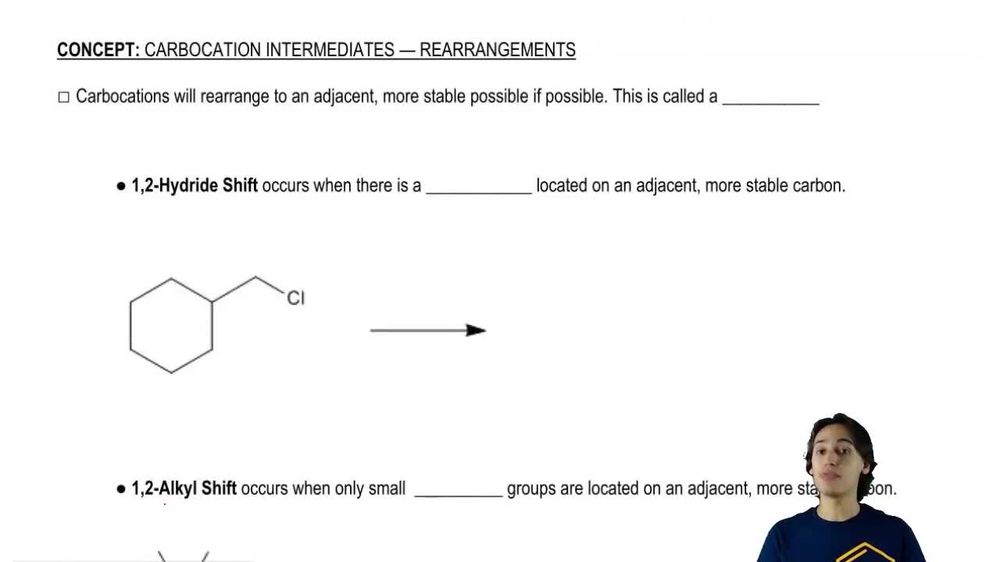
Carbocation rearrangement occurs when a less stable carbocation transforms into a more stable one through shifts of hydrogen or alkyl groups. Common types of rearrangements include hydride shifts, where a hydrogen atom moves with its bonding electrons, and alkyl shifts, where an alkyl group moves to stabilize the positive charge. These rearrangements are crucial in determining the final products of reactions involving carbocations.
Curved arrows are used in organic chemistry to illustrate the movement of electrons during chemical reactions. They indicate the flow of electron pairs, showing how bonds are formed or broken. In the context of carbocation rearrangements, curved arrows help depict the shifts of hydrogens or alkyl groups and the resulting changes in the carbocation structure, clarifying the mechanism of the reaction.